Overview
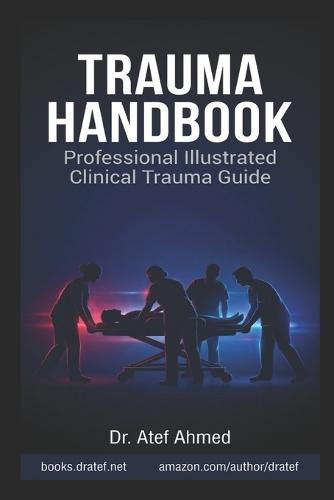
A trauma patient will not wait for you to open a textbook. Trauma Handbook puts the critical steps in your hands in seconds, so you can act with confidence when every heartbeat counts. When the trauma pager goes off, there is no time to search through long chapters or argue about doses. You need clear priorities, simple algorithms, and visual checklists you can trust. Trauma Handbook: Professional Illustrated Clinical Trauma Guide for Emergency, Surgical, and Critical Care Teams is a compact, illustrated reference built for that exact moment-when one well-timed decision can save a life. Written by Dr. Atef Ahmed, this handbook distills real trauma-bay experience into clean, bedside tools you can actually use under pressure. Each page focuses on a single problem, with visual flowcharts, dosing tables, and key ""pitfall"" warnings to support rapid, safe decisions. Organized by real resuscitation flow Phase 1 - Immediate Life Threats: xABCDE survey, catastrophic hemorrhage, tension/open pneumothorax, massive hemothorax, cardiac tamponade, airway obstruction, tracheal deviation, JVD, and hypovolemic shock. Phase 2 - Core Resuscitation: RSI 7-P's and trauma dosing, LEMON airway assessment, failed airway and CICO algorithm, surgical cricothyroidotomy, IV/IO access, 1:1:1 massive transfusion, TXA timing, calcium in MTP, lethal triad management, damage-control triggers, and structured handoff tools. Phase 3 - Special Populations: Pediatric trauma and Broselow-style dosing, geriatric trauma, pregnant trauma and perimortem C-section timing, obese RSI modifications, anticoagulated trauma reversal, burn TBSA and Parkland formula, and escharotomy locations. Phase 4 - Specific Injuries: FAST exam sequence, chest tube insertion, pelvic binder sites, compartment-syndrome 6 P's, solid-organ injury grading and packing, neck and orbital trauma, mandible fractures, and scalp avulsion repair basics. Phase 5 - Systems & Prevention: TCCC MARCH combat algorithm, mass-casualty START triage, REBOA zones, trauma-informed communication, and injury-prevention frameworks. Illustrated, at-a-glance design Clean diagrams, flowcharts, and tables are designed to be readable at arm's length in a crowded resuscitation room. There are no long theoretical chapters-only the essentials: what to look for, what to do next, and which mistakes to avoid. Built for the whole trauma team Emergency physicians, surgeons, anesthetists, intensivists, residents, nurses, paramedics, and EMS crews can all follow the same algorithms and language. Use it for daily practice, simulation training, OSCE and board prep, and onboarding new staff. This rapid trauma reference is ideal for: Emergency department and trauma-bay clinicians General and trauma surgeons, anesthetists, intensivists Residents and fellows in EM, surgery, anesthesia, and critical care Prehospital and EMS providers managing major trauma Educators running simulation and trauma bootcamps Keep Trauma Handbook in your white coat, trauma bay, or resuscitation cart as a visual cognitive aid. It does not replace ATLS, TCCC, or institutional policies-it helps you apply them in real time.
Full Product Details
Author: Atef Ahmed
Publisher: Independently Published
Imprint: Independently Published
Dimensions:
Width: 15.20cm
, Height: 0.50cm
, Length: 22.90cm
Weight: 0.141kg
ISBN: 9798196195242
Pages: 68
Publication Date: 09 May 2026
Audience:
General/trade
,
General
Format: Paperback
Publisher's Status: Active
Availability: Available To Order

We have confirmation that this item is in stock with the supplier. It will be ordered in for you and dispatched immediately.