Overview
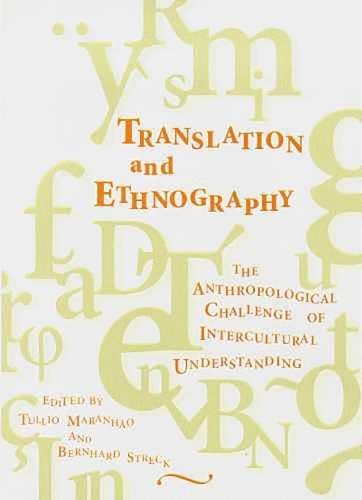
To most people, translation means making the words of one language understandable in another; but translation in a broader sense-seeing strangeness and incorporating it into one's understanding-is perhaps the earliest task of the human brain. This book illustrates the translation process in less-common contexts: cultural, religious, even the translation of pain. Its original contributions seek to trace human understanding of the self, of the other, and of the stranger by discovering how we bridge gaps within or between semiotic systems. Translation and Ethnography focuses on issues that arise when we attempt to make significant thematic or symbolic elements of one culture meaningful in terms of another. Its chapters cover a wide range of topics, all stressing the interpretive practices that enable the approximation of meaning: the role of differential power, of language and so-called world view, and of translation itself as a metaphor of many contemporary cross-cultural processes. The topics covered here represent a global sample of translation, ranging from Papua New Guinea to South America to Europe. Some of the issues addressed include postcolonial translation/transculturation from the perspective of colonised languages, as in the Mexican Zapatista movement; mis-translations of Amerindian conceptions and practices in the Amazon, illustrating the subversive potential of anthropology as a science of translation; Ethiopian oracles translating divine messages for the interpretation of believers; and dreams and clowns as translation media among the Gamk of Sudan. Anthropologists have long been accustomed to handling translation chains; in this book they open their diaries and show the steps they take toward knowledge. Translation and Ethnography raises issues that will shake up the most obdurate, objectivist translators and stimulate scholars in sociolinguistics, communication, ethnography, and other fields who face the challenges of conveying meaning across human boundaries.
Full Product Details
Author: Tullio Maranhao ,
Bernhard Streck ,
Tullio Maranhao ,
Bernhard Streck
Publisher: University of Arizona Press
Imprint: University of Arizona Press
Dimensions:
Width: 15.20cm
, Height: 1.90cm
, Length: 22.90cm
Weight: 0.456kg
ISBN: 9780816523030
ISBN 10: 0816523037
Pages: 220
Publication Date: 30 October 2003
Audience:
General/trade
,
College/higher education
,
General
,
Tertiary & Higher Education
Format: Hardback
Publisher's Status: Active
Availability: In Print

This item will be ordered in for you from one of our suppliers. Upon receipt, we will promptly dispatch it out to you. For in store availability, please contact us.
Reviews
This collection is really unlike other translation literature, most of which focuses either on the mechanics of translation generally or on the specific problems that arise in the interpretation of a single text. By addressing the broader issues of transforming the cultural and symbolic significances of one tradition into those of another, it places translation squarely within an interpretive or hermeneutic perspective.... An outstanding collection.
Author Information
The late Tullio Maranhão was Professor of Anthropology and Education at the University of St. Thomas. Bernhard Streck is Professor in the Institut für Ethnologie at the Universität Leipzig.