Overview
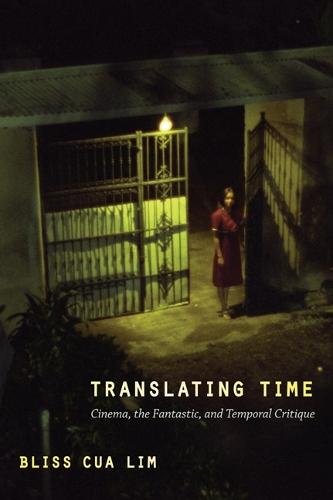
Under modernity, time is regarded as linear and measurable by clocks and calendars. Despite the historicity of clock-time itself, the modern concept of time is considered universal and culturally neutral. What Walter Benjamin called ""homogeneous, empty time"" founds the modern notions of progress and a uniform global present in which the past and other forms of time consciousness are seen as superseded. In Translating Time, Bliss Cua Lim argues that fantastic cinema depicts the coexistence of other modes of being alongside and within the modern present, disclosing multiple ""immiscible temporalities"" that strain against the modern concept of homogeneous time. In this wide-ranging study-encompassing Asian American video (On Cannibalism), ghost films from the New Cinema movements of Hong Kong and the Philippines (Rouge, Itim, Haplos), Hollywood remakes of Asian horror films (Ju-on, The Grudge, A Tale of Two Sisters) and a Filipino horror film cycle on monstrous viscera suckers (Aswang)-Lim conceptualizes the fantastic as a form of temporal translation. The fantastic translates supernatural agency in secular terms while also exposing an untranslatable remainder, thereby undermining the fantasy of a singular national time and emphasizing shifting temporalities of transnational reception. Lim interweaves scholarship on visuality with postcolonial historiography. She draws on Henri Bergson's understanding of cinema as both implicated in homogeneous time and central to its critique, as well as on postcolonial thought linking the ideology of progress to imperialist expansion. At stake in this project are more ethical forms of understanding time that refuse to domesticate difference as anachronism. While supernaturalism is often disparaged as a vestige of primitive or superstitious thought, Lim suggests an alternative interpretation of the fantastic as a mode of resistance to the ascendancy of homogeneous time and a starting-point for more ethical temporal imaginings.
Full Product Details
Author: Bliss Cua Lim
Publisher: Duke University Press
Imprint: Duke University Press
Dimensions:
Width: 15.60cm
, Height: 2.30cm
, Length: 23.50cm
Weight: 0.522kg
ISBN: 9780822345107
ISBN 10: 0822345102
Pages: 360
Publication Date: 21 September 2009
Audience:
Adult education
,
Professional and scholarly
,
Further / Higher Education
,
Professional & Vocational
Format: Paperback
Publisher's Status: Active
Availability: In Print

This item will be ordered in for you from one of our suppliers. Upon receipt, we will promptly dispatch it out to you. For in store availability, please contact us.
Reviews
Translating Time will set a new standard in cinema studies. It is not only deeply philosophical, bringing a much-needed postcolonial critique of historicism to cinema studies, but also a learned study of Asian, and especially Filipino, cinema in the context of postcoloniality and globalization. I learned an enormous amount from this book. It is quite an achievement. David L. Eng, author of Racial Castration: Managing Masculinity in Asian America Bliss Cua Lim's extension of ideas about the uncanny, the fantastic, and the genre we usually call the horror film beyond the usual references to Hollywood and European cinema is fully welcome in this new era of global cinema. But Lim does much more than that. Her consideration of the uncanny and fantastic open up the profoundly untimely nature of fantastic films--and new possibilities for conceiving the history of cinema. --Tom Gunning, author of The Films of Fritz Lang: Allegories of Vision and Modernity Translating Time is vital, fresh, expansive, and exciting. A strikingly sophisticated thinker, Bliss Cua Lim argues that a linear and progressive understanding of historical time (and its practice of history-writing) domesticates other times into a manageable past marked as retrograde, primitive, and naive. Lim denaturalizes such an understanding by bringing to the fore films that depend on nonsynchronous histories. Her book will have readers far beyond the field of cinema studies, and it will push that field toward new and crucial questions. --Amy Villarejo, author of Lesbian Rule: Cultural Criticism and the Value of Desire
Translating Time is vital, fresh, expansive, and exciting. A strikingly sophisticated thinker, Bliss Cua Lim argues that a linear and progressive understanding of historical time, and its practice of history and history-writing, domesticates other times into a manageable past marked as retrograde, primitive, and naive. Lim denaturalizes such an understanding by bringing to the fore films (and traditions of storytelling on which films are based) that depend on nonsynchonous histories. Her book will have readers far beyond the field of cinema studies, and it will push that field toward new and crucial questions. -Amy Villarejo, author of Lesbian Rule: Cultural Criticism and the Value of Desire Translating Time will set a new standard in cinema studies. It is not only deeply philosophical, bringing a much-needed postcolonial critique of historicism to cinema studies, but also a learned study of Asian, and especially Filipino, cinema in the context of postcoloniality and globalization. I learned an enormous amount from this book. It is quite an achievement. -David L. Eng, author of Racial Castration: Managing Masculinity in Asian America Bliss Cua Lim's extends ideas about the uncanny, the fantastic and the genre we usually call the horror film beyond its usual references to Hollywood and European cinema, which is fully welcome in this new era of global cinema. But it does much more than that. Her consideration of the uncanny and fantastic open up the profoundly untimely nature of fantasy films-and new possibilities for conceiving of the history of cinema. -Tom Gunning, author of The Films of Fritz Lang: Allegories of Vision and Modernity
""Translating Time will set a new standard in cinema studies. It is not only deeply philosophical, bringing a much-needed postcolonial critique of historicism to cinema studies, but also a learned study of Asian, and especially Filipino, cinema in the context of postcoloniality and globalization. I learned an enormous amount from this book. It is quite an achievement."" David L. Eng, author of Racial Castration: Managing Masculinity in Asian America ""Bliss Cua Lim's extension of ideas about the uncanny, the fantastic, and the genre we usually call the horror film beyond the usual references to Hollywood and European cinema is fully welcome in this new era of global cinema. But Lim does much more than that. Her consideration of the uncanny and fantastic open up the profoundly untimely nature of fantastic films--and new possibilities for conceiving the history of cinema.""--Tom Gunning, author of The Films of Fritz Lang: Allegories of Vision and Modernity ""Translating Time is vital, fresh, expansive, and exciting. A strikingly sophisticated thinker, Bliss Cua Lim argues that a linear and progressive understanding of historical time (and its practice of history-writing) domesticates other times into a manageable past marked as retrograde, primitive, and naive. Lim denaturalizes such an understanding by bringing to the fore films that depend on nonsynchronous histories. Her book will have readers far beyond the field of cinema studies, and it will push that field toward new and crucial questions.""--Amy Villarejo, author of Lesbian Rule: Cultural Criticism and the Value of Desire
Author Information
Bliss Cua Lim is Associate Professor of Film & Media Studies and Visual Studies at the University of California, Irvine.