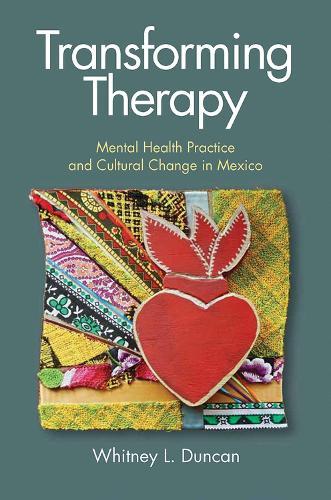
Full Product Details
Author: Whitney L. Duncan
Publisher: Vanderbilt University Press
Imprint: Vanderbilt University Press
Dimensions:
Width: 19.40cm
, Height: 2.30cm
, Length: 24.00cm
Weight: 0.825kg
ISBN: 9780826521972
ISBN 10: 0826521975
Pages: 272
Publication Date: 24 July 2018
Audience:
Professional and scholarly
,
Professional & Vocational
Format: Hardback
Publisher's Status: Active
Availability: Available To Order

We have confirmation that this item is in stock with the supplier. It will be ordered in for you and dispatched immediately.
Reviews
This marvelous book develops the concepts of psychological and psychiatric globalization in Oaxaca, Mexico, revealing the deep contradictions inherent in them. On the one hand, these terms denote the process by which two mental health disciplines develop transnational 'ways of knowing and working upon the self' that help fashion modern self-actualizing and regulating subjects ready to implement the neoliberal agendas of globalization. And, on the other, ethnographic analysis shows how this process results in locally recast, empowering tools for acknowledging the suffering created by these agendas and for seeking individual and collective liberation from them. The limits and contours of this quest for agency and empowerment are explored in a harsh environment of structural violence. Duncan focuses on psy-sociality--the ways in which people bond with and support each other through psy-organized practices to confront social and psychological suffering. Her analysis shows how psy-sociality is shaped locally by sufferers and practitioners themselves to resist their transformation into atomized subjects of governmentality and to reconstitute in new ways the cultural centrality of socio-moral concepts of the self and interdependent family relations in Oaxaca. Duncan provides rich ethnographic documentation of these transformative, contradictory processes, resulting in a study that is at once profound and hard to put down. --Roberto Lewis-Fern�ndez, MD, Professor of Clinical Psychiatry at Columbia College of Physicians and Surgeons and Director of the New York State (NYS) Center of Excellence for Cultural Competence and the Hispanic Treatment Program at NYS Psychiatric Institute This emotionally provocative ethnography explores diverse therapeutic experiences and psychiatric sociality among urban and rural Oaxacans and provides a potent theoretical and methodological balance to a burgeoning public health and policy discourse on global mental health. --Mary-Jo DelVecchio Good, Professor of Global Health and Social Medicine, Harvard University/Harvard Medical School This book explores psy-services in 'other' parts of the world, beyond the global North or large cities in the global South. As Duncan shows, psy-concepts are a key part of Oaxaca, where they are reinterpreted, re-examined, accepted wholesale, unpacked, or discarded. That is, they are mobile, moveable concepts that are used by people for their own psy-sociality needs. --Vania Smith-Oka, author of Shaping the Motherhood of Indigenous Mexico
This marvelous book develops the concepts of psychological and psychiatric globalization in Oaxaca, Mexico, revealing the deep contradictions inherent in them. On the one hand, these terms denote the process by which two mental health disciplines develop transnational 'ways of knowing and working upon the self' that help fashion modern self-actualizing and regulating subjects ready to implement the neoliberal agendas of globalization. And, on the other, ethnographic analysis shows how this process results in locally recast, empowering tools for acknowledging the suffering created by these agendas and for seeking individual and collective liberation from them. The limits and contours of this quest for agency and empowerment are explored in a harsh environment of structural violence. Duncan focuses on psy-sociality--the ways in which people bond with and support each other through psy-organized practices to confront social and psychological suffering. Her analysis shows how psy-sociality is shaped locally by sufferers and practitioners themselves to resist their transformation into atomized subjects of governmentality and to reconstitute in new ways the cultural centrality of socio-moral concepts of the self and interdependent family relations in Oaxaca. Duncan provides rich ethnographic documentation of these transformative, contradictory processes, resulting in a study that is at once profound and hard to put down. --Roberto Lewis-Fern ndez, MD, Professor of Clinical Psychiatry at Columbia College of Physicians and Surgeons and Director of the New York State (NYS) Center of Excellence for Cultural Competence and the Hispanic Treatment Program at NYS Psychiatric Institute This book explores psy-services in 'other' parts of the world, beyond the global North or large cities in the global South. As Duncan shows, psy-concepts are a key part of Oaxaca, where they are reinterpreted, re-examined, accepted wholesale, unpacked, or discarded. That is, they are mobile, moveable concepts that are used by people for their own psy-sociality needs. --Vania Smith-Oka, author of Shaping the Motherhood of Indigenous Mexico This emotionally provocative ethnography explores diverse therapeutic experiences and psychiatric sociality among urban and rural Oaxacans and provides a potent theoretical and methodological balance to a burgeoning public health and policy discourse on global mental health. --Mary-Jo DelVecchio Good, Professor of Global Health and Social Medicine, Harvard University/Harvard Medical School
This marvelous book develops the concepts of psychological and psychiatric globalization in Oaxaca, Mexico, revealing the deep contradictions inherent in them. On the one hand, these terms denote the process by which two mental health disciplines develop transnational 'ways of knowing and working upon the self' that help fashion modern self-actualizing and regulating subjects ready to implement the neoliberal agendas of globalization. And, on the other, ethnographic analysis shows how this process results in locally recast, empowering tools for acknowledging the suffering created by these agendas and for seeking individual and collective liberation from them. The limits and contours of this quest for agency and empowerment are explored in a harsh environment of structural violence. Duncan focuses on psy-sociality--the ways in which people bond with and support each other through psy-organized practices to confront social and psychological suffering. Her analysis shows how psy-sociality is shaped locally by sufferers and practitioners themselves to resist their transformation into atomized subjects of governmentality and to reconstitute in new ways the cultural centrality of socio-moral concepts of the self and interdependent family relations in Oaxaca. Duncan provides rich ethnographic documentation of these transformative, contradictory processes, resulting in a study that is at once profound and hard to put down. --Roberto Lewis-Fernandez, MD, Professor of Clinical Psychiatry at Columbia College of Physicians and Surgeons and Director of the New York State (NYS) Center of Excellence for Cultural Competence and the Hispanic Treatment Program at NYS Psychiatric Institute This emotionally provocative ethnography explores diverse therapeutic experiences and psychiatric sociality among urban and rural Oaxacans and provides a potent theoretical and methodological balance to a burgeoning public health and policy discourse on global mental health. --Mary-Jo DelVecchio Good, Professor of Global Health and Social Medicine, Harvard University/Harvard Medical School This book explores psy-services in 'other' parts of the world, beyond the global North or large cities in the global South. As Duncan shows, psy-concepts are a key part of Oaxaca, where they are reinterpreted, re-examined, accepted wholesale, unpacked, or discarded. That is, they are mobile, moveable concepts that are used by people for their own psy-sociality needs. --Vania Smith-Oka, author of Shaping the Motherhood of Indigenous Mexico
This marvelous book develops the concepts of psychological and psychiatric globalization in Oaxaca, Mexico, revealing the deep contradictions inherent in them. On the one hand, these terms denote the process by which two mental health disciplines develop transnational 'ways of knowing and working upon the self' that help fashion modern self-actualizing and regulating subjects ready to implement the neoliberal agendas of globalization. And, on the other, ethnographic analysis shows how this process results in locally recast, empowering tools for acknowledging the suffering created by these agendas and for seeking individual and collective liberation from them. The limits and contours of this quest for agency and empowerment are explored in a harsh environment of structural violence. Duncan focuses on psy-sociality--the ways in which people bond with and support each other through psy-organized practices to confront social and psychological suffering. Her analysis shows how psy-sociality is shaped locally by sufferers and practitioners themselves to resist their transformation into atomized subjects of governmentality and to reconstitute in new ways the cultural centrality of socio-moral concepts of the self and interdependent family relations in Oaxaca. Duncan provides rich ethnographic documentation of these transformative, contradictory processes, resulting in a study that is at once profound and hard to put down. --Roberto Lewis-Fernandez, MD, Professor of Clinical Psychiatry at Columbia College of Physicians and Surgeons and Director of the New York State (NYS) Center of Excellence for Cultural Competence and the Hispanic Treatment Program at NYS Psychiatric Institute This emotionally provocative ethnography explores diverse therapeutic experiences and psychiatric sociality among urban and rural Oaxacans and provides a potent theoretical and methodological balance to a burgeoning public health and policy discourse on global mental health. --Mary-Jo DelVecchio Good, Professor of Global Health and Social Medicine, Harvard University/Harvard Medical School This book explores psy-services in 'other' parts of the world, beyond the global North or large cities in the global South. As Duncan shows, psy-concepts are a key part of Oaxaca, where they are reinterpreted, re-examined, accepted wholesale, unpacked, or discarded. That is, they are mobile, moveable concepts that are used by people for their own psy-sociality needs. --Vania Smith-Oka, author of Shaping the Motherhood of Indigenous Mexico
Author Information
Whitney L. Duncan is Assistant Professor of Anthropology at the University of Northern Colorado.