Overview
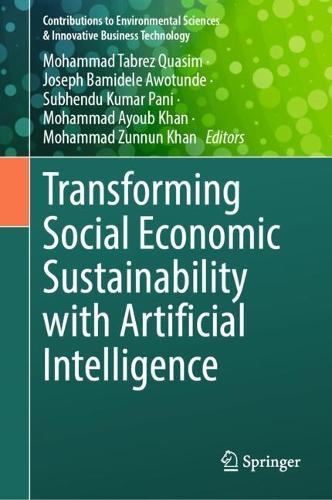
This book explores the intersection of artificial intelligence (AI) and sustainable development within social economies. The volume is contributed by leading experts in both AI and sustainability and delves into the potential of AI to catalyze positive change in economic systems while addressing pressing social and environmental challenges. In addition, the book provides a comprehensive overview of how AI technologies can be harnessed to optimize resource allocation, enhance decision-making processes, and foster inclusive economic growth. The volume also emphasizes the role of AI in promoting sustainability, offering insights into innovative applications such as smart resource management, climate modelling, and the creation of eco-friendly technologies. Furthermore, the book discusses ethical considerations surrounding the use of AI in social economies and proposes frameworks for responsible AI deployment. Through case studies and real-world examples, the book illustrates how AI-driven solutions can drive environmental conservation, reduce inequality, and contribute to the overall well-being of communities. This book is a valuable resource for policymakers, academics, and industry professionals seeking to leverage AI as a powerful tool for building a more sustainable and equitable future.
Full Product Details
Author: Mohammad Tabrez Quasim ,
Joseph Bamidele Awotunde ,
Subhendu Kumar Pani ,
Mohammad Ayoub Khan
Publisher: Springer Verlag, Singapore
Imprint: Springer Verlag, Singapore
ISBN: 9789819584727
ISBN 10: 9819584728
Pages: 204
Publication Date: 15 May 2026
Audience:
College/higher education
,
Professional and scholarly
,
Postgraduate, Research & Scholarly
,
Professional & Vocational
Format: Hardback
Publisher's Status: Forthcoming
Availability: Not yet available

This item is yet to be released. You can pre-order this item and we will dispatch it to you upon its release.
Author Information
Mohammad Tabrez Quasim received his Ph.D. in computer science from Tilkamanjhi Bhagalpur University, India, and master of computer application from Punjab Technical University, Punjab, India. Currently, he serves as an associate professor in the Department of Computer Science, University of Bisha, Saudi Arabia. His research interests include but are not limited to IoT, big data, cloud computing, blockchain, wireless sensor networks, and machine learning. He has published more than 50 research papers in many academic journals. He has also authored and edited five books. Joseph Bamidele Awotunde (Ph.D.) is a senior lecturer in the Department of Computer Science, University of Ilorin, Ilorin, Nigeria. His research interests include artificial intelligence, internet of things, cybersecurity, information security, social computing, bioinformatics, and biometrics. He has more than 150 publications to his credit in academic journals, conference proceedings and books. He was part of the team that won the Artificial Intelligence for Females in Science Technology, Engineering and Mathematics (AI4FS) Grant sponsored by the Royal Academy of Engineering. Dr. Subhendu Kumar Pani is a professor and the principal at Krupajal Group of Institutions. He received his Ph.D. degree in Computer Science from Utkal University, Odisha, India (2013) and a master of technology degree from the Kalinga Institute of Industrial Technology, India (2007). Dr. Pani works in a multi-disciplinary environment involving artificial intelligence, health informatics, internet of things, collective computational intelligence, robotics, social computing web intelligence, web services, and data mining. He has authored and co-authored more than 300 research publications including over 40 books. He has actively involved in the organization of several academic conferences. He is a member of many international program committees and several editorial review boards. Dr. Mohammad Ayoub Khan serves as a full Professor at the University of Bisha, Saudi Arabia. His research interests include internet of things, blockchain, RFID, wireless sensors networks, ad hoc network, smart cities, industrial IoT, signal processing, NFC, routing in network-on-chip, and real-time and embedded systems. He has published more than 70 research papers and books in the journals and international conferences. He is contributing to the research community by various volunteer activities. He has served as the conference chair in various reputed international conferences. Mohammad Zunnun Khan is currently affiliated with the College of Computing and IT in the University of Bisha, Saudi Arabia. With over 13 years of extensive teaching and research expertise, he previously dedicated more than 12 years to Integral University, India. Dr. Khan earned his Ph.D. in computer science and engineering. He has published 3 books, 9 book chapters, and over 35 research papers. Dr. Khan is a member of several editorial boards, advisory committees, and technical program committee in various journals and conferences.