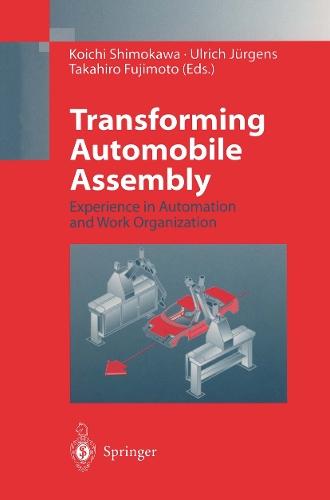
Transforming Automobile Assembly: Experience in Automation and Work Organization

Author:   Koichi Shimokawa ,  Ulrich Jürgens ,  Takahiro Fujimoto
Publisher:   Springer-Verlag Berlin and Heidelberg GmbH & Co. KG
Edition:   Softcover reprint of the original 1st ed. 1997
ISBN:  

9783642643774


Pages:   414
Publication Date:   22 September 2011
Format:   Paperback
Availability:   Manufactured on demand   Availability explained
We will order this item for you from a manufactured on demand supplier.

Our Price $290.37 Quantity:  
Add to Cart

Share |

Transforming Automobile Assembly: Experience in Automation and Work Organization


Overview

Five years after the publication of MITs lean production book practitioners and academics from Japan, USA and Europe present new concepts, findings and conclusions in regard to one of the most critical areas of automobile production. The focus of the book is to explore automation and work organization for the final assembly operations in the world automobile industry. The authors are company practitioners in charge of planning assembly operations and academic researchers drawing from recent empirical work. Thus, the book presents a multi-facetted view on a development of critical importance for future development of the industry. The book is rich with figures, fotos, tables, thus making the text vivid, easy to understand and illustrative.

Full Product Details

Author:   Koichi Shimokawa ,  Ulrich Jürgens ,  Takahiro Fujimoto
Publisher:   Springer-Verlag Berlin and Heidelberg GmbH & Co. KG
Imprint:   Springer-Verlag Berlin and Heidelberg GmbH & Co. K
Edition:   Softcover reprint of the original 1st ed. 1997
Dimensions:   Width: 15.50cm , Height: 2.20cm , Length: 23.50cm
Weight:   0.645kg
ISBN:  

9783642643774


ISBN 10:   3642643779
Pages:   414
Publication Date:   22 September 2011
Audience:   Professional and scholarly ,  Professional & Vocational
Format:   Paperback
Publisher's Status:   Active
Availability:   Manufactured on demand   Availability explained
We will order this item for you from a manufactured on demand supplier.

Table of Contents

1 Introduction.- 1 Introduction.- 2 Concepts and Histories.- 2.1 Assembly Automation in Europe — Past Experience and Future Trends.- 2.2 Basic Trends in the Physics and Economics of Automated Fabrication and Assembly Operations.- 2.3 Key Characteristics of Assembly Automation Systems.- 2.4 What Do You Mean by Automation Ratio? Definitions by the Japanese Auto Makers.- 3 Diversity of Approaches.- 3.1 Present State and Future Vision of Vehicle Assembly Automation in Mitsubishi Motors Corporation.- 3.2 Development of a new Vehicle Assembly Line at Toyota: Worker-oriented, Autonomous, new Assembly System.- 3.3 Modular Assembly in Mixed-Model Production at Mazda.- 3.4 Production of the NSX at Honda: An Alternative Directionfor Assembly Organization.- 3.5 The Development of an Intelligent Body Assembly System.- 3.6 The Opel Production System.- 3.7 Platform and Modular Concepts at Volkswagen — Their Effects on the Assembly Process.- 3.8 Automation at Renault: Strategy and Form.- 3.9 Building Capabilities in Assembly Automation: Fiat’s Experiences from Robogate to the Melfi Plant.- 3.10 The Development of a Reflective Production System Layout at Volvo’s Uddevalla Car Assembly Plant.- 4 Issues and Dynamics.- 4.1 Strategies for Assembly Automation in the Automobile Industry.- 4.2 From Fixed to Flexible: Automation and Work Organization Trends from the International Assembly Plant Study.- 4.3 Rolling Back Cycle Times: The Renaissance of the Classic Assembly Line in Final Assembly.- 4.4 Rationalization also Involves Workers — Teamwork in the Mercedes-Benz Lean Concept.- 4.5 Patterns of Work Organization in the German Automobile Industry.- 4.6 The Current Social Form of Automation and a Conceivable Alternative: Experience in France.- 4.7 Worker-Generated ProductionImprovements in a Reflective Production System — or Kaizen in a Reflective Production System.- 4.8 Advanced Automation or Alternative Production Design? A Reflection on the new Japanese Assembly Plants and the Alternative Approach of Volvo Uddevalla.- 4.9 A Misguided Trajectory? Automatically Guided Vehicles in Auto Assembly.- 4.10 Organizational Change and Assembly Automation in the Dutch Automotive Industry.- 4.11 Recycling and Disassembly — Legal Burden or Strategic Opportunity?.- 5 Conclusions and Outlook.- 5.1 Lessons to be Learnt from the Japanese Style of Production and their Application to Factory Automation.- 5.2 Design Choices for Assembly Systems.- 5.3 Outlook.- 6 The Authors of the Book.

Reviews

Author Information

Tab Content 6

Author Website:  

Countries Available

All regions
Latest Reading Guide

NOV RG 20252


Shopping Cart
Your cart is empty
Shopping cart
Mailing List