Overview
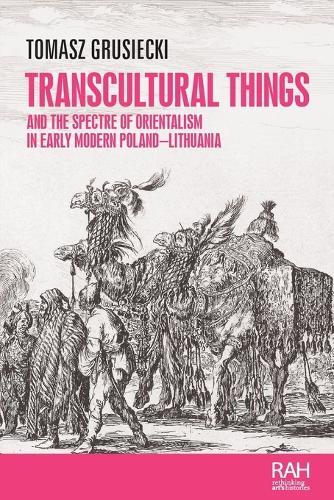
Transcultural things examines four sets of artefacts from the Polish-Lithuanian Commonwealth: maps pointing to PolandLithuania's roots in the supposedly 'Oriental' land of Sarmatia, portrayals of fashions that purport to trace Polish culture back to a distant and revered past, Ottomanesque costumes worn by Polish ambassadors and carpets labelled as Polish despite their foreign provenance. These examples of invented tradition borrowed from abroad played a significant role in narrating and visualising the cultural landscape of Polish-Lithuanian elites. But while modern scholarship defines these objects as exemplars of national heritage, early modern beholders treated them with more flexibility, seeing no contradiction in framing material things as local cultural forms while simultaneously acknowledging their foreign derivation. The book reveals how artefacts began to signify as vernacular idioms in the first place, often through obscuring their non-local origin and tainting subsequent discussions of the imagined purity of national culture as a result.
Full Product Details
Author: Tomasz Grusiecki
Publisher: Manchester University Press
Imprint: Manchester University Press
Dimensions:
Width: 15.60cm
, Height: 1.40cm
, Length: 23.40cm
Weight: 0.376kg
ISBN: 9781526194725
ISBN 10: 1526194724
Pages: 264
Publication Date: 20 January 2026
Audience:
College/higher education
,
Professional and scholarly
,
General/trade
,
Tertiary & Higher Education
,
Professional & Vocational
Format: Paperback
Publisher's Status: Active
Availability: Not yet available, will be POD

This item is yet to be released. You can pre-order this item and we will dispatch it to you upon it's release. This is a print on demand item which is still yet to be released.
Reviews
WINNER of The Oskar Halecki Award (PIASA) 2024. 'Reading this book is a great intellectual adventure.' - The English Historical Review ‘Tomasz Grusiecki's learned and theoretically informed Transcultural things is not only an important contribution to scholarship on early modern (Central and Eastern) Europe. His treatment of material evidence regarding Orientalism injects an important argument into ongoing discussions of cultural identity and appropriation.’ Thomas DaCosta Kaufmann is Frederick Marquand Professor of Art and Archaeology at Princeton University ‘Debates over originality and cultural distinctness have been studied outside art history for more than forty years, yet have still barely made a dent in the national culture model of the discipline. Grusiecki's intervention is especially welcome for its nuanced critical framing and the depth of his knowledge of a rich body of material evidence.’ Claire Farago, Professor Emerita, University of Colorado Boulder -- .
WINNER of The Oskar Halecki Award (PIASA) 2024. 'Reading this book is a great intellectual adventure.' - The English Historical Review 'Tomasz Grusiecki's book is an invaluable foundation for future research. It will arouse keen interest not only withing English-speaking academia, but also in Poland, Ukraine and Belarus. It weaves a number of highly important threads into the fabric of the historiography of art, and visual and material culture of the Polish-Lithuanian Commonwealth. I highly recommend this beautifully illustrated and exceptionally well-written and well-researched book to scholars, students and non-academic readers' - sehepunkte ‘Tomasz Grusiecki's learned and theoretically informed Transcultural things is not only an important contribution to scholarship on early modern (Central and Eastern) Europe. His treatment of material evidence regarding Orientalism injects an important argument into ongoing discussions of cultural identity and appropriation.’ Thomas DaCosta Kaufmann is Frederick Marquand Professor of Art and Archaeology at Princeton University ‘Debates over originality and cultural distinctness have been studied outside art history for more than forty years, yet have still barely made a dent in the national culture model of the discipline. Grusiecki's intervention is especially welcome for its nuanced critical framing and the depth of his knowledge of a rich body of material evidence.’ Claire Farago, Professor Emerita, University of Colorado Boulder -- .
Author Information
Tomasz Grusiecki is Associate Professor of Early Modern European Art and Material Cultures at Boise State University