Overview
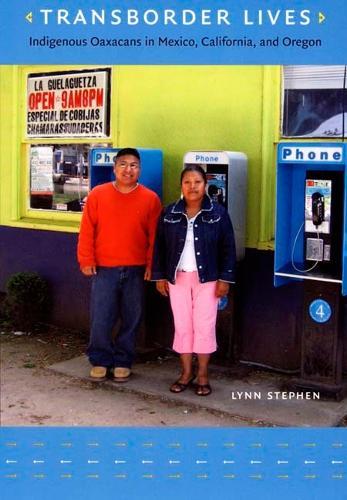
Lynn Stephen’s innovative ethnography follows indigenous Mexicans from two towns in the state of Oaxaca-the Mixtec community of San AgustÍn Atenango and the Zapotec community of TeotitlÁn del Valle-who periodically leave their homes in Mexico for extended periods of work in California and Oregon. Demonstrating that the line separating Mexico and the United States is only one among the many borders that these migrants repeatedly cross (including national, regional, cultural, ethnic, and class borders and divisions), Stephen advocates an ethnographic framework focused on transborder, rather than transnational, lives. Yet she does not disregard the state: She assesses the impact migration has had on local systems of government in both Mexico and the United States as well as the abilities of states to police and affect transborder communities.Stephen weaves the personal histories and narratives of indigenous transborder migrants together with explorations of the larger structures that affect their lives. Taking into account U.S. immigration policies and the demands of both commercial agriculture and the service sectors, she chronicles how migrants experience and remember low-wage work in agriculture, landscaping, and childcare and how gender relations in Oaxaca and the United States are reconfigured by migration. She looks at the ways that racial and ethnic hierarchies inherited from the colonial era-hierarchies that debase Mexico’s indigenous groups-are reproduced within heterogeneous Mexican populations in the United States. Stephen provides case studies of four grass-roots organizations in which Mixtec migrants are involved, and she considers specific uses of digital technology by transborder communities. Ultimately Stephen demonstrates that transborder migrants are reshaping notions of territory and politics by developing creative models of governance, education, and economic development as well as ways of maintaining their cultures and languages across geographic distances.
Full Product Details
Author: Lynn Stephen
Publisher: Duke University Press
Imprint: Duke University Press
Edition: annotated edition
Dimensions:
Width: 15.60cm
, Height: 2.50cm
, Length: 22.90cm
Weight: 0.590kg
ISBN: 9780822339908
ISBN 10: 0822339900
Pages: 400
Publication Date: 13 June 2007
Audience:
Professional and scholarly
,
Professional & Vocational
Format: Paperback
Publisher's Status: Active
Availability: In Print

This item will be ordered in for you from one of our suppliers. Upon receipt, we will promptly dispatch it out to you. For in store availability, please contact us.
Reviews
Lynn Stephen's multisited ethnography insightfully unpacks globalization from below, revealing the contours of cross-border communities as they reweave the social fabrics of twenty-first-century North America. -Jonathan Fox, University of California, Santa Cruz Where most research on things 'transnational' is anchored on one side of the border or the other, Transborder Lives is conceptually and empirically well grounded throughout the geographic, national, social, political, and economic spaces within which its subjects are dispersed in both Mexico and the United States. -Michael Kearney, author of Changing Fields of Anthropology: From Local to Global Transborder Lives confirms Stephen's reputation as a leading contributor to North American transnational and migration studies. Stephen's nuanced, empathetic-and, I would add, physically and temporally demanding-ethnographic work undergirds the study's elegantly narrated exploration of how indigenous Oaxacans articulate and understand their own individual and collective experiences of daily routines... -- Paul Allatson, American Ethnologist [Transborder Lives] is a must-read for anyone interested in indigenous migration to the United States, Oaxacan studies, political economy, the construction of race and ethnicity in a bi-national context, indigenous knowledges, and transborder studies writ large. And its clear prose makes it accessible to undergraduates as well as non-academics interested in policy studies. Certainly, for members of communities such as those described by Stephen, the book will be cherished as a historical and ethnographic document. -- Lourdes Gutierrez Najera, Journal of Latin American and Caribbean Anthropology [Stephen's] contribution to the literature on transnational migrants lies in the concept of transborder existence and drawing our attention to the myriads of borders, geographic as well as sociocultural, that many Mexicans cross. Their movement within Mexico, the United States, and the U.S.-Mexico border requires that they not only transcend gender, racial, ethnic, class, and state borders but also form collective efforts, interlinked networks, and transborder identities. Ultimately, her analysis moves beyond identities and relations defined by any one nation-state-Mexico or the United States-to the multiple ways people are read physically, legally, and otherwise. -- Ruth Trinidad Galvan, NWSA Journal Stephen certainly knows her stuff... The real intimacy and trust she shares with her respondents and her rich understanding of their lives come across powerfully in her frank conversations. Her commitment to telling migrants' stories and to using social science to promote social change is also clear... This book is valuable for many reasons... Transborder Lives also does an excellent job of placing migration dynamics within the context of broader political-economic factors on both sides of the border and analyzing how these have changed over time. -- Peggy Livett, American Journal of Sociology
"""Where most research on things 'transnational' is anchored on one side of the border or the other, Transborder Lives is conceptually and empirically well grounded throughout the geographic, national, social, political, and economic spaces within which its subjects are dispersed in both Mexico and the United States.""--Michael Kearney, author of Changing Fields of Anthropology: From Local to Global ""Lynn Stephen's multisited ethnography insightfully unpacks globalization from below, revealing the contours of cross-border communities as they reweave the social fabrics of twenty-first-century North America.""--Jonathan Fox, University of California, Santa Cruz ""The aim of the book is to weave together the personal histories and narratives of indigenous transborder migrants with the larger structures that affect their lives, and to highlight their creative responses to their mobile existence...She [Stephen] has certainly achieved her stated goal of pushing the borders crossed by Zapotec and Mixtec immigrants into centre stage, and in the process has illuminated the lives of the 130 million people, who, worldwide, live outside the country where they were born, and have transgressed many borders. This engaging and well researched book will appeal to specialists on Mexico, migration and ethnicity. Its author is to be congratulated on her model, multi-site study of a complex and important issue.""- Colin Clarke in Bulletin of Latin American Research, Vol. 28, No. 2, April 2009"
Where most research on things 'transnational' is anchored on one side of the border or the other, Transborder Lives is conceptually and empirically well grounded throughout the geographic, national, social, political, and economic spaces within which its subjects are dispersed in both Mexico and the United States. --Michael Kearney, author of Changing Fields of Anthropology: From Local to Global Lynn Stephen's multisited ethnography insightfully unpacks globalization from below, revealing the contours of cross-border communities as they reweave the social fabrics of twenty-first-century North America. --Jonathan Fox, University of California, Santa Cruz The aim of the book is to weave together the personal histories and narratives of indigenous transborder migrants with the larger structures that affect their lives, and to highlight their creative responses to their mobile existence...She [Stephen] has certainly achieved her stated goal of pushing the borders crossed by Zapotec and Mixtec immigrants into centre stage, and in the process has illuminated the lives of the 130 million people, who, worldwide, live outside the country where they were born, and have transgressed many borders. This engaging and well researched book will appeal to specialists on Mexico, migration and ethnicity. Its author is to be congratulated on her model, multi-site study of a complex and important issue. - Colin Clarke in Bulletin of Latin American Research, Vol. 28, No. 2, April 2009
Author Information
Lynn Stephen is Distinguished Professor of Anthropology at the University of Oregon. She is the author of Zapotec Women: Gender, Class, and Ethnicity in Globalized Oaxaca, also published by Duke University Press; Zapata Lives! Histories and Cultural Politics in Southern Mexico; and Women and Social Movements in Latin America: Power from Below.