Overview
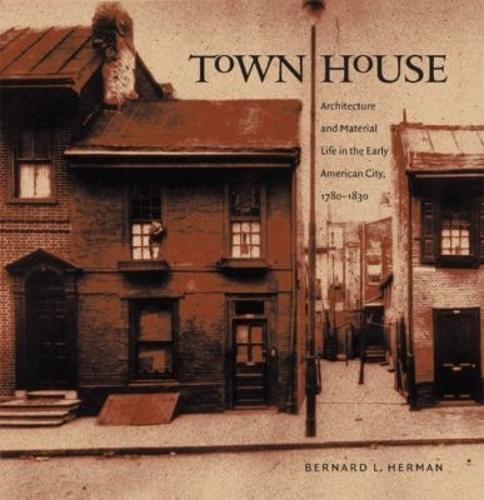
What houses tell us about the lives of those who dwelled within In this abundantly illustrated volume, Bernard L. Herman provides a history of urban dwellings and the people who built and lived in them in early America. In the eighteenth century, cities were constant objects of idealization, often viewed as the outward manifestations of an organized, civil society. As the physical objects that composed the largest portion of urban settings, town houses contained and signified different aspects of city life, argues Herman. Taking a material culture approach, Herman examines urban domestic buildings from Charleston, South Carolina, to Portsmouth, New Hampshire, as well as those in English cities and towns, to better understand why people built the houses they did and how their homes informed everyday city life. Working with buildings and documentary sources as diverse as court cases and recipes, Herman interprets town houses as lived experience. Chapters consider an array of domestic spaces, including the merchant family's house, the servant's quarter, and the widow's dower. Herman demonstrates that city houses served as sites of power as well as complex and often conflicted artifacts mapping the everyday negotiations of social identity and the display of sociability.
Full Product Details
Author: Bernard L. Herman
Publisher: The University of North Carolina Press
Imprint: The University of North Carolina Press
Edition: New edition
Dimensions:
Width: 21.50cm
, Height: 2.60cm
, Length: 22.80cm
Weight: 1.114kg
ISBN: 9780807829912
ISBN 10: 0807829919
Pages: 320
Publication Date: 30 November 2005
Audience:
College/higher education
,
Professional and scholarly
,
Tertiary & Higher Education
,
Professional & Vocational
Format: Hardback
Publisher's Status: Out of Print
Availability: In Print

Limited stock is available. It will be ordered for you and shipped pending supplier's limited stock.
Reviews
Town House is the first study to bring the methods of the new vernacular architectural history to the American city. Bernard Herman ranges far beyond architecture to people these houses, fill them with goods, set them next to their neighbors on the street, and link them to transatlantic predecessors and contemporaries. He shows us not only how these buildings were used, but what they meant to their residents. Town House is a tour de force of architectural and urban history. (Dell Upton, University of Virginia) Town House is the first study to bring the methods of the new vernacular architectural history to the American city. Bernard Herman ranges far beyond architecture to people these houses, fill them with goods, set them next to their neighbors on the street, and link them to transatlantic predecessors and contemporaries. He shows us not only how these buildings were used, but what they meant to their residents. Town House is a tour de force of architectural and urban history. (Dell Upton, University of Virginia) Herman's work, as it captures and restores to modern readers the ambiguity and lyricism of an earlier built environment, continues to show us how valuable such studies are, and makes that scholarship especially accessible, exciting, and inviting. -- Journal of the Early Republic [A] wide-ranging and amply illustrated work. . . . The book abounds in insights. -- American Historical Review
Herman's work, as it captures and restores to modern readers the ambiguity and lyricism of an earlier built environment, continues to show us how valuable such studies are, and makes that scholarship especially accessible, exciting, and inviting. <br> -- Journal of the Early Republic
Author Information
BERNARD L. HERMAN is Edward F. and Elizabeth Goodman Rosenberg Professor of Art History at the University of Delaware. He is author of three previous books, including Architecture and Rural Life in Central Delaware, 1700-1900; The Stolen House; and, with Gabrielle M. Lanier, Everyday Architecture of the Mid-Atlantic: Looking at Buildings and Landscapes.