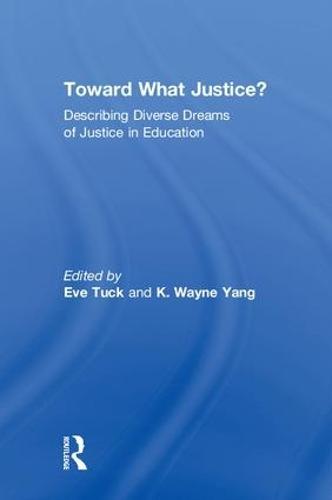
Full Product Details
Author: Eve Tuck (University of Toronto, Canada) ,
K. Wayne Yang (University of California, San Diego, USA)
Publisher: Taylor & Francis Ltd
Imprint: Routledge
Weight: 0.362kg
ISBN: 9781138205727
ISBN 10: 1138205729
Pages: 158
Publication Date: 07 February 2018
Audience:
College/higher education
,
Professional and scholarly
,
Tertiary & Higher Education
,
Professional & Vocational
Format: Hardback
Publisher's Status: Active
Availability: In Print

This item will be ordered in for you from one of our suppliers. Upon receipt, we will promptly dispatch it out to you. For in store availability, please contact us.
Reviews
'What if justice were a collective improvisational practice and not a thing that we could seize and hold? What if justice were not simple nor simplistic, what if it were not an empty set nor an empty void? How would we then approach the possibility for doing, practicing, inhabiting the rubric and sign of social justice? In this volume, edited by Eve Tuck and K. Wayne Yang, justice as social is put to question. Theirs is a project that grounds contingency and incommensurability not as foreclosures but as openings to the very possibilities for collaborative work and practice. In this way, justice-social would not be a private property to be grasped and held and owned, settler logic, but would instead be a pursuit in the direction of a mode for relating, a practice of behavior, a way of life. Not a utopia but a restiveness and desire and drive that imagines the constant flow and force of unfolding otherwise possibility.' -Ashon Crawley is Assistant Professor of Religious Studies and African American and African Studies at the University of Virginia, USA
'What if justice were a collective improvisational practice and not a thing that we could seize and hold? What if justice were not simple nor simplistic, what if it were not an empty set nor an empty void? How would we then approach the possibility for doing, practicing, inhabiting the rubric and sign of social justice? In this volume, edited by Eve Tuck and K. Wayne Wang, justice as social is put to question. Theirs is a project that grounds contingency and incommensurability not as foreclosures but as openings to the very possibilities for collaborative work and practice. In this way, justice-social would not be a private property to be grasped and held and owned, settler logic, but would instead be a pursuit in the direction of a mode for relating, a practice of behavior, a way of life. Not a utopia but a restiveness and desire and drive that imagines the constant flow and force of unfolding otherwise possibility.' -Ashon Crawley is Assistant Professor of Religious Studies and African American and African Studies at the University of Virginia, USA 'What if justice were a collective improvisational practice and not a thing that we could seize and hold? What if justice were not simple nor simplistic, what if it were not an empty set nor an empty void? How would we then approach the possibility for doing, practicing, inhabiting the rubric and sign of social justice? In this volume, edited by Eve Tuck and K. Wayne Yang, justice as social is put to question. Theirs is a project that grounds contingency and incommensurability not as foreclosures but as openings to the very possibilities for collaborative work and practice. In this way, justice-social would not be a private property to be grasped and held and owned, settler logic, but would instead be a pursuit in the direction of a mode for relating, a practice of behavior, a way of life. Not a utopia but a restiveness and desire and drive that imagines the constant flow and force of unfolding otherwise possibility.' -Ashon Crawley is Assistant Professor of Religious Studies and African American and African Studies at the University of Virginia, USA
'What if justice were a collective improvisational practice and not a thing that we could seize and hold? What if justice were not simple nor simplistic, what if it were not an empty set nor an empty void? How would we then approach the possibility for doing, practicing, inhabiting the rubric and sign of social justice? In this volume, edited by Eve Tuck and K. Wayne Wang, justice as social is put to question. Theirs is a project that grounds contingency and incommensurability not as foreclosures but as openings to the very possibilities for collaborative work and practice. In this way, justice-social would not be a private property to be grasped and held and owned, settler logic, but would instead be a pursuit in the direction of a mode for relating, a practice of behavior, a way of life. Not a utopia but a restiveness and desire and drive that imagines the constant flow and force of unfolding otherwise possibility.' -Ashon Crawley is Assistant Professor of Religious Studies and African American and African Studies at the University of Virginia, USA ã ã
Author Information
Eve Tuck is Associate Professor of Critical Race and Indigenous Studies at the Ontario Institute for Studies in Education (OISE), University of Toronto. K. Wayne Yang is Associate Professor in Ethnic Studies at the University of California, San Diego.