Overview
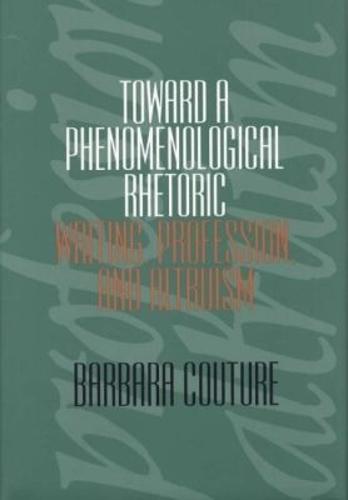
Current rhetorical and critical theory for the most part separates writing from consciousness and presumes relative truth to be the only possible expressive goal for rhetoric. These presumptions are reflected in our tradition of persuasive rhetoric, which values writing that successfully argues one person's belief at the expense of another's. Barbara Couture presents a case for a phenomenological rhetoric, one that values and respects consciousness and selfhood and that restores to rhetoric the possibility of seeking an all-embracing truth through pacific and cooperative interaction. Couture discusses the premises on which current interpretive theory has supported relative truth as the philosophical grounding for rhetoric, premises, she argues, that have led to constraints on our notion of truth that divorce it from human experience. She then shows how phenomenological philosophy might guide the theory and practice of rhetoric, reanimating its role in the human enterprise of seeking a shared truth. She proposes profession and altruism as two guiding metaphors for the phenomenological activity of ""truth-seeking through interaction."" Among the contemporary rhetoricians and philosophers who influence Couture are Pierre Teilhard de Chardin, Martin Buber, Charles Altieri, Charles Taylor, Alasdair Maclntyre, and Jürgen Habermas.
Full Product Details
Author: Southern Illinois University Press
Publisher: Southern Illinois University Press
Imprint: Southern Illinois University Press
Dimensions:
Width: 16.00cm
, Height: 2.40cm
, Length: 23.70cm
Weight: 0.333kg
ISBN: 9780809320332
ISBN 10: 0809320339
Pages: 288
Publication Date: 30 June 1998
Audience:
College/higher education
,
Professional and scholarly
,
Undergraduate
,
Postgraduate, Research & Scholarly
Format: Hardback
Publisher's Status: Active
Availability: To order

Stock availability from the supplier is unknown. We will order it for you and ship this item to you once it is received by us.
Reviews
[Couture's] argument is controversial but sound. She attempts to rescue truth, rhetoric, and writing from what she sees as the debilitating effects of postmodernism, especially postmodernist preoccupations with relativism and skepticism. --Thomas Kent, author of Paralogic Rhetoric: A Theory of Communicative Interaction
[Couture s] argument is controversial but sound. She attempts to rescue truth, rhetoric, and writing from what she sees as the debilitating effects of postmodernism, especially postmodernist preoccupations with relativism and skepticism. Thomas Kent, author of Paralogic Rhetoric: A Theory of Communicative Interaction
[Couture's] argument is controversial but sound. She attempts to rescue truth, rhetoric, and writing from what she sees as the debilitating effects of postmodernism, especially postmodernist preoccupations with relativism and skepticism. --Thomas Kent, author of Paralogic Rhetoric: A Theory of Communicative Interaction <br>
Author Information
Barbara Couture is a professor of English at Wayne State University. The editor of Functional Approaches to Writing: Research Perspectives and Professional Writing: Toward a College Curriculum, she is the coauthor (with Jone Rymer Goldstein) of Cases for Technical and Professional Writing, which won the NCTE Excellence in Technical and Scientific Communication Award for ""Best Book.""