Overview
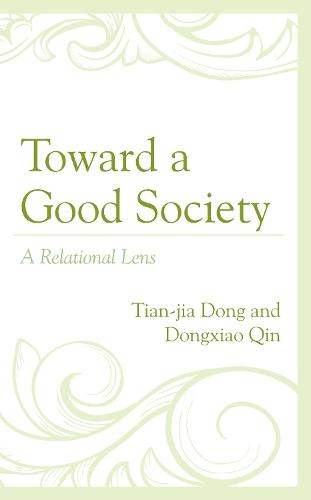
In Toward a Good Society: A Relational Lens, authors Tian-jia Dong and Dongxiao Qin theorize a mutually empowering and growth-fostering society. The authors first demonstrate the feasibility of this society by grounding it in the framework of relational psychology. Departing from there, they travel along nine paths reconstructed from nine classic social science theories. In each chapter, they respectively reconstruct and find ways to move beyond Durkheimian structural-functionalism, de Tocqueville’s communalism, Mead’s symbolic interactionism, Freud’s psychoanalytic perspective, Simmel’s network theory, Smith’s “invisible hand”, Marx’s class theory, Hobbes’s contractarianism, and Weber’s rational-legal formulation. This leads them to propose a new Golden Rule that is as simple as it is profound and foundational to what makes a good society.
Full Product Details
Author: Tian-jia Dong ,
Dongxiao Qin
Publisher: Bloomsbury Publishing Plc
Imprint: Lexington Books
Dimensions:
Width: 16.10cm
, Height: 1.90cm
, Length: 22.70cm
Weight: 0.503kg
ISBN: 9781498593151
ISBN 10: 1498593151
Pages: 168
Publication Date: 05 November 2021
Audience:
Professional and scholarly
,
Professional & Vocational
Format: Hardback
Publisher's Status: Active
Availability: Manufactured on demand

We will order this item for you from a manufactured on demand supplier.
Reviews
This elegantly written book is the fruit of the authors' personal and professional lives dedicated to studying and embodying the power of mutual relation as the source of creative energy, empowerment and well- being. The authors reimagine and revision a number of classical social theories to call forth a new vision of a good society with a foundation in interconnectedness and mutually empowering human relatedness. This is an outstanding and highly relevant contribution to the crucial and creative integration of psychological and sociological theory.--Janet L. Surrey, Founding Scholar ofJean Baker Miller Institute, Wellesley College This eye-opening book gives us a clear vision of the centrality of relationship as the most healthy element in our popular social theories. The talented authors range widely and sensibly through familiar social histories and shed new light on the success that comes from good connections as the key to justice and healthy living. The authors analyze authors from de Toqueville through Marx--as well as jazz, courtrooms, and even baseball. It is beautifully written, describing even complex theory in language that all can understand. A great book for any of us who try to find the healing power of good connection. Bravo.--Stephen Bergman, New York University, Grossman Medical School
This elegantly written book is the fruit of the authors' personal and professional lives dedicated to studying and embodying the power of mutual relation as the source of creative energy, empowerment and well- being. The authors reimagine and revision a number of classical social theories to call forth a new vision of a good society with a foundation in interconnectedness and mutually empowering human relatedness. This is an outstanding and highly relevant contribution to the crucial and creative integration of psychological and sociological theory.--Janet L. Surrey, Wellesley College This eye-opening book gives us a clear vision of the centrality of relationship as the most healthy element in our popular social theories. The talented authors range widely and sensibly through familiar social histories and shed new light on the success that comes from good connections as the key to justice and healthy living. The authors analyze authors from de Toqueville through Marx--as well as jazz, courtrooms, and even baseball. It is beautifully written, describing even complex theory in language that all can understand. A great book for any of us who try to find the healing power of good connection. Bravo.--Stephen Bergman, New York University, Grossman Medical School
Author Information
Tian-jia Dong is professor of sociology at Westfield State University. Dongxiao Qin is professor of psychology at Western New England University.