Overview
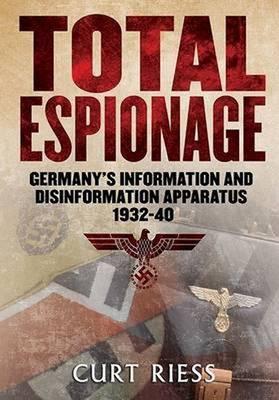
Total Espionage was first published shortly before Pearl Harbor and is fresh in its style, retaining immediacy unpolluted by the knowledge of subsequent events. It tells how the whole apparatus of the Nazi state was geared towards war by its systematic gathering of information and dissemination of disinformation. The author, a Berlin journalist, went into exile in 1933 and eventually settled in Manhattan in where he wrote for the Saturday Evening Post. He maintained a network of contacts throughout Europe and from inside the regime to garner his facts. The Nazis made use of many people and organizations: officers associations who were in touch with many who left to help organize the armies of South American countries, and in the USA there were the Friends of the New Germany. German consulates sprang up and aircraft would make unusual detours to observe interesting parts of foreign countries. News agencies and various associations dedicated to maintaining contacts with particular countries were encouraged to supply information. Film studios would send large crews abroad to shoot documentaries as well as perform acts of espionage. Foreign nationals were bribed or blackmailed; and pro-fascist groups in foreign countries were supported via the Auslandsorganization. All Germans living abroad were encouraged to report their observations to the authorities, particular attention was being focused on engineers, technicians, scientists and people in other professions who were particularly likely to obtain valuable information; however, other Germans abroad were also used, even cabaret singers, waiters, language teachers, as well as Germans travelling abroad as tourists. Germans living abroad were exempt from mobilization because of their value as spies. Foreigners were given opportunity to study in Germany, and connections with them were kept in the hope that they would one day provide useful information. All of this was Goebbels Total Espionage.
Full Product Details
Author: Curt Riess ,
Alan Sutton ,
Alan Sutton
Publisher: Fonthill Media Ltd
Imprint: Fonthill Media Ltd
Dimensions:
Width: 15.60cm
, Height: 1.90cm
, Length: 23.50cm
Weight: 0.400kg
ISBN: 9781781554517
ISBN 10: 178155451
Pages: 256
Publication Date: 21 January 2016
Audience:
General/trade
,
General
Format: Hardback
Publisher's Status: Active
Availability: Temporarily unavailable

The supplier advises that this item is temporarily unavailable. It will be ordered for you and placed on backorder. Once it does come back in stock, we will ship it out to you.
Author Information
Curt Riess was born of Jewish-German origin in Wurzburg, Germany in 1902. As a young man, Riess studied in Paris, Munich, and Heidelberg, and spent time working as a merchant in both New York and Berlin. On a business trip to the USA he discovered his talent for journalism and decided to pursue a career in the industry. Riess' first journalistic position was for a liberal 12 o'clock worksheet in Berlin, for which he also edited the sports section and throughout the 1920s he toured Europe as a reporter and film and theatre critic. In 1933, Riess was forced into exile and finally settled in Manhattan where he wrote for the Saturday Evening Post. Throughout the Second World War, he was heavily engaged in anti-Nazi activity, serving as a spy, and then, once the USA had joined the Allies, as a specialist in the United States Navy. His final military job was as a war correspondent for the Army, and as such he became well known for his exposure of the moral depravity of Adolf Hitler's regime.