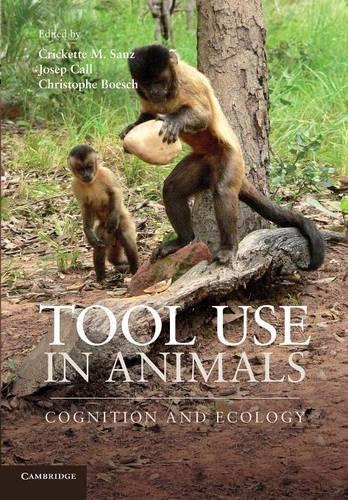
Full Product Details
Author: Crickette M. Sanz (Washington University, St Louis) ,
Josep Call (Max-Planck-Institut für Evolutionäre Anthropologie, Germany) ,
Christophe Boesch (Max-Planck-Institut für Evolutionäre Anthropologie, Germany)
Publisher: Cambridge University Press
Imprint: Cambridge University Press
Dimensions:
Width: 17.00cm
, Height: 1.70cm
, Length: 24.40cm
Weight: 0.520kg
ISBN: 9781107657434
ISBN 10: 1107657431
Pages: 324
Publication Date: 06 March 2014
Audience:
Professional and scholarly
,
Professional & Vocational
Format: Paperback
Publisher's Status: Active
Availability: Manufactured on demand

We will order this item for you from a manufactured on demand supplier.
Reviews
'Tool Use in Animals: Cognition and Ecology may well be the new benchmark text for animal cognition. This book is clear, well-written, suitably broad in its approach, and delivers information that covers a review of the field in addition to new data. Its appeal will encompass readers from various connected academic disciplines, and [it] is an appropriate text for professionals and for students. This is an important and timely offering, and a happy addition to my library.' Kerrie Lewis Graham, American Journal of Physical Anthropology
'Tool Use in Animals: Cognition and Ecology may well be the new benchmark text for animal cognition. This book is clear, well-written, suitably broad in its approach, and delivers information that covers a review of the field in addition to new data. Its appeal will encompass readers from various connected academic disciplines, and [it] is an appropriate text for professionals and for students. This is an important and timely offering, and a happy addition to my library.' Kerrie Lewis Graham, American Journal of Physical Anthropology 'During the half century since Jane Goodall first observed a chimpanzee fashioning and using a tool, there has been great interest and attention to defining, describing, and interpreting tool use among many animal phyla. Whereas some books have catalogued tool use, this volume investigates four behavioral domains - phylogenetic, functional, ontogenetic, and mechanistic ... Readers will gain perspective on the interaction of evolutionary and environmental factors shaping tool use behaviour, yet wonder why more animals do not use tools or make better use of them ... Highly recommended. Lower-division undergraduates and above; general readers.' J. Burger, Choice
Author Information
Crickette Sanz is an Assistant Professor in Anthropology at Washington University, St Louis, where she teaches courses on primate behaviour and human evolution. She is one of the principal investigators of the Goualougo Triangle Ape Project, which focuses on studying and conserving sympatric central chimpanzee and western lowland gorilla populations. Josep Call is a comparative psychologist specialising in primate cognition at the Max Planck Institute for Evolutionary Anthropology. He is also the co-founder of the Wolfgang Kohler primate research centre and has an extensive back catalogue of works including 3 books and nearly 200 peer-reviewed articles. Christophe Boesch is Director of the Max Planck Institute of Evolutionary Anthropology's primatology department. His work covers many areas of chimpanzee biology which he has used to further understanding of the evolution of cognitive and cultural abilities in humans. He is also the founder and president of the Wild Chimpanzee Foundation.