Overview
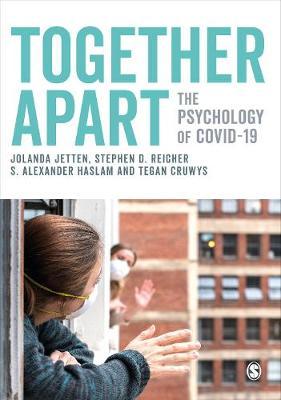
Written by leading social psychologists with expertise in leadership, health and emergency behaviour - who have also played an important role in advising governments on COVID-19 - this book provides a broad but integrated analysis of the psychology of COVID-19 It explores the response to COVID-19 through the lens of social identity theory, drawing from insights provided by four decades of research. Starting from the premise that an effective response to the pandemic depends upon people coming together and supporting each other as members of a common community, the book helps us to understand emerging processes related to social (dis)connectedness, collective behaviour and the societal effects of COVID-19. In this it shows how psychological theory can help us better understand, and respond to, the events shaping the world in 2020. Considering key topics such as: Leadership Communication Risk perception Social isolation Mental health Inequality Misinformation Prejudice and racism Behaviour change Social Disorder This book offers the foundation on which future analysis, intervention and policy can be built. We are proud to support the research into Covid-19 and are delighted to offer the finalised eBook for free, available from all major ebook retailers, including Amazon, Kobo, Ebooks.com and Google. For those who prefer print, it is possible to purchase a paperback version. All Royalties from this book will be donated to charity.
Full Product Details
Author: Jolanda Jetten ,
Stephen D. Reicher ,
S. Alexander Haslam ,
Tegan Cruwys
Publisher: SAGE Publications Ltd
Imprint: SAGE Publications Ltd
ISBN: 9781529744712
ISBN 10: 1529744717
Pages: 176
Publication Date: 12 September 2020
Audience:
College/higher education
,
Professional and scholarly
,
Tertiary & Higher Education
,
Professional & Vocational
Format: Hardback
Publisher's Status: Active
Availability: In Print

This item will be ordered in for you from one of our suppliers. Upon receipt, we will promptly dispatch it out to you. For in store availability, please contact us.
Author Information
Broadly my research addresses the issues of group behaviour and the individual-social relationship. More specifically, my recent research can be grouped into three areas. The first is an attempt to develop a model of crowd action that accounts for both social determination and social change. The second concerns the construction of social categories through language and action. The third concerns political rhetoric and mass mobilisation - especially around the issue of national identity. Currently, I am starting work on a Leverhulme funded project (jointly with Nick Hopkins of Lancaster University) looking at the impact of devolution on Scottish identity and social action in Scotland. S. Alexander Haslam is Professor of Psychology and Australian Laureate Fellow at the University of Queensland. His research focuses on the study of group and social identity processes in social, organizational, health and sport contexts. In May 2017, Alexander was awarded the British Psychological Society's Presidents' Award. Tegan Cruwys is an Australian Research Council Discovery Early Career Researcher Award (DECRA) fellow, clinical psychologist, and lecturer at the University of Queensland. Her research investigates how social relationships shape mental and physical health-work that is at the intersection of social, clinical, and health psychology. She completed her PhD at Australian National University in 2012.