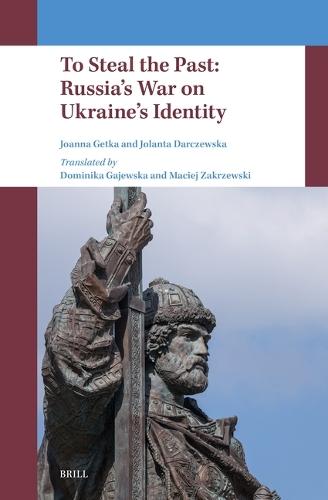
Overview
When juxtaposed with the practice of aggressive action and the brutal reality of war, Russian ideas appear completely incomprehensible. For more than three hundred years, Russians have cultivated the myth of the community, brotherhood of blood, and the indissoluble bond of the brotherly East Slavic peoples, while only recently they have unleashed a bloody war against the Ukrainians, killing children and defenceless civilians, burning and destroying everything along the way, and threatening the “mother of all Ruthenian cities” – Kyiv. The Russian invasion is difficult to explain using the concepts of realism or political pragmatism. They are also completely useless for understanding the mentality of Russians. To this day, the majority of Russians do not accept the existence of separate Ukrainian and Belarusian identities, considering Ukrainians and Belarusians as subgroups of the Russian nation, and the Belarusian and Ukrainian languages as dialects of Russian. They tacitly accept the Kremlin's arguments about the need to defend the Russian-speaking inhabitants of Ukrainian lands against the “fascist coup of the Banderites” and to bring about the “denazification” of Ukraine. The aim of the present work is to analyse the causes of this state of affairs from a linguocultural perspective.
Full Product Details
Author: Maciej Zakrzewski ,
Dominika Gajewska ,
Joanna Getka ,
Jolanta Darczewska
Publisher: Brill
Imprint: Brill
Dimensions:
Width: 15.50cm
, Height: 1.90cm
, Length: 23.50cm
ISBN: 9789004757905
ISBN 10: 9004757902
Pages: 224
Publication Date: 26 February 2026
Audience:
Professional and scholarly
,
Professional & Vocational
Format: Hardback
Publisher's Status: Forthcoming
Availability: Not yet available

This item is yet to be released. You can pre-order this item and we will dispatch it to you upon its release.
Author Information
Joanna Getka, Head of the Institute of Intercultural Studies of Central and Eastern Europe at the University of Warsaw (ISIEŚW UW), is a philologist, a specialist in Belarusian and Russian studies, and a cultural anthropologist. She is the author of monographs and articles on the literary culture of the Belarusian and Ukrainian cultural area, and on the formation of the modern cultural identity of Belarusians and Ukrainians. Jolanta Darczewska (1950–2025), Ph.D., was a doctor of the humanities, political scientist, translator, and expert on security issues in the post-Soviet area. From 1992 to 2021, she was affiliated with the Centre for Eastern Studies in Warsaw, and was its director in the years 2007–2011. She was the author of numerous publications devoted to the internal security of states in the post-Soviet area, including works on security management and specialized state administration bodies and their role in the political system.