Overview
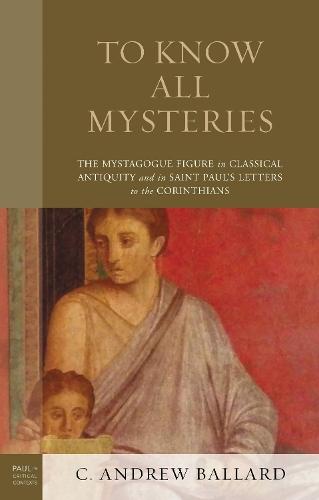
This book examines the way that Paul presents himself as a guide into mysteries, a “mystagogue,” in 1–2 Corinthians. By describing himself as a type of mystagogue for the community, Paul was following a precedent in both Jewish and non-Jewish sources for invoking mystagogic language to engage in polemics with a rival. In opposition to the precedent, however, Paul understands the mystagogue to be a bi-partite figure—comprised of both foolishness and wisdom simultaneously. C. Andrew Ballard argues that ancient mystagogues were often described in two disparate ways: figures of power, and figures of weakness and foolishness. Paul synthesizes both aspects of the mystagogue in his self-presentation to the Corinthians. The figure of the mystagogue, as a wise-fool, was useful to Paul because it was descriptive not only of his own experience as a suffering yet authoritative apostle, but also of the experience of his deity, the suffering and glorified Christ. By presenting himself as both a powerful and foolish mystagogue, Paul could argue that he was a more authentic imitator of Christ than his opponents in Corinth, who boasted in self-exaltation instead of self-humility. In this way, Paul used the character of the mystagogue as a strategic rhetorical tool in his communication with the Corinthians.
Full Product Details
Author: C. Andrew Ballard
Publisher: Bloomsbury Publishing Plc
Imprint: Lexington Books/Fortress Academic
Dimensions:
Width: 15.80cm
, Height: 3.60cm
, Length: 23.90cm
Weight: 0.771kg
ISBN: 9781978711105
ISBN 10: 1978711107
Pages: 404
Publication Date: 01 September 2022
Audience:
Professional and scholarly
,
Professional & Vocational
Format: Hardback
Publisher's Status: Active
Availability: Manufactured on demand

We will order this item for you from a manufactured on demand supplier.
Reviews
Ballard's To Know All Mysteries offers an extensive, well-researched, and insightful study of 1 and 2 Corinthians in relation to a vast topic--the Greek mystery religions and the figure of the mystagogue, who would lead an initiate into esoteric knowledge. Ballard's volume makes a compelling case that Paul incorporates the trope of the itinerant mystagogue into his self-presentation to the Corinthian community. Anyone interested in Paul's use of mystery language in 1 and 2 Corinthians should read this book.--Matthew Goff, Florida State University
There is a growing trend among scholars of Christian origins, myself included, to interpret Paul as a Jewish mystic. Ballard draws upon an impressive command of primary sources, current theory, and the history of interpretation, to argue that the pagan mysteries also inform Paul's mysticism, and that in the eyes of his gentile recruits he presented as a powerful mystagogue. The case he makes is learned, measured, and persuasive. The last two chapters on the Corinthian letter archive will need to be consulted by anyone working on those letters. This is an important and timely book. Paul scholars are very much in Ballard's debt.--Paul A. Holloway, Sewanee: The University of the South Ballard's To Know All Mysteries offers an extensive, well-researched, and insightful study of 1 and 2 Corinthians in relation to a vast topic--the Greek mystery religions and the figure of the mystagogue, who would lead an initiate into esoteric knowledge. Ballard's volume makes a compelling case that Paul incorporates the trope of the itinerant mystagogue into his self-presentation to the Corinthian community. Anyone interested in Paul's use of mystery language in 1 and 2 Corinthians should read this book.--Matthew Goff, Florida State University
There is a growing trend among scholars of Christian origins, myself included, to interpret Paul as a Jewish mystic. Ballard draws upon an impressive command of primary sources, current theory, and the history of interpretation, to argue that the pagan mysteries also inform Paul's mysticism, and that in the eyes of his gentile recruits he presented as a powerful mystagogue . The case he makes is learned, measured, and persuasive. The last two chapters on the Corinthian letter archive will need to be consulted by anyone working on those letters. This is an important and timely book. Paul scholars are very much in Ballard's debt.--Paul A. Holloway, Sewanee: The University of the South Ballard's To Know All Mysteries offers an extensive, well-researched, and insightful study of 1 and 2 Corinthians in relation to a vast topic--the Greek mystery religions and the figure of the mystagogue, who would lead an initiate into esoteric knowledge. Ballard's volume makes a compelling case that Paul incorporates the trope of the itinerant mystagogue into his self-presentation to the Corinthian community. Anyone interested in Paul's use of mystery language in 1 and 2 Corinthians should read this book.--Matthew Goff, Florida State University
Author Information
C. Andrew Ballard is adjunct instructor of religion at Fordham University.