Awards
- Winner of Warren F. Kuehl Prize of the Society for Historians of American Foreign Relations 1995 (United States)
Overview
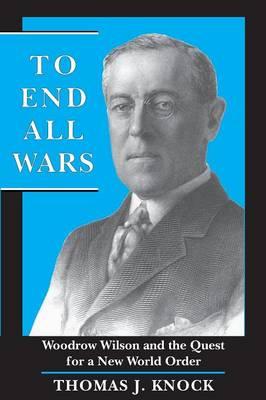
In his widely acclaimed To End All Wars, Thomas Knock provides an intriguing, often provocative narrative of Woodrow Wilson's epic quest for a new world order. The account follows Wilson's thought and diplomacy from his policy toward revolutionary Mexico, through his dramatic call for ""Peace without Victory"" in World War I, to the Senate's rejection of the League of Nations. Throughout Knock explores the place of internationalism in American politics, sweeping away the old view that isolationism was the cause of Wilson's failure and revealing the role of competing visions of internationalism--conservative and progressive.
Full Product Details
Author: Thomas Knock
Publisher: Princeton University Press
Imprint: Princeton University Press
Edition: New edition
Dimensions:
Width: 19.70cm
, Height: 2.70cm
, Length: 25.40cm
Weight: 0.624kg
ISBN: 9780691001500
ISBN 10: 0691001502
Pages: 400
Publication Date: 15 June 1995
Audience:
Professional and scholarly
,
College/higher education
,
Professional & Vocational
,
Tertiary & Higher Education
Format: Paperback
Publisher's Status: Out of Print
Availability: In Print

Limited stock is available. It will be ordered for you and shipped pending supplier's limited stock.
Language: English
Reviews
Winner of the Warren F. Kuehl Prize, Society for Historians of American Foreign Relations ""[This book] challenges virtually every recent historian who has tackled the subject. Knock demands that we see Wilson in a genuinely new framework and succeeds admirably.""--Gary J. Ostrower, The American Historical Review ""Now that humanity is possibly drawing closer to ... [a] 'Federation of the World,' To End All Wars is an enlightening and valuable introduction to the birth of that noble vision.""--Arthur Schlesinger, Jr., The Times Literary Supplement
Fresh analysis of Wilson, his times, and the evolution of his international position; by Knock (History/Southern Methodist Univ.). With never an extra word, Knock creates a sense of the creative ferment, innocence, and scale of a still-young America that brought into being such vigorous visionaries as Teddy Roosevelt, Eugene Debs, and John Reed. He shows a thoughtful Wilson, confident in his intellectual capacities, unafraid in the company of socialists and radicals, aware that new ideas would be needed to solve new problems. But Knock's Wilson isn't an original thinker: The salient ideas...he derived from other groups and individuals and the broad concept [of the League of Nations]...had long been espoused by a disparate constellation.... Nor was Wilson quick to grasp realpolitik. His (and America's) isolation and lack of historical instinct are clear as he-conducts WW I press conferences that simply ignore the incredible slaughter in Europe in the belief that we can remain uninvolved. Knock traces a pattern of Christian virtue, moral conviction, and idealism that made Wilson into a national hero who could address the (primarily Republican) League to Enforce Peace to thundering applause; and he shows how these same qualities - combined with lack of experience in international affairs and negotiations - would eventually undo Wilson. The American leader's reliance on his advisor Edward Mandell House's intrigues and optimistically inaccurate reports here figure in the failure of the President's Pan American Pact (a kind of model for the League of Nations), and suggest how this pattern of wishful thinking about human and national motivations would lead to similar results at Versailles. Sharp, succinct, and expert. (Kirkus Reviews)
[This book] challenges virtually every recent historian who has tackled the subject. Knock demands that we see Wilson in a genuinely new framework and succeeds admirably. -- Gary J. Ostrower, The American Historical Review Now that humanity is possibly drawing closer to ... [a] 'Federation of the World,' To End All Wars is an enlightening and valuable introduction to the birth of that noble vision. -- Arthur Schlesinger, Jr., The Times Literary Supplement
[This book] challenges virtually every recent historian who has tackled the subject. Knock demands that we see Wilson in a genuinely new framework and succeeds admirably. -- Gary J. Ostrower The American Historical Review Now that humanity is possibly drawing closer to ... [a] 'Federation of the World,' To End All Wars is an enlightening and valuable introduction to the birth of that noble vision. -- Arthur Schlesinger, Jr. The Times Literary Supplement
Author Information
Thomas J. Knock is Associate Professor of History at Southern Methodist University.