Overview
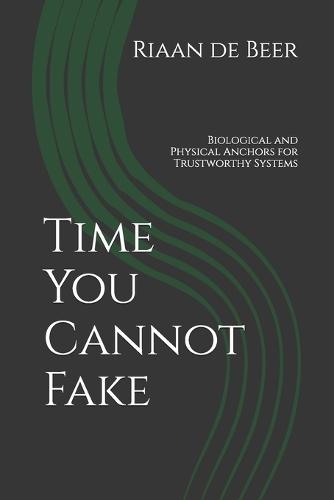
Modern digital systems treat time and location as values to be reported, synchronized, and authenticated. This abstraction enables global coordination-but it also introduces a structural vulnerability. Signals can be replayed, relayed, or synthesized without requiring the physical experiences they purport to represent. Under adversarial conditions, internal consistency is no longer sufficient for truth. Time You Cannot Fake develops a different foundation for trust. Rather than treating time and place as signals, this book argues that they must be validated as experience. Trustworthy systems, it contends, must be grounded in irreversible physical processes that accumulate history and cannot be shortcut without reproducing the underlying conditions. Biological growth, chemical kinetics, circadian rhythms, environmental imprints, radioactive decay, and entropic irreversibility all encode evidence of having endured time and inhabited place. The central unifying concept introduced is that of irreversible evidentiary processes: processes whose present state constrains the set of plausible pasts. These processes do not provide precise timestamps or coordinates. Instead, they exclude implausible histories, transforming validation from a problem of measurement into one of physical constraint. The book develops this framework systematically. It begins by analyzing why signal-based representations of time and location fail under replay, relay, and synthetic-environment attacks. It then introduces hysteresis and irreversibility as evidentiary properties, examines biological, chemical, and physical validators across multiple timescales, and extends these principles to spatial proof-of-presence. The later chapters assemble these elements into a multi-reference validation architecture and explore implications for critical infrastructure, autonomous systems, and long-term system trust. This work is intentionally conservative in scope. It avoids implementation specifics, political framing, and short-lived examples. Its aim is not to prescribe a particular system, but to establish a durable conceptual framework grounded in physical reality. Time passes. Places are inhabited. Experience accumulates. Systems that wish to be trustworthy must respect these facts.
Full Product Details
Author: Riaan de Beer
Publisher: Independently Published
Imprint: Independently Published
Dimensions:
Width: 15.20cm
, Height: 0.40cm
, Length: 22.90cm
Weight: 0.104kg
ISBN: 9798246671627
Pages: 70
Publication Date: 02 February 2026
Audience:
General/trade
,
General
Format: Paperback
Publisher's Status: Active
Availability: Available To Order

We have confirmation that this item is in stock with the supplier. It will be ordered in for you and dispatched immediately.