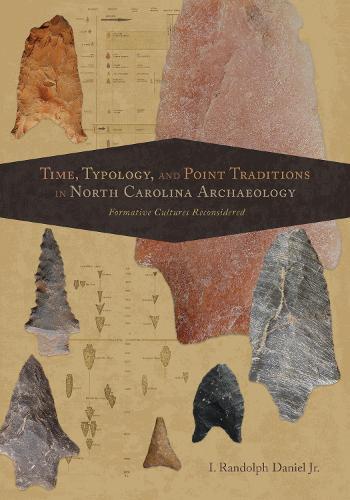
Full Product Details
Author: I. Randolph Daniel
Publisher: The University of Alabama Press
Imprint: The University of Alabama Press
Dimensions:
Width: 17.70cm
, Height: 2.20cm
, Length: 25.60cm
Weight: 0.625kg
ISBN: 9780817320867
ISBN 10: 0817320865
Pages: 232
Publication Date: 02 March 2021
Audience:
Professional and scholarly
,
Professional & Vocational
Format: Hardback
Publisher's Status: Active
Availability: Available To Order

We have confirmation that this item is in stock with the supplier. It will be ordered in for you and dispatched immediately.
Reviews
Daniel deftly covers a variety of topics, including theory and collector-professional relationships, augmenting the discussion of stone-tool types and culture history, that make this work significantly more than a picture book for comparative purposes. --Philip J. Carr, coeditor of Contemporary Lithic Analysis in the Southeast: Problems, Solutions, and Interpretations Daniel's volume is in the right place at the right time. In the last decade there has been an increased interest on the part of the archaeological community in reaching out to like-minded individuals in the public who have an active interest in the collection of archaeological artifacts. This rapprochement between professional practitioners and avocationals is long overdue. Daniel's volume targets this intersectional position, and argues that both sides can jointly contribute more to our understanding of the past than either group can do on their own. --Thomas E. Emerson, author of Cahokia and the Archaeology of Power, co-author of Projectile Points and the Illinois Landscape: People, Time, and Place In Time, Typology, and Point Traditions in North Carolina Archaeology, Daniel tackles three issues: clarification of well-known point types and creation of much-needed types; an evaluation of the validity of commonly used point types since Coe 1964; and a new look at the overall cultural-historical point sequence around the questions of traditions of cultural change and continuity within a framework of communities of practice. Daniel's inclusion of a discussion of lithic raw material use is most welcome. The result of this massive undertaking is not only timely and useful, but it will undoubtedly recharge lithic studies but also more mature considerations of Archaic and Woodland technologies in North Carolina and beyond. --Larry R. Kimball, professor of anthropology, Appalachian State University True to the title of this book, Randy Daniel provides a thorough review of the issues of typology, dating, and the place of traditions in North Carolina projectile point studies. Building on the foundational work of Joffre Coe's Formative Cultures, the author affirms, refines, and adds new types. With this volume Daniel seeks to engage two mutually interested communities, the professional archaeologist and the avocational-collector. He does an admirable job of meeting the needs of both. Because of his successful effort here, I expect an increase in archaeological knowledge and preservation to be forthcoming in North Carolina archaeology. --Albert C. Goodyear III, coeditor of Early Human Life on the Southeastern Coastal Plain In Time, Typology, and Point Traditions in North Carolina Archaeology, Daniel provides a comprehensive, critical reassessment of the foundational projectile point sequence developed by Joffre Coe at the Hardaway and Doerschuk sites in central North Carolina and relied upon as a typological tool by Southeastern archaeologists for more than half a century. Daniel addresses the gaps and other weaknesses in the sequence that have become apparent since it was first introduced and proposes a revised framework that incorporates more recent data as well as new theoretical perspectives. Because of the continued importance of projectile point typologies to North American archaeology, I predict Daniel's book will be broadly welcomed as an essential reference work by professional and avocational archaeologists alike. --R. P. Stephen Davis, Jr., coauthor of Time Before History: The Archaeology of North Carolina
True to the title of this book, Randy Daniel provides a thorough review of the issues of typology, dating, and the place of traditions in North Carolina projectile point studies. Building on the foundational work of Joffre Coe's Formative Cultures, the author affirms, refines, and adds new types. With this volume Daniel seeks to engage two mutually interested communities, the professional archaeologist and the avocational-collector. He does an admirable job of meeting the needs of both. Because of his successful effort here, I expect an increase in archaeological knowledge and preservation to be forthcoming in North Carolina archaeology. --Albert C. Goodyear III, coeditor of Early Human Life on the Southeastern Coastal Plain In Time, Typology, and Point Traditions in North Carolina Archaeology, Daniel provides a comprehensive, critical reassessment of the foundational projectile point sequence developed by Joffre Coe at the Hardaway and Doerschuk sites in central North Carolina and relied upon as a typological tool by Southeastern archaeologists for more than half a century. Daniel addresses the gaps and other weaknesses in the sequence that have become apparent since it was first introduced and proposes a revised framework that incorporates more recent data as well as new theoretical perspectives. Because of the continued importance of projectile point typologies to North American archaeology, I predict Daniel's book will be broadly welcomed as an essential reference work by professional and avocational archaeologists alike. --R. P. Stephen Davis, Jr., coauthor of Time Before History: The Archaeology of North Carolina In Time, Typology, and Point Traditions in North Carolina Archaeology, Daniel tackles three issues: clarification of well-known point types and creation of much-needed types; an evaluation of the validity of commonly used point types since Coe 1964; and a new look at the overall cultural-historical point sequence around the questions of traditions of cultural change and continuity within a framework of communities of practice. Daniel's inclusion of a discussion of lithic raw material use is most welcome. The result of this massive undertaking is not only timely and useful, but it will undoubtedly recharge lithic studies but also more mature considerations of Archaic and Woodland technologies in North Carolina and beyond. --Larry R. Kimball, professor of anthropology, Appalachian State University Daniel deftly covers a variety of topics, including theory and collector-professional relationships, augmenting the discussion of stone-tool types and culture history, that make this work significantly more than a picture book for comparative purposes. --Philip J. Carr, coeditor of Contemporary Lithic Analysis in the Southeast: Problems, Solutions, and Interpretations Daniel's volume is in the right place at the right time. In the last decade there has been an increased interest on the part of the archaeological community in reaching out to like-minded individuals in the public who have an active interest in the collection of archaeological artifacts. This rapprochement between professional practitioners and avocationals is long overdue. Daniel's volume targets this intersectional position, and argues that both sides can jointly contribute more to our understanding of the past than either group can do on their own. --Thomas E. Emerson, author of Cahokia and the Archaeology of Power, co-author of Projectile Points and the Illinois Landscape: People, Time, and Place
Daniel's volume is in the 'right place at the right time.' In the last decade there has been an increased interest on the part of the archaeological community in reaching out to like-minded individuals in the public who have an active interest in the collection of archaeological artifacts. This rapprochement between professional practitioners and avocationals is long overdue. Daniel's volume targets this intersectional position, and argues that both sides can jointly contribute more to our understanding of the past than either group can do on their own. --Thomas E. Emerson, author of Cahokia and the Archaeology of Power, co-author of Projectile Points and the Illinois Landscape: People, Time, and Place Daniel deftly covers a variety of topics, including theory and collector-professional relationships, augmenting the discussion of stone-tool types and culture history, that make this work significantly more than a picture book for comparative purposes. --Philip J. Carr, coeditor of Contemporary Lithic Analysis in the Southeast: Problems, Solutions, and Interpretations
Daniel deftly covers a variety of topics, including theory and collector-professional relationships, augmenting the discussion of stone-tool types and culture history, that make this work significantly more than a picture book for comparative purposes. --Philip J. Carr, coeditor of Contemporary Lithic Analysis in the Southeast: Problems, Solutions, and Interpretations Daniel's volume is in the right place at the right time. In the last decade there has been an increased interest on the part of the archaeological community in reaching out to like-minded individuals in the public who have an active interest in the collection of archaeological artifacts. This rapprochement between professional practitioners and avocationals is long overdue. Daniel's volume targets this intersectional position, and argues that both sides can jointly contribute more to our understanding of the past than either group can do on their own. --Thomas E. Emerson, author of Cahokia and the Archaeology of Power, co-author of Projectile Points and the Illinois Landscape: People, Time, and Place In Time, Typology, and Point Traditions in North Carolina Archaeology, Daniel tackles three issues: clarification of well-known point types and creation of much-needed types; an evaluation of the validity of commonly used point types since Coe 1964; and a new look at the overall cultural-historical point sequence around the questions of traditions of cultural change and continuity within a framework of communities of practice. Daniel's inclusion of a discussion of lithic raw material use is most welcome. The result of this massive undertaking is not only timely and useful, but it will undoubtedly recharge lithic studies but also more mature considerations of Archaic and Woodland technologies in North Carolina and beyond. --Larry R. Kimball, professor of anthropology, Appalachian State University True to the title of this book, Randy Daniel provides a thorough review of the issues of typology, dating, and the place of traditions in North Carolina projectile point studies. Building on the foundational work of Joffre Coe's Formative Cultures, the author affirms, refines, and adds new types. With this volume Daniel seeks to engage two mutually interested communities, the professional archaeologist and the avocational-collector. He does an admirable job of meeting the needs of both. Because of his successful effort here, I expect an increase in archaeological knowledge and preservation to be forthcoming in North Carolina archaeology. --Albert C. Goodyear III, coeditor of Early Human Life on the Southeastern Coastal Plain In Time, Typology, and Point Traditions in North Carolina Archaeology, Daniel provides a comprehensive, critical reassessment of the foundational projectile point sequence developed by Joffre Coe at the Hardaway and Doerschuk sites in central North Carolina and relied upon as a typological tool by Southeastern archaeologists for more than half a century. Daniel addresses the gaps and other weaknesses in the sequence that have become apparent since it was first introduced and proposes a revised framework that incorporates more recent data as well as new theoretical perspectives. Because of the continued importance of projectile point typologies to North American archaeology, I predict Daniel's book will be broadly welcomed as an essential reference work by professional and avocational archaeologists alike. --R. P. Stephen Davis, Jr., coauthor of Time Before History: The Archaeology of North Carolina
Author Information
I. Randolph Daniel Jr. is professor and chair of Anthropology at East Carolina University. A noted expert on Native American stone tools, he is the author of Hardaway Revisited: Early Archaic Settlement in the Southeast.