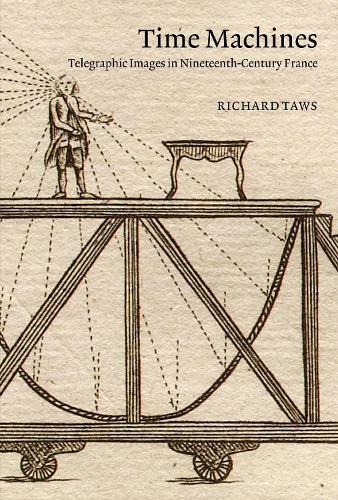
Time Machines: Telegraphic Images in Nineteenth-Century France

Author:   Richard Taws
Publisher:   MIT Press Ltd
ISBN:  

9780262049184


Pages:   448
Publication Date:   21 January 2025
Format:   Hardback
Availability:   To order   Availability explained
Stock availability from the supplier is unknown. We will order it for you and ship this item to you once it is received by us.

Our Price $125.00 Quantity:  
Add to Cart

Share |

Time Machines: Telegraphic Images in Nineteenth-Century France


Overview

A riveting exploration of the relationship between art and telegraphy, and its implications for understanding time and history in nineteenth-century France. A riveting exploration of the relationship between art and telegraphy, and its implications for understanding time and history in nineteenth-century France. In Time Machines Richard Taws examines the relationship between art and telegraphy in the decades following the French Revolution. The optical telegraph was a novel form of visual communication developed in the 1790s that remained in use until the mid-1850s. This pre-electric telegraph, based on a semaphore code, irrevocably changed the media landscape of nineteenth-century France. Although now largely forgotten, in its day it covered vast distances and changed the way people thought about time. It also shaped, and was shaped by, a proliferating world of images. What happens, Taws asks, if we think about art telegraphically? Placed on prominent buildings across France-for several years there was one on top of the Louvre-the telegraph's waving limbs were a ubiquitous sight, shifting how public space was experienced and represented. The system was depicted by a wide range of artists, who were variously amused, appalled, irritated, or seduced by the telegraph's intractable coded messages and the uncanny environmental and perceptual disruption it caused. Clouds, architecture, landscapes, and gestures- all signified differently in the era of telegraphy, and the telegraph became a powerful means to comprehend France's technological and political past. While Paris's famous arcades began to crisscross the city at ground level, a more enigmatic network was operating above. Shifting attention from the streets to the skies, this book shows how modern France took shape quite literally under the telegraph's sign.

Full Product Details

Author:   Richard Taws
Publisher:   MIT Press Ltd
Imprint:   MIT Press
Weight:   0.567kg
ISBN:  

9780262049184


ISBN 10:   026204918
Pages:   448
Publication Date:   21 January 2025
Audience:   General/trade ,  General
Format:   Hardback
Publisher's Status:   Active
Availability:   To order   Availability explained
Stock availability from the supplier is unknown. We will order it for you and ship this item to you once it is received by us.

Table of Contents

1 The Compass of Time 2 Revolutionary Horizons 3 Lines in Sand 4 Paris in Code 5 When I was a Telegrapher 6 The Machine Stops Acknowledgments Illustration Credits Notes Index

Reviews

Author Information

Richard Taws is Professor of History of Art and Visual Culture at University College London. He is the author of The Politics of the Provisional as well as coeditor, with Iris Moon, of Time, Media, and Visuality in Post-Revolutionary France and, with Genevieve Warwick, Art and Technology in Early Modern Europe.

Tab Content 6

Author Website:  

Countries Available

All regions
Latest Reading Guide

NOV RG 20252


Shopping Cart
Your cart is empty
Shopping cart
Mailing List