|
|
|||
|
||||
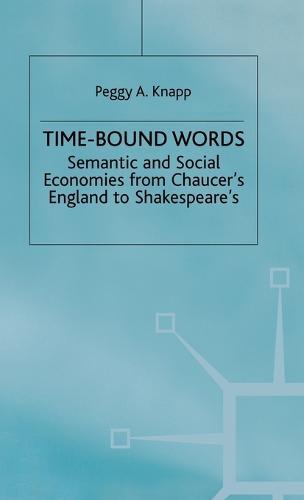
OverviewThis study argues that changes in English society and the English language are woven together, often in surprising ways, and investigates this claim by following 11 words from Chaucer's time to Shakespeare's. Middle English words like ""corage, estat, thrift"", and ""virt"" come to serve the logic of new social discourses by 1611. Language from Chaucer, Wyclif, More, Spenser, Shakespeare, Jonson and others is examined both as current and emerging usage, and as verbal play that accomplishes cultural work. Full Product DetailsAuthor: P. KnappPublisher: Palgrave Macmillan Imprint: Palgrave Macmillan Dimensions: Width: 14.00cm , Height: 1.30cm , Length: 21.60cm Weight: 0.450kg ISBN: 9780333753798ISBN 10: 0333753798 Pages: 224 Publication Date: 29 March 2000 Audience: Professional and scholarly , Professional and scholarly , Professional & Vocational , Postgraduate, Research & Scholarly Format: Hardback Publisher's Status: Active Availability: In Print This item will be ordered in for you from one of our suppliers. Upon receipt, we will promptly dispatch it out to you. For in store availability, please contact us. Table of ContentsIntroduction: Philology in A New Key Corage/Courage Estat/Estate Fre/Free Gloss Kynde/Kind Lewed/Lewd Providence Queynte/Quaint Sely/Silly Thrift Virtù/Virtue After Words References Cited IndexReviews...provide useful and vivid introductions to the lived textures of the early modern world. Renaissance Quarterly Author InformationPEGGY A. KNAPP is a Professor of English at Carnegie Mellon University. She is the co-founder and editor of the annual book series Assays: Critical Approaches to Medieval and Renaissance Texts (1981-89) and the author of The Style of John Wyclif's English Sermons (1977) and Chaucer and the Social Contest (1990). Her essays on medieval, early modern, and contemporary writers have appeared in PMLA, ELH, MLN, Criticism, Chaucer Review, and many other publications. Tab Content 6Author Website:Countries AvailableAll regions |
||||