Awards
- Winner of Winner of the College Language Association Creative Scholarship Award.
Overview
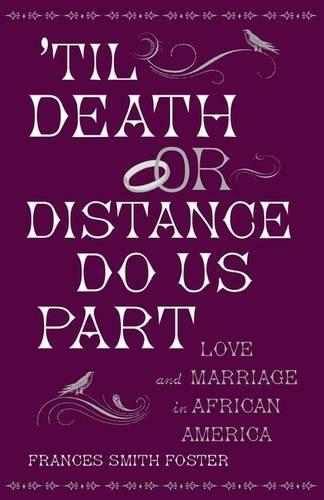
Conventional wisdom tells us that marriage was illegal for African Americans during the antebellum era, and that if people married at all, their vows were tenuous ones: until death or distance do us part. It is an impression that imbues beliefs about black families to this day. But it's a perception primarily based on documents produced by abolitionists, the state, or other partisans. It doesn't tell the whole story.Drawing on a trove of less well-known sources including family histories, folk stories, memoirs, sermons, and especially the fascinating writings from the Afro-Protestant Press,'Til Death or Distance Do Us Part offers a radically different perspective on antebellum love and family life.Frances Smith Foster applies the knowledge she's developed over a lifetime of reading and thinking. Advocating both the potency of skepticism and the importance of story-telling, her book shows the way toward a more genuine, more affirmative understanding of African American romance, both then and now.
Full Product Details
Author: Frances Smith Foster (Charles Howard Chandler Professor in English and Women's Studies and Chair of the English Department, Emory University)
Publisher: Oxford University Press Inc
Imprint: Oxford University Press Inc
Dimensions:
Width: 14.20cm
, Height: 1.40cm
, Length: 21.50cm
Weight: 0.262kg
ISBN: 9780199389704
ISBN 10: 0199389705
Pages: 220
Publication Date: 09 October 2014
Audience:
General/trade
,
General
Format: Paperback
Publisher's Status: Active
Availability: Manufactured on demand

We will order this item for you from a manufactured on demand supplier.
Reviews
This is a challenging and important text. After deconstructing our national myths about marriage and our specific assumptions about African American marriage, Foster masterfully reconstructs the reality of marriage for enslaved black people. Rather than finding a fragile institution of transient attachments, she uncovers a legacy of love, struggle, and commitment. By choosing whom to love, how to love, and what to sacrifice, black Americans carved out space for their human selves. Their marriages contributed to decades of resistance against the dehumanizing effects of slavery. Although there is not a hint of sentimentalism, this book is truly an inspiring love story. --Melissa Harris-Lacewell, author of Barbershops, Bibles, and BET: Everyday Talk and Black Political Thought Foster demolishes stereotypes about the history of love, sexuality, and marriage among antebellum African Americans and issues a passionate argument for why contemporary Americans need to understand the complexity, variety, and richness of the intimate relationships forged by enslaved and free African American women and men in the past. -Stephanie Coontz, author of Marriage, A History: How Love Conquered Marriage No stranger to writing about African slaves and Blacks in the antebellum period, Foster has done an excellent job discussing a significant ritualized institution that very often gets lost in the history of Africans in America -- marriage. --Shannon Butler-Mokoro, Journal of Sociology & SocialWelfare
Author Information
Frances Smith Foster is Charles Howard Candler Professor of English and Women's Studies (Emeritus) at Emory University. Her previous books include Written By Herself: Literary Production by African American Women, 1746-1892 (Indiana UP, 1993), Witnessing Slavery: The Development of the Ante-Bellum Slave Narrative (Greenwood, 1979), and several edited collections. Her VSI to African American Literature is forthcoming.