Overview
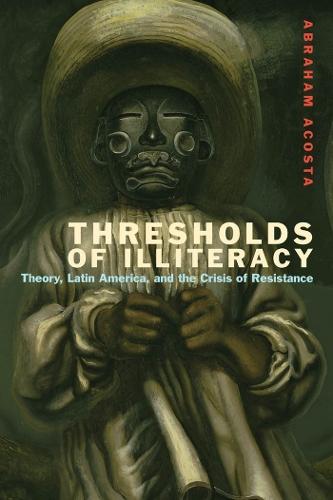
Thresholds of Illiteracy reevaluates Latin American theories and narratives of cultural resistance by advancing the concept of ""illiteracy"" as a new critical approach to understanding scenes or moments of social antagonism. ""Illiteracy,"" Acosta claims, can offer us a way of talking about what cannot be subsumed within prevailing modes of reading, such as the opposition between writing and orality, that have frequently been deployed to distinguish between modern and archaic peoples and societies. This book is organized as a series of literary and cultural analyses of internationally recognized postcolonial narratives. It tackles a series of the most important political/aesthetic issues in Latin America that have arisen over the past thirty years or so, including indigenism, testimonio, the Zapatista movement in Chiapas, and migration to the United States via the U.S.-Mexican border. Through a critical examination of the ""illiterate"" effects and contradictions at work in these resistant narratives, the book goes beyond current theories of culture and politics to reveal radically unpredictable forms of antagonism that advance the possibility for an ever more democratic model of cultural analysis.
Full Product Details
Author: Abraham Acosta
Publisher: Fordham University Press
Imprint: Fordham University Press
Dimensions:
Width: 15.20cm
, Height: 2.30cm
, Length: 22.90cm
Weight: 0.386kg
ISBN: 9780823257102
ISBN 10: 082325710
Pages: 292
Publication Date: 03 April 2014
Audience:
Professional and scholarly
,
Professional & Vocational
Format: Paperback
Publisher's Status: Active
Availability: In Print

This item will be ordered in for you from one of our suppliers. Upon receipt, we will promptly dispatch it out to you. For in store availability, please contact us.
Reviews
Thresholds of Illiteracy is destined to make an indelible mark in Latin American literary critical and cultural studies. One of the book's major theoretical contributions resides in Acosta's highly original development of what he calls illiteracy, which sustains a number of interrelated senses and metonymical associations related to classical ethnography, postcolonial studies and contemporary debates in political thought. Acosta deals very capably with a wide range of geographical and cultural contexts, including Peru, Cuba, Central America, Mexico and the US-Mexico border... --Patrick Dove, Indiana University
Thresholds of Illiteracy is destined to make an indelible mark in Latin American literary critical and cultural studies. One of the book's major theoretical contributions resides in Acosta's highly original development of what he calls illiteracy, which sustains a number of interrelated senses and metonymical associations related to classical ethnography, postcolonial studies and contemporary debates in political thought. Acosta deals very capably with a wide range of geographical and cultural contexts, including Peru, Cuba, Central America, Mexico and the US-Mexico border... --Patrick Dove, Indiana University ... it [the book] is important and significant-perhaps even vital-in a number of ways. -Posthegemony
Author Information
Abraham Acosta is Assistant Professor of Spanish and Portuguese at the University of Arizona.