Overview
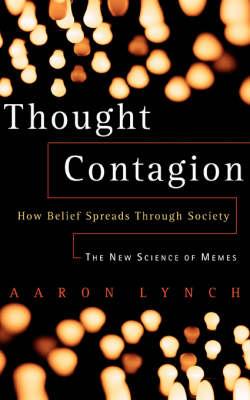
Fans of Douglas Hofstadter, Daniel Bennet, and Richard Dawkins (as well as science buffs and readers of Wired Magazine ) will revel in Aaron Lynch's ground-breaking examination of memetics,the new study of how ideas and beliefs spread. What characterizes a meme is its capacity for displacing rival ideas and beliefs in an evolutionary drama that determines and changes the way people think. Exactly how do ideas spread, and what are the factors that make them genuine thought contagions? Why, for instance, do some beliefs spread throughout society, while others dwindle to extinction? What drives those intensely held beliefs that spawn ideological and political debates such as views on abortion and opinions about sex and sexuality? By drawing on examples from everyday life, Lynch develops a conceptual basis for understanding memetics. Memes evolve by natural selection in a process similar to that of Genes in evolutionary biology. What makes an idea a potent meme is how effectively it out-propagates other ideas. In memetic evolution, the fittest ideas"" are not always the truest or the most helpful, but the ones best at self replication. Thus, crash diets spread not because of lasting benefit, but by alternating episodes of dramatic weight loss and slow regain. Each sudden thinning provokes onlookers to ask, How did you do it?"" thereby manipulating them to experiment with the diet and in turn, spread it again. The faster the pounds return, the more often these people enter that disseminating phase, all of which favours outbreaks of the most pathogenic diets. Like a software virus traveling on the Internet or a flu strain passing through a city, thought contagions proliferate by programming for their own propagation. Lynch argues that certain beliefs spread like viruses and evolve like microbes, as mutant strains vie for more adherents and more hosts. In its most revolutionary aspect, memetics asks not how people accumulate ideas, but how ideas accumulate people. Readers of this intriguing theory will be amazed to discover that many popular beliefs about family, sex, politics, religion, health, and war have succeeded by their fitness"" as thought contagions.
Full Product Details
Author: Aaron Lynch
Publisher: Basic Books
Imprint: Basic Books
Dimensions:
Width: 12.80cm
, Height: 1.20cm
, Length: 20.20cm
Weight: 0.212kg
ISBN: 9780465084678
ISBN 10: 0465084672
Pages: 208
Publication Date: 27 November 1998
Audience:
General/trade
,
College/higher education
,
Professional and scholarly
,
General
,
Tertiary & Higher Education
Format: Paperback
Publisher's Status: Active
Availability: Manufactured on demand

We will order this item for you from a manufactured on demand supplier.
Reviews
Are persistent ideas or beliefs the intellectual equivalent of a successful virus? According to Lynch, in this workmanlike, if dour, survey of the emerging science of memetics (the study of how ideas or convictions spread through a society), they are. Former Fermilab engineering physicist Lynch charts the development of the concept of the meme - a self-propagating, contagious idea - through discussions of its originator, zoologist Richard Dawkins (in his 1976 book The Selfish Gene), and other influential thinkers such as Daniel Dennett and Douglas Hofstadter. Using the model of a virus retransmitting itself among people, he explores how ideas retransmit themselves and affect all aspects of life, from areas of academic study to everyday existence. For example, an Amish religious taboo against modern farm equipment necessitates a great supply of manual labor; thus the Amish need large families, and their population doubles twice as fast as the world's. Deciding to bear a child engenders optimism because its great expense . . . requires an optimistic view of one's future. Similarly interesting conclusions about the effects of declining taboos against homosexuality (likely, Lynch suggests, to lead to a decline in the gay population), the impact of the Christian concept of love on the growth of the early Church ( Love thy neighbor as thyself was a meme so broadly appealing that it was guaranteed a long life), and abortion prohibitions (cyclical, likely to remain a persistent presence causing social discord), dot the book and provoke thought. But stultifying jargon (such as the phrases proselytic competition and high-fertility meme in a paragraph about sex talk ) and a lack of stories, anecdotes, or quotes within the larger structure of a survey stop the book cold. And jargon-filled lists, such as one on the modes by which memes retransmit themselves from host carrier to group host population also lose general readers. Lacking humanism, wit, and readability, this is hardly the popularizing primer it might have been. (Kirkus Reviews)
Author Information
Aaron Lynch was an engineering physicist. In 1990 he was awarded a grant for full-time research by a private sponsor.