Overview
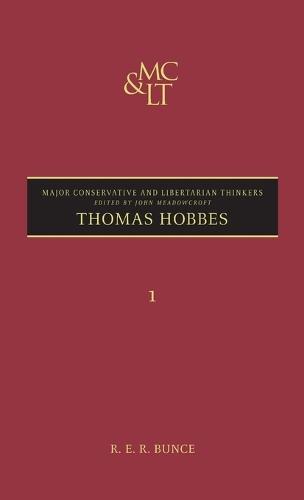
In this volume, Dr Bunce (University of Cambridge) introduces Hobbes' ambitious philosophical project to discover the principles that govern the social world. If Hobbes' immodest assessment that he successfully attained this goal may be disputed, Bunce nevertheless captures the extraordinary enduring value of Hobbes' work for the contemporary reader. Thomas Hobbes's name and the title of his most famous work, Leviathan, have come to be synonymous with the idea that the natural state of humankind is 'nasty, brutish, and short' and only the intervention of a munificent overlord may spare men and women from this unenviable fate by imposing order where there would otherwise be chaos. The problem that Hobbes formulated resonates through the centuries as the enduring dilemma of political organisation and social cooperation. Indeed it can be seen today in fields as diverse as theoretical game theory and international relations.
Full Product Details
Author: Dr. R.E.R. Bunce ,
John Meadowcroft
Publisher: Bloomsbury Publishing PLC
Imprint: Continuum International Publishing Group Ltd.
Volume: v. 1
Dimensions:
Width: 13.80cm
, Height: 1.80cm
, Length: 21.60cm
Weight: 0.340kg
ISBN: 9780826429797
ISBN 10: 0826429793
Pages: 176
Publication Date: 15 July 2009
Audience:
College/higher education
,
Postgraduate, Research & Scholarly
Format: Hardback
Publisher's Status: Active
Availability: Manufactured on demand

We will order this item for you from a manufactured on demand supplier.
Language: English
Reviews
As the inaugural volume in a new series from John Meadowcraft, Major Conservative and Libertarian Thinkers, Bunce's Thomas Hobbes sets a high standard for future volumes. Bunce (Univ. of Cambridge) has provided a text useful for undergraduates, graduates, and faculty alike. The book includes a brief yet informative biographical sketch, an account of the development of Hobbes's civil philosophy, and a particularly valuable discussion of how Hobbes's thought was received in his own day, as well as the various avenues of interpretation subsequently developed. The discussion of Hobbes's reception and interpretation is particularly useful to students as it addresses the critiques of Hobbes made by Pufendorf, Locke, and Rousseau. The account of contemporary views of Hobbes discusses his place in the thought of important recent theorists such as Michael Oakeshott, Leo Strauss, and Francis Fukuyama as well as his continued relevance to contemporary political subjects. Bunce's volume has the particular virtue of paying due attention to Hobbes's physics as well as his politics, clarifying the frequently neglected link between his physics and his moral and political teachings. Summing Up: Recommended. All undergraduate, graduate, and research collections. -- M. Harding, University of Dallas-CHOICE, Editor's Pick
As the inaugural volume in a new series from John Meadowcraft, Major Conservative and Libertarian Thinkers, Bunce's Thomas Hobbes sets a high standard for future volumes. Bunce (Univ. of Cambridge) has provided a text useful for undergraduates, graduates, and faculty alike. The book includes a brief yet informative biographical sketch, an account of the development of Hobbes's civil philosophy, and a particularly valuable discussion of how Hobbes's thought was received in his own day, as well as the various avenues of interpretation subsequently developed. The discussion of Hobbes's reception and interpretation is particularly useful to students as it addresses the critiques of Hobbes made by Pufendorf, Locke, and Rousseau. The account of contemporary views of Hobbes discusses his place in the thought of important recent theorists such as Michael Oakeshott, Leo Strauss, and Francis Fukuyama as well as his continued relevance to contemporary political subjects. Bunce's volume has the p
As the inaugural volume in a new series from John Meadowcraft, Major Conservative and Libertarian Thinkers, Bunce's Thomas Hobbes sets a high standard for future volumes. Bunce (Univ. of Cambridge) has provided a text useful for undergraduates, graduates, and faculty alike. The book includes a brief yet informative biographical sketch, an account of the development of Hobbes's civil philosophy, and a particularly valuable discussion of how Hobbes's thought was received in his own day, as well as the various avenues of interpretation subsequently developed. The discussion of Hobbes's reception and interpretation is particularly useful to students as it addresses the critiques of Hobbes made by Pufendorf, Locke, and Rousseau. The account of contemporary views of Hobbes discusses his place in the thought of important recent theorists such as Michael Oakeshott, Leo Strauss, and Francis Fukuyama as well as his continued relevance to contemporary political subjects. Bunce's volume has the particular virtue of paying due attention to Hobbes's physics as well as his politics, clarifying the frequently neglected link between his physics and his moral and political teachings. Summing Up: Recommended. All undergraduate, graduate, and research collections. -- M. Harding, University of Dallas-CHOICE, Editor's Pick The volumes in this timely series comprise the most comprehensive body of material on conservative and libertarian thought yet published in a single project devoted to the subject. The series will prove an indispensable tool not only for those concerned with the history of political thought but also for those who confront the challenging task of constructing a viable contemporary conservative identity. Professor Meadowcroft had a difficult editorial task, to which he has responded with a judicious choice of thinkers and topics. --Noel O'Sullivan, Professor of Political Philosophy, the University of Hull, UK.
""The volumes in this timely series comprise the most comprehensive body of material on conservative and libertarian thought yet published in a single project devoted to the subject. The series will prove an indispensable tool not only for those concerned with the history of political thought but also for those who confront the challenging task of constructing a viable contemporary conservative identity. Professor Meadowcroft had a difficult editorial task, to which he has responded with a judicious choice of thinkers and topics."" --Noel O'Sullivan, Professor of Political Philosophy, the University of Hull, UK. As the inaugural volume in a new series from John Meadowcraft, ""Major Conservative and Libertarian Thinkers, Bunce's Thomas Hobbes sets a high standard for future volumes. Bunce (Univ. of Cambridge) has provided a text useful for undergraduates, graduates, and faculty alike. The book includes a brief yet informative biographical sketch, an account of the development of Hobbes's civil philosophy, and a particularly valuable discussion of how Hobbes's thought was received in his own day, as well as the various avenues of interpretation subsequently developed. The discussion of Hobbes's reception and interpretation is particularly useful to students as it addresses the critiques of Hobbes made by Pufendorf, Locke, and Rousseau. The account of contemporary views of Hobbes discusses his place in the thought of important recent theorists such as Michael Oakeshott, Leo Strauss, and Francis Fukuyama as well as his continued relevance to contemporary political subjects. Bunce's volume has the particular virtue of paying due attention to Hobbes's physics as well as his politics, clarifying the frequently neglected link between his physics and his moral and political teachings. Summing Up: Recommended. All undergraduate, graduate, and research collections. -- M. Harding, University of Dallas-CHOICE, Editor's Pick
Author Information
Dr Bunce completed a PhD on Hobbes' thought and teaches at the University of Cambridge, UK