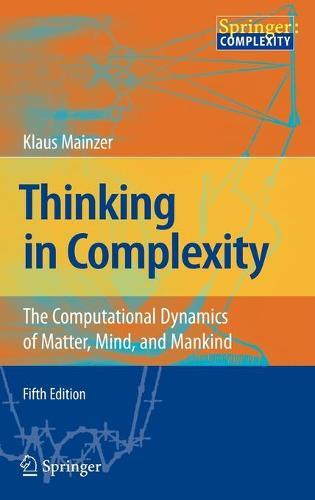
Full Product Details
Author: Klaus Mainzer
Publisher: Springer-Verlag Berlin and Heidelberg GmbH & Co. KG
Imprint: Springer-Verlag Berlin and Heidelberg GmbH & Co. K
Edition: Fifth Edition 2007
Dimensions:
Width: 15.50cm
, Height: 2.60cm
, Length: 23.50cm
Weight: 0.916kg
ISBN: 9783540722274
ISBN 10: 3540722270
Pages: 482
Publication Date: 10 September 2007
Audience:
Professional and scholarly
,
Professional & Vocational
Format: Hardback
Publisher's Status: Active
Availability: Out of stock

The supplier is temporarily out of stock of this item. It will be ordered for you on backorder and shipped when it becomes available.
Reviews
From the reviews of the fourth edition: THE INDUSTRIAL PHYSICIST: The science of complexity is likely to be among the most salient features of the 21st century, and Thinking in Complexity: Computational Dynamics of Matter, Mind, and Mankind is just as likely to be among the most popular introductions to the topic. Author Klaus Mainzer treats highly technical materials related to descriptions of complexity pervading science, engineering, and societal dynamics-and even ethics-with a lucidity that is sure to captivate physicists as well as the general public with a moderate scientific background. ... Readers of this book will enjoy Mainzer's exposition, which is based on a tight coupling between classical and historical concepts from Plato and Aristotle to modern, mathematical and physical developments, including relativity, chaos, and quantum physics. Every chapter begins with a section designed to orient the reader to the perspective of philosophical developments through the ages pertinent to the topic at hand. Readers patient enough to read through the lines will be rewarded with occasional gems such as Mainzer's speculation on a possible correlation between a society's development of atomistic ideas and its possession of a phonetic alphabet. The author takes pains to point out essential differences between classical science and the science of complexity. ... Thinking in Complexity is an outstandingly readable book. This book is ambitious, incredibly erudite wih 22 pages of references, and is indisputably clearly and beautifully illustrated. It is perfectly suited to a first course on the science of complexity. (Physicalia 2005, vol. 57, page 191-192) All-in-all, this highly recommended book is a wonderful resource for intuitive basic ideas in the need of rigorous formulation. (Albert A. Mullin, Zentralblatt MATH 2004, vol. 1046, page 5) 'This is the fourth revised and slightly enlarged edition' of what has been a bestseller since its first publication in 1994. ... This book is ambitious, incredibly erudite with 22 pages of references, and is indisputably clearly and beautifully written and illustrated. It is perfectly suited to a first course on the science of complexity. Even beginners and young graduate students will have something to learn from this book. (Andre Hautot, Physicalia, Vol. 57 (3), 2005) Here is the fourth edition of a highly successful sequence of editions of this excellent book on complexity theory and its implications. ... The major change from the three earlier editions is a shift of emphasis from the complex dynamics of matter, mind, and mankind towards the computational dynamics of mind, matter and mankind. ... 100 pages of useful new material have been added to the book. All-in-all, this highly recommended book is a wonderful resource for intuitive basic ideas in the need of rigorous formulation. (Albert A. Mullin, Zentralblatt MATH, Vol. 1046 (21), 2004) Readers of this book will enjoy Mainzer's exposition, which is based on a tight coupling between classical and historical concepts from Plato and Aristotle to modern, mathematical and physical developments ... . Every chapter begins with a section designed to orient the reader to the perspective of philosophical developments through the ages pertinent to the topic at hand. ... The author takes pains to point out essential differences between classical science and the science of complexity. ... Thinking in Complexity is an outstandingly readable book. (Anutosh Moitra, The Industrial Physicist, August/September, 2004) From the reviews of the fifth edition: A new fifth edition of 'Thinking in Complexity' reflects recent developments associated with complexity research in life and physical sciences, computer science, economics, social and cognitive sciences. ... This valuable text on complexity theory and nonlinear dynamics features profound applications to important problems in natural and social sciences, culture, economics and serves both as a gentle introduction to complexity and a versatile encyclopedia where recent contributions to the field are thoroughly collected. (Yuri V. Rogovchenko, Zentralblatt MATH, Vol. 1163, 2009)
From the reviews of the fourth edition: <p>THE INDUSTRIAL PHYSICIST: <p> The science of complexity is likely to be among the most salient features of the 21st century, and Thinking in Complexity: Computational Dynamics of Matter, Mind, and Mankind is just as likely to be among the most popular introductions to the topic. Author Klaus Mainzer treats highly technical materials related to descriptions of complexity pervading science, engineering, and societal dynamicsa and even ethicsa with a lucidity that is sure to captivate physicists as well as the general public with a moderate scientific background. a ] Readers of this book will enjoy Mainzera (TM)s exposition, which is based on a tight coupling between classical and historical concepts from Plato and Aristotle to modern, mathematical and physical developments, including relativity, chaos, and quantum physics. Every chapter begins with a section designed to orient the reader to the perspective of philosophical developments through the ages pertinent to the topic at hand. Readers patient enough to read through the lines will be rewarded with occasional gems such as Mainzera (TM)s speculation on a possible correlation between a societya (TM)s development of atomistic ideas and its possession of a phonetic alphabet. The author takes pains to point out essential differences between classical science and the science of complexity. a ] Thinking in Complexity is an outstandingly readable book. <p> This book is ambitious, incredibly erudite wih 22 pages of references, and is indisputably clearly and beautifully illustrated. It is perfectly suited to a first course on the science of complexity. (Physicalia 2005, vol. 57, page191-192) <p> All-in-all, this highly recommended book is a wonderful resource for intuitive basic ideas in the need of rigorous formulation. (Albert A. Mullin, Zentralblatt MATH 2004, vol. 1046, page 5) <p> a ~This is the fourth revised and slightly enlarged editiona (TM) of what has been a bestseller since its first publication in 1994. a ] This book is ambitious, incredibly erudite with 22 pages of references, and is indisputably clearly and beautifully written and illustrated. It is perfectly suited to a first course on the science of complexity. Even beginners and young graduate students will have something to learn from this book. (AndrA(c) Hautot, Physicalia, Vol. 57 (3), 2005) <p> Here is the fourth edition of a highly successful sequence of editions of this excellent book on complexity theory and its implications. a ] The major change from the three earlier editions is a shift of emphasis from the complex dynamics of matter, mind, and mankind towards the computational dynamics of mind, matter and mankind. a ] 100 pages of useful new material have been added to the book. All-in-all, this highly recommended book is a wonderful resource for intuitive basic ideas in the need of rigorous formulation. (Albert A. Mullin, Zentralblatt MATH, Vol. 1046 (21), 2004) <p> Readers of this book will enjoy Mainzera (TM)s exposition, which is based on a tight coupling between classical and historical concepts from Plato and Aristotle to modern, mathematical and physical developments a ] . Every chapter begins with a section designed to orient the reader to the perspective of philosophical developments through the ages pertinent to the topic at hand. a ] The author takes pains to point outessential differences between classical science and the science of complexity. a ] Thinking in Complexity is an outstandingly readable book. (Anutosh Moitra, The Industrial Physicist, August/September, 2004)