Overview
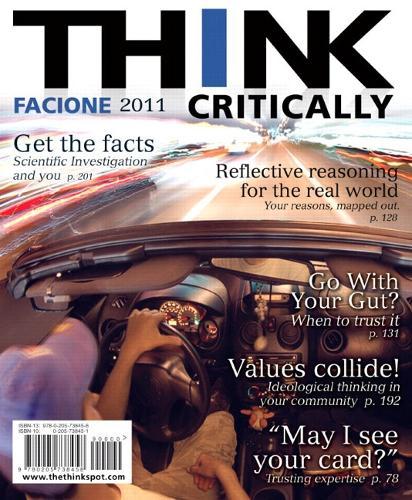
THINK Critically is a cutting-edge self-reflective guide for improving critical thinking skills through careful analysis, reasoned inference and thoughtful evaluation of contemporary culture and ideas. Taking cues from everyday life -- education, business, health sciences, social work, law, government policy issues and current events -- THINK Critically bridges the principles of critical thinking with real-world application. With a highly-visual design, accessible narrative, and interactive approach, THINK Critically strengthens students’ skills and motivation to make reasoned judgments. This text introduces critical thinking by showcasing what vital and central positive habits of mind are, revisiting and building upon those skills throughout the text. Jam-packed with engaging examples and masterful exercises, THINK Critically explains how to clarify ideas, analyze arguments, and evaluate inductive, deductive, comparative, ideological and empirical reasoning.
Full Product Details
Author: Peter Facione
Publisher: Pearson Education (US)
Imprint: Pearson
Dimensions:
Width: 22.90cm
, Height: 1.00cm
, Length: 27.60cm
Weight: 0.522kg
ISBN: 9780205738458
ISBN 10: 0205738451
Pages: 264
Publication Date: 21 May 2010
Audience:
Professional and scholarly
,
Professional & Vocational
Replaced By: 9780205490981
Format: Paperback
Publisher's Status: Out of Print
Availability: Out of stock 
Table of Contents
Chapter 1: Purposeful, Reflective Judgment Risk and Uncertainty Abound Critical Thinking and a Free Society The One and the Many What Do We Mean by “Critical Thinking”? Expert Consensus Conceptualization “Critical Thinking” Does Not Mean “Negative Thinking” How to Get the Most Out of This Book Evaluating Critical Thinking The Students’ Assignment The Students’ Statements The Holistic Critical Thinking Scoring Rubric Chapter 2: The “Able” in “Willing and Able” to Think Critically Core Critical Thinking Skills Interpreting and Analyzing the Consensus Statement The Jury Is Deliberating Critical Thinking Skills Fire In Many Combinations Strengthening Our Core Critical Thinking Skills The Art of the Good Question Skills and Subskills Defined Inductive and Deductive Reasoning Nurses’ Health Study - Decades of Data Inductive Reasoning Cosmos vs. Chaos Deductive Reasoning Chapter 3: The “Willing” in “Willing and Able” to Think Critically A Group Engaged in Crisis-Level Critical Thinking The Spirit of a Strong Critical Thinker Positive and Negative Habits of Mind Preliminary Self-Assessment Research on the Disposition toward Critical Thinking Seven Positive Critical Thinking Habits of Mind Negative Habits of Mind Is a Good Critical Thinker Automatically a Good Person? Building Positive Habits of Mind Reconnecting Skills and Dispositions Chapter 4: Clarifying Ideas Interpretation, Context, and Purpose How Precise Is Precise Enough? Language and Thought Vagueness: “Does the Term Include This Case or Not?” Problematic Vagueness Ambiguity: “Does the Term Mean This, or Does It Mean That?” Problematic Ambiguity Resolving Problematic Vagueness and Ambiguity Contextualizing Clarifying Original Intent Negotiating the Meaning Using Qualifications, Exceptions, or Exclusions Stipulating the Meaning Your Language Communities National and Global Language Communities Language Communities Formed of People with Like Interests Academic Disciplines as Language Communities Critical Thinking and College Introductory Courses Chapter 5: Using Maps to Analyze Arguments and Decisions Analyzing and Mapping Arguments “Argument = (Reason + Claim)” Two Reasons, Two Arguments Two Confusions to Avoid “Reason” and “Premise” Distinguishing Reasons from Conclusion Mapping Claims and Reasons Mapping a Line of Reasoning Mapping Implicit Ideas Interpreting Unspoken Reasons and Claims in Context Interpreting the Use of Irony, Humor, Sarcasm, and More Giving Reasons and Making Arguments in Real Life The El Train Argument from Twelve Angry Men Huckabee and Stewart Discuss “The Pro-Life Issue — Abortion” Analyzing and Mapping Decisions “We Should Cancel the Spring Trip” #1 “We Should Cancel the Spring Trip” #2 Chapter 6: Evaluating Claims Assessing the Source — Whom Should I Trust? Claims Without Reasons Cognitive Development and Healthy Skepticism Authority and Expertise Learned and Experienced On-Topic, Up-to-Date, and Capable of Explaining Unbiased and Truthful Free of Conflicts of Interest, and Acting in the Client’s Interest Unconstrained, Informed, and Mentally Stable Assessing the Substance — What Should I Believe? Donkey Dung Detector Marketing, Spin, Disinformation, and Propaganda Slanted Language and Loaded Expressions Independent Verification Can the Claim Be Confirmed? Can the Claim Be Disconfirmed? Independent Investigation and the Q-Ray Bracelet Case Suspending Judgment Chapter 7: Evaluating Arguments Giving Reasons and Making Arguments Truthfulness Logical Strength Relevance Non-Circularity The Four Tests for Evaluating Arguments Test #1: Truthfulness of the Premises Test #2: Logical Strength Test #3: Relevance Test #4: Non-Circularity Contexts for Argument Making and Evaluative Terms Common Reasoning Errors Fallacies of Relevance Appeals to Ignorance Appeals to the Mob Appeals to Emotion Ad Hominem Attacks Straw Man Fallacy Playing with Words Misuse of Authority Chapter 8: Evaluating Deductive and Inductive Reasoning Deductive Validity and Language Reasoning Deductively about Declarative Statements Denying the Consequent Affirming the Antecedent Disjunctive Syllogism Reasoning Deductively about Classes of Objects Applying a Generalization Applying an Exception The Power of “Only” Reasoning Deductively about Relationships Transitivity, Reflexivity, and Identity Fallacies Masquerading as Valid Deductive Arguments Affirming the Consequent Denying the Antecedent False Classification Fallacies of Composition and Division False Reference Inductions and the Evidence at Hand Evaluating Generalizations Was the correct group sampled? Were the data obtained in an effective way? Were enough cases considered? Was the sample representatively structured? Coincidences, Correlations, and Causes Coincidences Correlations Causes Fallacies Masquerading as Strong Inductive Arguments Erroneous Generalization Playing with Numbers False Dilemma The Gambler’s Fallacy False Cause Slippery Slope Chapter 9: Snap Judgments — Heuristic Thinking Human Decision-Making Systems The “Two-Systems” Approach to Human Decision Making Reactive (System-1) Thinking Reflective (System-2) Thinking The Value of Each System Heuristics: Their Benefits and Risks Individual Cognitive Heuristics 1. Satisficing and 2. Temporizing 3. Affect: “Go with your Gut” 4. Simulation 5. Availability 6. Representation 7. Association 8. Stereotyping 9. “Us vs. Them” 10. Power Differential 11. Anchoring with Adjustment 12. Illusion of Control 13. Optimistic Bias and 14. Hindsight Bias 15. Elimination by Aspect: “One Strike and You’re Out” 16. Loss and Risk Aversion 17. “All-or-Nothing” Heuristics in Action Chapter 10: Deciding What to Do and Doing It Dominance Structuring: A Fortress of Conviction “I Would Definitely Go to the Doctor” Explaining and Defending Ourselves A Poorly Crafted Assignment Moving from Decision to Action Phase 1: Pre-editing Phase 2: Identifying One Promising Option Phase 3: Testing the Promising Option Phase 4: Fortifying the To-Be-Chosen Option Benefits and Risks of Dominance Structuring O.J. Simpson’s Vigorous Defense Self-Regulation Critical Thinking Skill Strategies Critical Thinking Precautions when Pre-editing Be Sure About “the Problem” Specify the Decision-Critical Attributes Be Clear about Why an Option Is In or Out Critical Thinking Precautions When Identifying the Promising Option Scrutinize Options with Disciplined Impartiality Listen to Both Sides First Critical Thinking Precautions when Testing the Promising Option Use All the Essential Criteria Treat Equals as Equals Diligently Engage in Truth-Seeking and Remain Impartial Critical Thinking Precautions when Fortifying the To-Be-Chosen Option Be Honest with Yourself Critical Thinking Strategies for Better Decision Making Task Independent Teams with the Same Problem Decide When It’s Time to Decide Analyze Indicators and Make Mid-Course Corrections Create a Culture of Respect for Critical Thinking Chapter 11: Comparative Reasoning — “This is Like That” Thinking Comparative, Ideological, and Empirical Inferences “This is Like That” — Recognizing Comparative Reasoning Evaluating Comparative Inferences Do the Four Tests of Acceptability Apply? Five Criteria for Evaluating Comparative Reasoning Familiarity Simplicity Comprehensiveness Productivity Testability Shaping our View of the Universe for Two Thousand Years The Many Uses of Comparative Inferences Chapter 12: Ideological Reasoning — “Top Down” Thinking “Top Down” Thinking — Recognizing Ideological Reasoning Examples of Ideological Reasoning Three Features of Ideological Reasoning Ideological Reasoning Is Deductive in Character Ideological Premises Are Axiomatic The Argument Maker Takes the Ideological Absolutes on Faith Evaluating Ideological Reasoning Are the Ideological Premises True? Logical Strength and Ideological Belief Systems Relevancy, Non-Circularity and Ideological Reasoning Uses, Benefits and Risks of Ideological Reasoning Chapter 13: Empirical Reasoning — “Bottom — Up” Thinking Recognizing Empirical Reasoning Characteristics of Empirical Reasoning Empirical Reasoning Is Inductive Empirical Reasoning Is Self-Corrective Empirical Reasoning Is Open to Independent Verification Hypotheses, Conditions and Measurable Manifestations Conducting an Investigation Scientifically Perhaps the First Recorded Empirical Investigation Steps in the Process an Extended Example Evaluating Empirical Reasoning Benefits and Risks Associated with Empirical Reasoning
Reviews
I have enjoyed watching this book progress from the first chapter to the last, and I honestly cannot wait to teach it. I am proud to have been a part of it (though of course in my very little way). I had the experience of reading precisely the sort of text I would like to write. --John Gibson, University of Louisville Excellent. I was pleased to see the book conclude with a nice, meaty discussion of empirical reasoning that will help students understand how to apply the lessons of CT to material they will encounter in courses in the hard and soft sciences. --John Gibson, University of Louisville One of the greatest strengths of this text is the author's emphasis throughout the text on critical thinking in real life, supported by thoughtful, engaging examples and exercises from real life situations. --Anne Glauser, University of Georgia Other texts just discuss inductive reasoning. Approaching it by way of empirical reasoning makes the discussion seem smarter and newer (or at least: less tired and boring) --John Gibson, University of Louisville I can not think of a better presentation on the steps involved in logically and systematically investigating an empirical question. Students will learn how to recognize empirical reasoning, explore the necessary steps involved in conducting an investigation scientifically, and about the benefits and risks of empirical reasoning. --Anne Glauser, University of Georgia This chapter's streamlined and straightforward style is a help to comprehending the complexities of this topic and I think students might prefer it. --John Kimsey, DePaul University This is the best introduction to CT I have read. I especially liked the section on CT and the free society & and the absolutely necessary section on CT does NOT = Negative Thinking! It outdoes Moore and Parker, who are very good at this sort of thing. -John Gibson, University of Louisville This prose is much more readable and accessible than the text I am currently using. I am certain that my students would prefer this text. -Stephanie Semler, Radford University I use a developmental approach to teach critical thinking. The approach of the chapter is a good fit with my curriculum. I like the pragmatic approach coupled with all of the engaging, relevant examples that are scattered throughout the chapter. Students will enjoy reading about the recent legislation and debating whether or not the Kennedy National Service Act is a good idea. I address volunteerism in my course so I am pleased to see this information presented within this chapter. Chapter one offers a good introduction to the importance of developing critical thinking skills and the right disposition to make good judgments. -Ann Glauser, University of Georgia The strengths of this chapter are its simplicity, directness and emphasis on how critical thinking fits into everyday life and responsible citizenship. In my course I make the same points, particularly the one about responsible citizenship, and I also like to refer to current events and popular culture, so yes--the chapter would work with the way I design and structure my course. -John Kimsey, DePaul University It is informative, it gives a VERY good sense of the point of CT, and the material is germane yet light and witty. It manages to introduce substantive issues gently, and it gives the student the sense that course might actually be fun. - John Gibson, University of Louisville The chapter's style is more hip than that of my current text. I think my students would prefer this style. - John Kimsey, DePaul University Yes, the purpose of the chapter is to advance students' thinking. This chapter will accomplish this in an engaging, entertaining way. The students will have fun with Carlin's language. Students will be motivated to think more critically. The chapter offers a good, solid definition of critical thinking! the process of purposeful, self-regulatory judgment. I think that the rubric needs to be better explained so that students use it as effectively as possible to evaluate critical thinking. Through reading this chapter, students can learn how to better analyze others' ideas and how to monitor their own thinking. -Ann Glauser, University of Georgia Compared to the comparable section in my current book, this chapter is much more attuned to political issues of the day and much more emphatic about the connection between CT, citizenship and achieving a functional democracy. - John Kimsey, DePaul University The approach of the chapter is a good fit with my curriculum. The chapter provides a good overall introduction into specific critical thinking skills. Students and instructors will appreciate the way critical thinking skills have been broken down into six basic thinking skills (interpretation, analysis, inference, evaluation, explanation, and self-regulation). -Ann Glauser, University of Georgia Information about inductive and deductive reasoning that appears on pages 10 and 11 presents the best definitions that I have seen in texts on critical thinking. Students will no longer confuse the two concepts after reading about them. -Ann Glauser, University of Georgia The text I use does not contain this material (a treatment of CR from the standpoint of habits of mind). It is a welcome addition to what is currently available. I think students will appreciate it. -John Gibson, University of Louisville I especially like the way the author manages to cover many of the topics traditionally covered in a chapter on definitions & vagueness & ambiguity without using jargon. A traditional text would ask students to memorize the meanings of terms like stipulative definition, rhetorical definition, precising definition, and so on. This text introduces these concepts through a discussion of examples of how these sorts of definitions might be necessary in ordinary life. I think this will be much more accessible to students than the usual way of introducing these concepts, which leads (in my experience) to students obsessing about getting the definitions of the concepts exactly right and failing to see how the concepts apply in real life situations. I also like that the chapter focuses on real-life cases of ambiguity, not the contrived sorts of examples of ambiguity that one typically finds in textbooks but never in real life (headlines like Child's Stool Useful in Garden ). Also, this chapter does an excellent job of showing that vagueness and ambiguity are not always problematic. I have encountered many students who, having learned about vagueness & ambiguity, start to see vagueness everywhere -- and think that it is always problematic. It would be very helpful to have a textbook which points out the importance of context, as this one does. -Deborah Boyle, College of Charleston The text continuously provides creative, relevant examples that fortify the concepts being taught and emphasize critical thinking in real life situations. Students often do not see the relevance of some of the courses they need to take in the core curriculum. Students will find that relevance in a course using this text because the text takes such a pragmatic approach to building positive habits of the mind. This chapter continues with the idea put forth in chapter 3 that critical thinking skills need to be exercised to become stronger like any other skill. -Ann Glauser, University of Georgia The emphasis on everyday reasoning as well as on structured analysis of discourse fits with my approach. I also like to reference current events and examples from popular culture and again the chapter is in line with this approach. -John Kimsey, DePaul University Yes. I like the multimedia approach (i.e., the use of video clips, pictures, and comics). Throughout the chapter students will enjoy learning about critical thinking from multimedia presentations (i.e., clips from The Daily Show and Law and Order) and wonderful, relevant examples from a student deciding about enrolling in ROTC to the High Sierra Hikers planning their camping trip. -Ann Glauser, University of Georgia The chapter contains numerous concrete examples and this is a strength because it helps ground the abstract concepts in reader-friendly specifics. -John Kimsey, DePaul Unversity I think that the approach is useful and compelling. Students will be engaged with the concrete examples that the chapter begins with. I also like the methodic outlay of ideas in the chapter -Stephanie Semler, Radford University The material strengthens the overall engaging approach to helping students develop strong critical thinking habits. Students are given opportunities through the exercise to learn how to give strong explanations for why something is or is no. On page eight, the discussion on the processes of reflecting, analyticity, inquisitiveness, self-monitoring, and self-correcting is well placed, adding continuity to the chapters. -Ann Glauser, University of Georgia The scope and sequence are right. I love the way the chapter starts off with such a focused, intense example (Morris Dees and Selma Goncalves). Beginning with the first sentence, students are introduced to the notion of how important it is to evaluate any claims being made and assess credibility of the source. The continued use of video clips offers great continuity between the chapters. The summary of the chapter as well as the next steps is helpful in organizing the material covered and preparing for the future readings. -Ann Glauser, University of Georgia Yes, it is precisely what I am looking for. Every concept and idea is well taught. I believe that students are often quite reluctant to learning about these two major forms of arguments (inductive and deductive) and the fallacies associated with them. This chapter does an excellent job of presenting the material clearly, reinforcing all the concepts throughout the chapter with well placed, creative exercises, and reiterating important ideas associated with critical thinking (i.e., the four qualities of an acceptable argument so that students can understand and implement them in their own thinking and the four questions that need to be asked to discover if a sampling is adequate to support probabilistic inferences that have been drawn). -Ann Glauser, University of Georgia Excellent. Again I appreciate how the author goes back to important concepts and takes the time to communicate them using a different format (i.e., exercises, diagrams, and summaries) to reinforce student learning. This material would be difficult for some students to master without the logical way in which the information is organized. -Ann Glauser, University of Georgia Extremely original and helpful approach. Calling these kinds of reasoning (snap judgements) as heuristic devices instead of fallacies is very smart (many of things Moore and Parker call fallacies are, in the appropriate context, not really mistakes in reasoning). This is a much better way to get at the same thing. -John Gibson, University of Louisville This chapter would work with the way I design my course, yes. It's a particularly interesting and fun chapter and it's significant because cognitive heuristics is an important topic and one that's not covered in many Critical Thinking texts. -John Kimsey, DePaul University The organization is exceptional. I can't recommend any improvements. -Michael Monge, Long Beach City College It is ahead of the pack!it represents a significant improvement over Moore and Parker. This is much better and much more original. Students will love it. -John Gibson, University of Louisville Not only would it work, but it would enhance my curriculum. This is an excellent chapter that could stand alone as a guide for anyone who is faced with the process of selecting the best option among a variety of choices. The information in this chapter related to dominance structuring was a reminder to me to be more aware of my decision making processes and those of my colleagues during the next search committee .I think that many of us forget how the process of dominance structuring can unknowingly wedge us into making bad decisions. We all need to avoid the dominant structure around just one option. This chapter may need to be required reading for all committee members. Excellent information about the continued need for self-regulation and the search for truth for students and everyone else. -Ann Glauser, University of Georgia Yes, the author is gifted in doing this [creating exercises]. Instructors will use all of the exercises. -Ann Glauser, University of Georgia Through the use of creative and thoughtful exercises, students are guided through a series of well synthesized informative sections on comparative reasoning. Exercises and examples are placed appropriately throughout the chapter. Having this chapter presented along with chapters 12 on ideological inferences and chapter 13 on empirical inferences makes good sense and brings continuity to these basic reasoning patterns. -Ann Glauser, University of Georgia This is NOTHING like this in the other books. Now that one sees it (= a focused discussion of 'ideological' reasoning), it seems so obvious. But I think it is entirely novel. At any rate, I am excited to try it out in the classroom. I will definitely use this text when it comes out. -John Gibson, University of Louisville Yes. The chapter covers everything that I would cover in my course and then some. Information within the text thoroughly covers how empirical reasoning is used to explain, predict or control what happens, and how accurate predictions enable us to anticipate what is likely to happen under certain conditions. I like how the author emphasizes within this chapter and throughout the text the importance of communicating our ideas and explanations. -Ann Glauser, University of Georgia
"I have enjoyed watching this book progress from the first chapter to the last, and I honestly cannot wait to teach it. I am proud to have been a part of it (though of course in my very little way). I had the experience of reading precisely the sort of text I would like to write. --John Gibson, University of Louisville Excellent. I was pleased to see the book conclude with a nice, meaty discussion of empirical reasoning that will help students understand how to apply the lessons of CT to material they will encounter in courses in the hard and soft sciences. --John Gibson, University of Louisville One of the greatest strengths of this text is the author’s emphasis throughout the text on critical thinking in real life, supported by thoughtful, engaging examples and exercises from real life situations. --Anne Glauser, University of Georgia Other texts just discuss inductive reasoning. Approaching it by way of empirical reasoning makes the discussion seem smarter and newer (or at least: less tired and boring) --John Gibson, University of Louisville I can not think of a better presentation on the steps involved in logically and systematically investigating an empirical question. Students will learn how to recognize empirical reasoning, explore the necessary steps involved in conducting an investigation scientifically, and about the benefits and risks of empirical reasoning. --Anne Glauser, University of Georgia This chapter's streamlined and straightforward style is a help to comprehending the complexities of this topic and I think students might prefer it. --John Kimsey, DePaul University This is the best introduction to CT I have read. I especially liked the section on CT and the free society & and the absolutely necessary section on CT does NOT = Negative Thinking… It outdoes Moore and Parker, who are very good at this sort of thing. -John Gibson, University of Louisville This prose is much more readable and accessible than the text I am currently using. I am certain that my students would prefer this text. -Stephanie Semler, Radford University I use a developmental approach to teach critical thinking. The approach of the chapter is a good fit with my curriculum. I like the pragmatic approach coupled with all of the engaging, relevant examples that are scattered throughout the chapter. Students will enjoy reading about the recent legislation and debating whether or not the Kennedy National Service Act is a good idea. I address volunteerism in my course so I am pleased to see this information presented within this chapter. Chapter one offers a good introduction to the importance of developing critical thinking skills and the right disposition to make good judgments. -Ann Glauser, University of Georgia The strengths of this chapter are its simplicity, directness and emphasis on how critical thinking fits into everyday life and responsible citizenship. In my course I make the same points, particularly the one about responsible citizenship, and I also like to refer to current events and popular culture, so yes--the chapter would work with the way I design and structure my course. -John Kimsey, DePaul University It is informative, it gives a VERY good sense of the point of CT, and the material is germane yet light and witty. It manages to introduce substantive issues gently, and it gives the student the sense that course might actually be fun. - John Gibson, University of Louisville The chapter's style is more hip than that of my current text. I think my students would prefer this style. - John Kimsey, DePaul University Yes, the purpose of the chapter is to advance students’ thinking. This chapter will accomplish this in an engaging, entertaining way. The students will have fun with Carlin’s language. Students will be motivated to think more critically. The chapter offers a good, solid definition of critical thinking…”the process of purposeful, self-regulatory judgment.” I think that the rubric needs to be better explained so that students use it as effectively as possible to evaluate critical thinking. Through reading this chapter, students can learn how to better analyze others’ ideas and how to monitor their own thinking. -Ann Glauser, University of Georgia Compared to the comparable section in my current book, this chapter is much more attuned to political issues of the day and much more emphatic about the connection between CT, citizenship and achieving a functional democracy. - John Kimsey, DePaul University The approach of the chapter is a good fit with my curriculum. The chapter provides a good overall introduction into specific critical thinking skills. Students and instructors will appreciate the way critical thinking skills have been broken down into six basic thinking skills (interpretation, analysis, inference, evaluation, explanation, and self-regulation). -Ann Glauser, University of Georgia “Information about inductive and deductive reasoning that appears on pages 10 and 11 presents the best definitions that I have seen in texts on critical thinking. Students will no longer confuse the two concepts after reading about them.” -Ann Glauser, University of Georgia The text I use does not contain this material (a treatment of CR from the standpoint of habits of mind). It is a welcome addition to what is currently available. I think students will appreciate it. -John Gibson, University of Louisville I especially like the way the author manages to cover many of the topics traditionally covered in a chapter on definitions & vagueness & ambiguity without using jargon. A traditional text would ask students to memorize the meanings of terms like ""stipulative definition,"" ""rhetorical definition,"" ""precising definition,"" and so on. This text introduces these concepts through a discussion of examples of how these sorts of definitions might be necessary in ordinary life. I think this will be much more accessible to students than the usual way of introducing these concepts, which leads (in my experience) to students obsessing about getting the definitions of the concepts exactly right and failing to see how the concepts apply in real life situations. I also like that the chapter focuses on real-life cases of ambiguity, not the contrived sorts of examples of ambiguity that one typically finds in textbooks but never in real life (headlines like ""Child's Stool Useful in Garden""). Also, this chapter does an excellent job of showing that vagueness and ambiguity are not always problematic. I have encountered many students who, having learned about vagueness & ambiguity, start to see vagueness everywhere -- and think that it is always problematic. It would be very helpful to have a textbook which points out the importance of context, as this one does. -Deborah Boyle, College of Charleston The text continuously provides creative, relevant examples that fortify the concepts being taught and emphasize critical thinking in real life situations. Students often do not see the relevance of some of the courses they need to take in the core curriculum. Students will find that relevance in a course using this text because the text takes such a pragmatic approach to building positive habits of the mind. This chapter continues with the idea put forth in chapter 3 that critical thinking skills need to be exercised to become stronger like any other skill. -Ann Glauser, University of Georgia The emphasis on everyday reasoning as well as on structured analysis of discourse fits with my approach. I also like to reference current events and examples from popular culture and again the chapter is in line with this approach. -John Kimsey, DePaul University Yes. I like the multimedia approach (i.e., the use of video clips, pictures, and comics). Throughout the chapter students will enjoy learning about critical thinking from multimedia presentations (i.e., clips from The Daily Show and Law and Order) and wonderful, relevant examples from a student deciding about enrolling in ROTC to the High Sierra Hikers planning their camping trip. -Ann Glauser, University of Georgia The chapter contains numerous concrete examples and this is a strength because it helps ground the abstract concepts in reader-friendly specifics. -John Kimsey, DePaul Unversity I think that the approach is useful and compelling. Students will be engaged with the concrete examples that the chapter begins with. I also like the methodic outlay of ideas in the chapter -Stephanie Semler, Radford University The material strengthens the overall engaging approach to helping students develop strong critical thinking habits. Students are given opportunities through the exercise to learn how to give strong explanations for why something is or is no. On page eight, the discussion on the processes of reflecting, analyticity, inquisitiveness, self-monitoring, and self-correcting is well placed, adding continuity to the chapters. -Ann Glauser, University of Georgia The scope and sequence are right. I love the way the chapter starts off with such a focused, intense example (Morris Dees and Selma Goncalves). Beginning with the first sentence, students are introduced to the notion of how important it is to evaluate any claims being made and assess credibility of the source. The continued use of video clips offers great continuity between the chapters. The summary of the chapter as well as the next steps is helpful in organizing the material covered and preparing for the future readings. -Ann Glauser, University of Georgia Yes, it is precisely what I am looking for. Every concept and idea is well taught. I believe that students are often quite reluctant to learning about these two major forms of arguments (inductive and deductive) and the fallacies associated with them. This chapter does an excellent job of presenting the material clearly, reinforcing all the concepts throughout the chapter with well placed, creative exercises, and reiterating important ideas associated with critical thinking (i.e., the four qualities of an acceptable argument so that students can understand and implement them in their own thinking and the four questions that need to be asked to discover if a sampling is adequate to support probabilistic inferences that have been drawn). -Ann Glauser, University of Georgia Excellent. Again I appreciate how the author goes back to important concepts and takes the time to communicate them using a different format (i.e., exercises, diagrams, and summaries) to reinforce student learning. This material would be difficult for some students to master without the logical way in which the information is organized. -Ann Glauser, University of Georgia Extremely original and helpful approach. Calling these kinds of reasoning (snap judgements) as heuristic devices instead of fallacies is very smart (many of things Moore and Parker call fallacies are, in the appropriate context, not really mistakes in reasoning). This is a much better way to get at the same thing. -John Gibson, University of Louisville This chapter would work with the way I design my course, yes. It's a particularly interesting and fun chapter and it's significant because cognitive heuristics is an important topic and one that's not covered in many Critical Thinking texts. -John Kimsey, DePaul University The organization is exceptional. I can't recommend any improvements. -Michael Monge, Long Beach City College It is ahead of the pack…it represents a significant improvement over Moore and Parker. This is much better and much more original. Students will love it. -John Gibson, University of Louisville Not only would it work, but it would enhance my curriculum. This is an excellent chapter that could stand alone as a guide for anyone who is faced with the process of selecting the best option among a variety of choices. The information in this chapter related to dominance structuring was a reminder to me to be more aware of my decision making processes and those of my colleagues during the next search committee .I think that many of us forget how the process of dominance structuring can unknowingly wedge us into making bad decisions. We all need to avoid the dominant structure around just one option. This chapter may need to be required reading for all committee members. Excellent information about the continued need for self-regulation and the search for truth for students and everyone else. -Ann Glauser, University of Georgia Yes, the author is gifted in doing this [creating exercises]. Instructors will use all of the exercises. -Ann Glauser, University of Georgia Through the use of creative and thoughtful exercises, students are guided through a series of well synthesized informative sections on comparative reasoning. Exercises and examples are placed appropriately throughout the chapter. Having this chapter presented along with chapters 12 on ideological inferences and chapter 13 on empirical inferences makes good sense and brings continuity to these basic reasoning patterns. -Ann Glauser, University of Georgia This is NOTHING like this in the other books. Now that one sees it (= a focused discussion of 'ideological' reasoning), it seems so obvious. But I think it is entirely novel. At any rate, I am excited to try it out in the classroom. I will definitely use this text when it comes out. -John Gibson, University of Louisville Yes. The chapter covers everything that I would cover in my course and then some. Information within the text thoroughly covers how empirical reasoning is used to explain, predict or control what happens, and how accurate predictions enable us to anticipate what is likely to happen under certain conditions. I like how the author emphasizes within this chapter and throughout the text the importance of communicating our ideas and explanations. -Ann Glauser, University of Georgia"
Author Information
In This Section: I. Author Bio II. Author Letter I. Author Bio Peter Facione, PhD, wants to help everyone build up their critical thinking skills, for their own sakes, and for the sake of our freedom and democracy. Facione draws on decades of experience as a teacher, consultant, business entrepreneur, university dean, grandfather, husband, and avid “old school” pickup basketball player. Now he is taking his message about the importance of critical thinking directly to students. For improving reasoning skills for use in one’s personal, professional, and civic life, there may never before have been a more practical, enjoyable, important, comprehensive, and engaging text than this. “I’ve paid very close attention to the way people make decisions since I was 13 years old,” says Facione. “Some people were good at solving problems and making decisions; others were not. I have always felt driven to figure out how to tell which were which.” He says that this led him as an undergraduate and later as a professor to study psychology, philosophy, logic, statistics, and information systems as he searched for how our beliefs, values, thinking skills, and habits of mind connect with the decisions we make, particularly in contexts of risk and uncertainty. “As a teacher and as a college administrator, I focused on problem-solving and decision-making strategies so that I could be a more effective teacher and a more capable leader. I found it was always valuable when working with groups or individuals to be mindful of how they applied their cognitive skills and habits of mind to solve a problem, make a decision, or troubleshoot a situation. Careful analysis and open-minded truth seeking always worked better than any other way of approaching problems.” A native Midwesterner, Facione earned his PhD in philosophy from Michigan State University and his BA in philosophy from Sacred Heart College in Detroit. He says, “Critical thinking has helped me be a better parent, citizen, manager, teacher, writer, and friend. It even helps a little when playing point guard!” In academia, Facione served as provost of Loyola University—Chicago, dean of the College of Arts and Sciences at Santa Clara University, and dean of the School of Human Development and Community Service at California State University—Fullerton. “As a dean and provost, I could easily see that critical thinking was alive and well in every professional field and academic discipline.” “I’ve focused my research on the teaching and measurement of critical thinking since my earliest years as a faculty member in the 1960s and 1970s. But before you can measure something that crosses into every aspect of life, you have to be sure that you understand what it is. So in the 1980s, I first had to see whether there was a consensus among experts about the term critical thinking. After two years of research, a solid consensus emerged. That plus all the stats and behavioral science research I had studied and taught for years enabled me and my research team, during the 1990s, to design and validate tools to assess critical thinking skills and habits of mind. In the first decade of this century, our team has explored the connections between critical thinking and human decision making in its broadest sense.” In fact, Facione spearheaded the international study to define critical thinking, sponsored by the American Philosophical Association. His research formed the basis for numerous government policy studies about critical thinking in the workplace, including research sponsored by the U.S. Department of Education. Today, his tools for assessing reasoning are used around the world in educational, business, legal, military, and health sciences. Today, Peter operates his own business, Measured Reasons. He is a speaker, writer, workshop presenter, and consultant for organizations large and small. His work focuses on strategic planning and leadership decision making, in addition to teaching and assessing critical thinking. With his wife, who is also his closest research colleague and coauthor of many books and assessment tools, he now lives in sunny Los Angeles, which suits him just fine. He welcomes questions from students and instructors–you can reach him at pfacione@measuredreasons.com. II. Author Letter Dear Colleague, Please forgive this intrusion, but I wanted to offer you some personal thoughts about why this book Think Critically , is for me, rather special. Think Critically incorporates lessons learned over a 40+ year career devoted to teaching, measuring, researching and advocating for greater attention to critical thinking. As you may know, in addition to my own work with college students, I’ve authored critical thinking tests, written widely used essays about critical thinking, and presented hundreds of workshops and presentations to community college, four-year college, and university faculty on teaching for and about critical thinking. Why all this effort and attention devoted to critical thinking? Because in my view there may be no more valuable thing that one can gain through a college education than learning to solve problems effectively and to make well informed and well reasoned decisions. And for this we need strong critical thinking skills and positive critical thinking habits of mind. When Pearson Education invited me to write Think Critically, it was a joy, an honor, and, I soon realized, an awesome responsibility. The book had to be accessible to students from a very wide variety of educational and social backgrounds, and, at the same time it had pass muster with faculty from many different disciplines. The book had to be practical and enjoyable, and yet based on solid conceptual foundations and proven pedagogical principles. The book had to address the topics that faculty from the widest possible spectrum of academic divisions would expect to find and do so in a way that was intellectually in harmony with the other courses those faculty might teach. And, above all, the book had to work! If using Think Critically did not lead to measurable gains in students' critical thinking, then the effort would have been for naught. At this point the reviews are in from faculty around the country. The demands were met. The book works. Students do improve in their critical thinking skills and, equally importantly, in their critical thinking habits of mind. Instructors from a host of different academic departments enjoy teaching with Think Critically. There are extra exercises, sample test questions, and many other learning support materials for students at the free online URL www.TheThinkSpot.com that have been contributed by several faculty from around the country. The Instructor’s Manual, written by Dr. Carol Gittens, offers teaching tips for every part of the book, creative alternative exercise ideas for every class session, and it includes a special section for faculty who may never before have offered a critical thinking course. How lucky we are, who teach for thinking, to have such an important part to play in our students' education! There can perhaps be no more valuable gift to our students than that we guide their development of stronger critical thinking skills and deeper positive critical thinking habits of mind. Truth-seeking, open-mindedness, judiciousness, intellectual integrity and inquisitiveness are habits for life, not just for their brief sojourns in college. The core critical thinking skills are the tools these habits impel them to use in order to make well-reasoned, reflective judgments whenever and wherever deciding what to believe or what to do. How could I hope for more than that our mutual efforts, yours as their professor and mentor, mine as the author of the text book, should bring about such wonderful and valuable learning? Please know that even if you decide to use some other textbook, we still share this common purpose - we teach for critical thinking. And if, as I hope, you select Think Critically, then please also know that I am only an email away (pfacione@measuredreasons.com). I would love to hear your comments about how the book is working for your students, suggestions you or they might have for improvements, or simply reactions to any of the over one hundred sets of exercises it contains. Seriously, write me any time about critical thinking - questions, concerns, whatever. This work we do is important. Pete Facione Measured Reasons
Tab Content 6
Author Website:
Countries Available
All regions
|