Overview
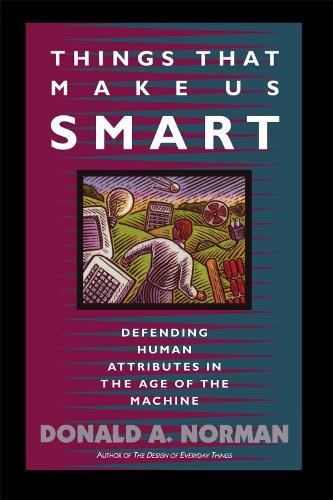
In Things That Make Us Smart, Donald A. Norman explores the complex interaction between human thought and the technology it creates, arguing for the development of machines that fit our minds, rather than minds that must conform to the machine. Humans have always worked with objects to extend our cognitive powers, from counting on our fingers to designing massive supercomputers. But advanced technology does more than merely assist with thought and memory, the machines we create begin to shape how we think and, at times, even what we value. Norman, in exploring this complex relationship between humans and machines, gives us the first steps towards demanding a person-centred redesign of the machines that surround our lives.
Full Product Details
Author: Don Norman ,
Don Norman ,
Tamara Dunaeff ,
Tamara Dunaeff
Publisher: INGRAM PUBLISHER SERVICES US
Imprint: Perseus Books
Dimensions:
Width: 23.20cm
, Height: 2.00cm
, Length: 15.70cm
Weight: 0.442kg
ISBN: 9780201626957
ISBN 10: 0201626950
Pages: 304
Publication Date: 21 April 1994
Audience:
College/higher education
,
Professional and scholarly
,
Undergraduate
,
Postgraduate, Research & Scholarly
Format: Paperback
Publisher's Status: Active
Availability: Awaiting stock

The supplier is currently out of stock of this item. It will be ordered for you and placed on backorder. Once it does come back in stock, we will ship it out for you.
Reviews
Cognitive psychologist Norman searches for humane technology and just plain user-friendliness in the paraphernalia and artifacts employed in everyday life. What he finds is that today we serve technology, though, of course, technology should serve us. Currently a thinker at Apple Computer (actually, an Apple Fellow ), Norman expands on his previous offerings (Turn Signals Are the Facial Expressions of Automobiles, 1992; The Psychology of Everyday Things, 1988, etc.) - and his current text, though more thoughtful, is just as user-friendly as his earlier works. Citing the appalling slogan of the 1933 Chicago World's Fair, Science Finds, Industry Applies, Man Conforms, the good Apple Fellow offers a new guiding principle: People Propose, Science Studies, Technology Conforms. Usage, he says - especially of computer software - follows design, but it doesn't have to be that way. With intelligences now darting though cyberspace, Norman can differentiate between the human and the artificial kind. Neither of them is the sole, true McCoy: They're just different, each with different innate abilities. People are better at language, the arts and emotions that make life worthwhile. Technology is better at such things as logic and mathematics, both invented artifices. Not new notions, certainly, but when was the last time you heard a technocrat say that our goal should be to develop human centered activities, to make...the task fit the person, not the other way round ? Norman's presentation is eminently accessible, with incidental insights into such matters as primitive office procedures, and why, for addition and subtraction, Roman numeration is superior to Arabic. As he notes, books are one form of technology. Television is another. It might be interesting to see if his message could survive a change of medium, perhaps to educational TV. Lots of things make us smart, Norman points out. His book could be one of them. (Kirkus Reviews)
Author Information
Donald A. Norman is Professor of Computer Science at Northwestern University, a former Apple Fellow,"" and a partner in the Nielsen Norman Group Consulting Firm, which consults with corporations on design. He is the author of a number of books on design, including Emotional Design and the best-selling The Design of Everyday Things. He lives in Northbrook, Illinois and Palo Alto, California.