|
|
|||
|
||||
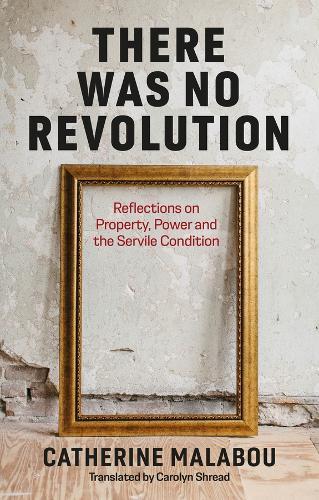
OverviewIn her new book, Catherine Malabou argues that the French Revolution existed in name only, not in reality – privileges disappeared only on the surface and the old forms of domination persisted in structuring everyday life. And, sure enough, French citizens soon came to ask: ""How is it that we are falling back into the same patterns of privilege and servitude?"" In developing this argument, Malabou echoes the conclusion drawn by Pierre-Joseph Proudhon, whose work, What is Property?, written in 1840, claimed that there was no revolution. Proudhon witnessed how, in the aftermath of the French Revolution, feudal relations persisted and monarchy was restored. He connected the persistence of feudalism and servitude to his critique of property. For Proudhon, property is but another name for domination: ""Property is theft,"" he famously declared; by which he meant that private property starts with a theft of memory and meaning that transforms continuous bondage into a promise of emancipation. This marks the specificity of the anarchist critique of property, and it led Proudhon to conclude ""I am an anarchist."" Malabou connects her re-reading of Proudhon's masterpiece with our own political situation today, more than two hundred years after the French Revolution. She examines how the enduring domination that is central to private property infiltrates various aspects of the modern world, from the legacies of colonialism and slavery to work and politics. This timely re-assessment of the relation between property and domination will be of interest to students of philosophy and politics, and to anyone concerned with today's key political questions. Full Product DetailsAuthor: Catherine Malabou (University of Paris-X Nanterre) , Carolyn ShreadPublisher: Polity Press Imprint: Polity Press ISBN: 9781509567577ISBN 10: 1509567577 Pages: 224 Publication Date: 27 March 2026 Audience: College/higher education , Professional and scholarly , Tertiary & Higher Education , Professional & Vocational Format: Paperback Publisher's Status: Forthcoming Availability: Awaiting stock Table of ContentsTranslator's Note 1. Aubaine right ""Property"" and ""private property"" Marx: defining property as theft presupposes the existence of property Theft as junction point Proudhon's skeleton key: aubaine right The modern meaning of aubaine The medieval meaning of aubaine On inheritance Changing lineages The finding The approach 2. Contemporary Critiques of Private Property: Commons, Colonial Dospossession, Revisiting Anarchism The neoliberal wall Is the age of access the end of the means of production? No change The commons Colonial dispossession Proudhon, yes-but no, not anarchism Back to Marx The ""oxymoron"" 3. ""Property is Impossible"" (Marx/Proudhon) Theft as performative act Ten propositions Marx: from praise to caricature Disregarding aubaine right From proportionality to disproportionality 4. The Aporias of Primitive Accumulation (Proudhon/Marx) Marx on theft Primitive accumulation and the long transition Kropotkin to Proudhon's rescue 5. Timelines of the French Revolution Continuities and blackouts An erasure saturated with memory The theft of something that never existed ""In their heart"" 6. Aubains, serfs and bastards: the taint of three tars The aubain's servitude ""Aubenage"", or the serf as aubain: mortmain Bastards are serfs and aubains Shipwreck right Tars and traces Physical mark, symbollic tar Two types of forfeiture From the outset 7. Outsiders and Insiders Extraterritoriality and marginality Sahlins' analysis of the invention of naturalization Totality and fragmentation Cerutti's study of the liminal state of property and the uncertainty of the disinherited vulnerability and weak belonging Belonging to no one at all 8. And yet... 9. The Impossible Demarcation The feudal property system ""Revolutionary"" property The challenges of the Great Demarcation: paying relief, abolishing The failure Proudhon's conclusions Powerful as the kingdom 10. On Neo-Feudalism Techno-feudalism Contemporary versions of aubaine right 11. Examining Self-Government: From ""commons"" to common The ""program"" Self-management versus self-government Some definitions Are Ostram and Proudhon fighting the same battle? From plural (commons) to singular (common) Best intentions Antipathy for the principle of authority Is community everything or nothing? 12. Servitudes: In the land of freedom The Edict of Louis X: ""There are no slaves in France"" On and off French soil The dual appropriation of Toussaint Louverture Unthought twice over Servitude, serfdom, slavery. Proudhon's ambivalence From slavery to servitude: the hesitation of historians The historians' cross to bear: relations between ancient slavery and serfdom Transatlantic slavery denial Cesaire the federalist Back to ""Theft is property!"" 13. Anarchies of the Revolution Anarchy as the internal debate of the Revolution Anarchy between Revolution and Republic Property Equality Separation of powers Sovereignty From invective to forming From forming to invective The difficulties of self-designation At the rish of going in circles Notes IndexReviews""In this brilliant and original study, Catherine Malabou extends her ongoing research into Pierre-Joseph Proudhon's critique of private property."" Justin Clemens, University of Melbourne Author InformationCatherine Malabou is Professor of Philosophy in the departments of Comparative Literature and European Languages and Studies at the University of California at Irvine. Tab Content 6Author Website:Countries AvailableAll regions |
||||