|
|
|||
|
||||
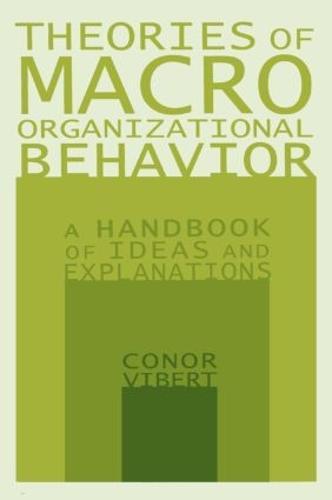
OverviewThis book provides a comprehensive summary of the major theories meant to explain the way business and other organizations work, why they look and act as they do, and what makes some succeed and others fail. Among the many different approaches to the subject, no one school of thought accurately reflects current thinking on these issues. The author presents a much-needed overview of thirty of the major theories that underpin Organization Theory and Economic Organization. Each theory is summarized in a stand-alone fashion, allowing each chapter to be used either in complement or as a separate perspective. Integration of the various topics and perspectives is accomplished within section introductions and in the overall introduction and conclusion to the text. The goal of this book is to inform students of the main issues confronting organizations, the main theoretical ideas within the different paradigms, why it is important to theorize about organizations, how these theories are constructed, and how learning is improved by scanning multiple perspectives. It can be used as a stand-alone uourse text or supplementary text for advanced undergraduate or graduate courses in Organization Theory. Full Product DetailsAuthor: Conor VibertPublisher: Taylor & Francis Ltd Imprint: Routledge Edition: New edition Dimensions: Width: 15.20cm , Height: 1.90cm , Length: 22.90cm Weight: 0.362kg ISBN: 9780765612953ISBN 10: 076561295 Pages: 240 Publication Date: 31 March 2004 Audience: College/higher education , Professional and scholarly , College/higher education , Tertiary & Higher Education , Professional & Vocational Format: Paperback Publisher's Status: Active Availability: In Print This item will be ordered in for you from one of our suppliers. Upon receipt, we will promptly dispatch it out to you. For in store availability, please contact us. Table of ContentsAcknowledgments; 1. Introduction; 2. A Primer on Organization Theory with Deborah Hurst; Part 1. Function Economic Theories of the Firm; 3. Neo-Classical Economics Perspective; 4. Chicago School Perspective; 5. Bain-Mason Perspective; 6. Transaction Cost Perspective; 7. Network Perspective; 8. Agency Perspective; 9. Stakeholder Perspective; 10. Resource Based Theory Perspective; 11. Behavioral Perspective; 12. Game Theory Perspective; 13. Property Right Perspective; 14. Knowledge Perspective; 15. Evolutionary Perspective; 16. Natural Environment Perspective Greg Berry; Part 2. Functional Organization Theories; 17. Bureaucracy Perspective; 18. Contingency Perspective; 19. Strategic Choice Perspective; 20. Resource Dependence Perspective; 21. Population Ecology Perspective; 22. Institutional PerspectiveReviewsAuthor InformationConor Vibert Tab Content 6Author Website:Countries AvailableAll regions |
||||