|
|
|||
|
||||
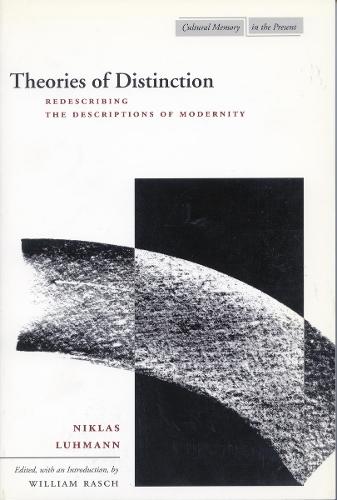
OverviewThe essays in this volume formulate what is considered to be the preconditions for an adequate theory of modern society. The first two essays deal with the modern European philosophical and scientific tradition. The next four essays concern the notion of observation as defined by Luhmann. They examine the history of paradox as a logical problem and as a historically conditioned feature of rhetoric; deconstruct the thinking of Jacques Derrida; discuss the usefulness of Spencer Brown's Laws of Form; and assess the consequences of observation and paradox for epistemology. The following essays present Luhmann's theory of communication and his articulation of the difference between thought and communication, a difference that makes clear one of Luhmann's most radical and controversial theses, that the individual not only does not form the basic element of society but is excluded from it altogether, situated instead in the environment of the social system. Full Product DetailsAuthor: Niklas Luhmann , William Rasch , Elliott Schreiber , Kerstin BehnkePublisher: Stanford University Press Imprint: Stanford University Press Edition: New edition Dimensions: Width: 15.20cm , Height: 1.50cm , Length: 22.90cm Weight: 0.327kg ISBN: 9780804741231ISBN 10: 0804741239 Pages: 240 Publication Date: 25 February 2002 Audience: College/higher education , Professional and scholarly , Undergraduate , Postgraduate, Research & Scholarly Format: Paperback Publisher's Status: Active Availability: In Print This item will be ordered in for you from one of our suppliers. Upon receipt, we will promptly dispatch it out to you. For in store availability, please contact us. Table of ContentsContents Rasch William PART I. 1. 2. PART II. 3. 4. 5. 6. PART III. 7. 8. PART IV. 9.Reviews'Niklas Luhmann's thought has become more and more influential internationally as one of the very rare examples of the ability of social theory to enlarge its theoretical resources and thereby gain a new grasp of significant empirical phenomena. This book presents Luhmann as a thinker who advances existing difference theories by combining them with system theory. This is very important, because, in my view, difference theories are the core of postmodern thinking and perhaps the only element of it that will survive.' Dirk Baecker, University of Witten/Herdecke Author InformationNiklas Luhmann was Professor Emeritus of Sociology at the University of Bielefeld. Stanford has published five other of his books, most recently The Reality of the Mass Media (2000) Tab Content 6Author Website:Countries AvailableAll regions |
||||