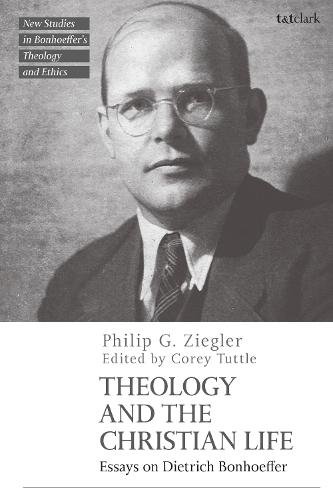
Full Product Details
Author: Professor Philip G. Ziegler (University of Aberdeen, UK) ,
Corey Tuttle (University of Aberdeen, UK)
Publisher: Bloomsbury Publishing PLC
Imprint: T.& T.Clark Ltd
Dimensions:
Width: 16.20cm
, Height: 2.00cm
, Length: 23.60cm
Weight: 0.560kg
ISBN: 9780567693099
ISBN 10: 0567693090
Pages: 264
Publication Date: 16 April 2026
Audience:
College/higher education
,
Postgraduate, Research & Scholarly
Format: Hardback
Publisher's Status: Active
Availability: Manufactured on demand

We will order this item for you from a manufactured on demand supplier.
Reviews
At a time when conflicting portraits of Bonhoeffer abound, also in popular culture, Ziegler’s excellent book attests to the gains when one keeps the focus not only on Bonhoeffer as a pastor, saint, martyr, or conspirator, but indeed interpret him as a Christian theologian––and, more particularly, a theologian of the Word of God. Readers will find in this collection of essays a sure-footed, fully-fledged, and deeply informed portrayal of Bonhoeffer’s theological context and vision. A highly original and coherent contribution to Bonhoeffer scholarship that leaves no doubt why a theologically mature engagement with Bonhoeffer the theologian matters! * Robert Vosloo, University of Stellenbosch, South Africa * In these 16 essays on Dietrich Bonhoeffer, Ziegler seeks to ensure that Bonhoeffer’s remarkable life-story does not overshadow his equally remarkable work as a theologian of the Word of God. As Ziegler describes and analyzes Bonhoeffer’s theology in the context in which it was written, the reader can also ascertain how Bonhoeffer’s theology is significant for our context today. Through the clarity of Ziegler’s writing and analysis, this book will serve new students of Bonhoeffer’s theology as well as long-established scholars. * Nancy J. Duff, Princeton Theological Seminary, USA * Karl Barth once wondered ‘whether theological systematics was Bonhoeffer’s real strength’. One might feel that scholarly reflection on Bonhoeffer often seems to affirm Barth’s question, by always focusing on Bonhoeffer’s theology in relation to his biography and his work within the German resistance. In his various Bonhoeffer essays, Ziegler has resisted that temptation; in his opinion, Bonhoeffer stands as an independent dogmatic theologian with his own voice. Ziegler shows the importance and originality of Bonhoeffer’s contributions to many dogmatic fields. It is wonderful to have these fine and thought-provoking essays in one volume now. Anyone who may want to update their insight in the field of Bonhoeffer studies will benefit from this rich volume. * Edward van ’t Slot, Protestant Theological University, The Netherlands * The need to appropriate Dietrich Bonhoeffer’s work theologically (that is, in a way which sees the vital role his work can have in shaping contemporary theological and ethical discourse) is pressing. All too often, engagements with him have been historical, hagiographical or encyclopaedic in approach. But Bonhoeffer was a theologian whose work should form part of the great cloud of witnesses with whom contemporary theologians converse in their own work. In this volume, Ziegler does an extraordinary job in drawing out the significance of Bonhoeffer’s theological thinking for central doctrinal loci and, from there, for ethics and political theology. There are few – if any – more trustworthy guides to undertake this work. * Tom Greggs, Center of Theological Inquiry, USA * This collection of thought-provoking pieces demonstrates how much Bonhoeffer has to offer to twenty-first-century theology – especially if he is read carefully on his own terms. Ziegler shows us how to deepen contemporary dialogue with Bonhoeffer by deepening our engagement with Bonhoeffer’s own context and commitments, especially with his vocation as ‘theologian of the Word of God’. * Rachel Muers, University of Edinburgh, UK *
The need to appropriate Dietrich Bonhoeffer’s work theologically (that is, in a way which sees the vital role his work can have in shaping contemporary theological and ethical discourse) is pressing. All too often, engagements with him have been historical, hagiographical or encyclopaedic in approach. But Bonhoeffer was a theologian whose work should form part of the great cloud of witnesses with whom contemporary theologians converse in their own work. In this volume, Ziegler does an extraordinary job in drawing out the significance of Bonhoeffer’s theological thinking for central doctrinal loci and, from there, for ethics and political theology. There are few – if any – more trustworthy guides to undertake this work. * Tom Greggs, Center of Theological Inquiry, USA * This collection of thought-provoking pieces demonstrates how much Bonhoeffer has to offer to twenty-first-century theology – especially if he is read carefully on his own terms. Ziegler shows us how to deepen contemporary dialogue with Bonhoeffer by deepening our engagement with Bonhoeffer’s own context and commitments, especially with his vocation as ‘theologian of the Word of God’. * Rachel Muers, University of Edinburgh, UK *
The need to appropriate Dietrich Bonhoeffer’s work theologically (that is, in a way which sees the vital role his work can have in shaping contemporary theological and ethical discourse) is pressing. All too often, engagements with him have been historical, hagiographical or encyclopaedic in approach. But Bonhoeffer was a theologian whose work should form part of the great cloud of witnesses with whom contemporary theologians converse in their own work. In this volume, Ziegler does an extraordinary job in drawing out the significance of Bonhoeffer’s theological thinking for central doctrinal loci and, from there, for ethics and political theology. There are few – if any – more trustworthy guides to undertake this work. * Tom Greggs, Center of Theological Inquiry, USA *
Author Information
Philip G. Ziegler is Professor of Christian Dogmatics, University of Aberdeen, UK.