Overview
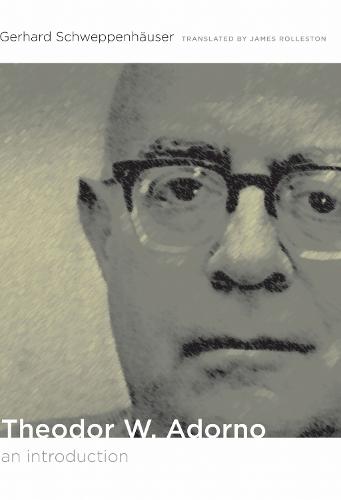
Theodor W. Adorno (1903–1969) was one of the twentieth century’s most important thinkers. In light of two pivotal developments-the rise of fascism, which culminated in the Holocaust, and the standardization of popular culture as a commodity indispensable to contemporary capitalism-Adorno sought to evaluate and synthesize the essential insights of Western philosophy by revisiting the ethical and sociological arguments of his predecessors: Kant, Nietzsche, Hegel, and Marx. This book, first published in Germany in 1996, provides a succinct introduction to Adorno’s challenging and far-reaching thought. Gerhard SchweppenhÄuser, a leading authority on the Frankfurt School of critical theory, explains Adorno’s epistemology, social and political philosophy, aesthetics, and theory of culture.After providing a brief overview of Adorno’s life, SchweppenhÄuser turns to the theorist’s core philosophical concepts, including post-Kantian critique, determinate negation, and the primacy of the object, as well as his view of the Enlightenment as a code for world domination, his diagnosis of modern mass culture as a program of social control, and his understanding of modernist aesthetics as a challenge to conceive an alternative politics. Along the way, SchweppenhÄuser illuminates the works widely considered Adorno’s most important achievements: Minima Moralia, Dialectic of Enlightenment (co-authored with Horkheimer), and Negative Dialectics. Adorno wrote much of the first two of these during his years in California (1938–49), where he lived near Arnold Schoenberg and Thomas Mann, whom he assisted with the musical aesthetics at the center of Mann’s novel Doctor Faustus.
Full Product Details
Author: James Rolleston ,
Gerhard Schweppenhäuser
Publisher: Duke University Press
Imprint: Duke University Press
Dimensions:
Width: 16.00cm
, Height: 2.00cm
, Length: 22.40cm
Weight: 0.885kg
ISBN: 9780822344544
ISBN 10: 0822344548
Pages: 200
Publication Date: 06 April 2009
Audience:
College/higher education
,
Tertiary & Higher Education
Format: Hardback
Publisher's Status: Active
Availability: In Print

This item will be ordered in for you from one of our suppliers. Upon receipt, we will promptly dispatch it out to you. For in store availability, please contact us.
Reviews
This superb introduction to Adorno's complex and difficult work is full of extraordinary insights, which will benefit the old hands as well as the beginners. --Fredric Jameson, Duke University This is a clear and concise overview of Theodor W. Adorno's philosophical, political, sociological, and aesthetic thought, written by a brilliant German theorist. Gerhard Schweppenhauser covers all the central topics in Adorno's writing, shows a firm grasp not only of his work but also of the secondary literature on it, and relates his thought to the more recent theoretical literature that has challenged it. --George Steinmetz, University of Michigan Theodor W. Adorno: An Introduction is a useful survey of Adorno's thought. It is concise, written in plain language, and focused on the most important topics and themes of the theorist's work. Gerhard Schweppenhauser gives essential background about the intellectual and historical context of Adorno's thought and writings, and he makes a convincing case for the internal coherence of a complex and at times apparently heterogeneous body of work. --Uwe Steiner, Rice University
This superb introduction to Adorno's complex and difficult work is full of extraordinary insights, which will benefit the old hands as well as the beginners. --Fredric Jameson, Duke University This is a clear and concise overview of Theodor W. Adorno's philosophical, political, sociological, and aesthetic thought, written by a brilliant German theorist. Gerhard Schweppenhauser covers all the central topics in Adorno's writing, shows a firm grasp not only of his work but also of the secondary literature on it, and relates his thought to the more recent theoretical literature that has challenged it. --George Steinmetz, University of Michigan Theodor W. Adorno: An Introduction is a useful survey of Adorno's thought. It is concise, written in plain language, and focused on the most important topics and themes of the theorist's work. Gerhard Schweppenhauser gives essential background about the intellectual and historical context of Adorno's thought and writings, and he makes a convincing case for the internal coherence of a complex and at times apparently heterogeneous body of work. --Uwe Steiner, Rice University Schweppenhauser's text is never less than eminently readable and often deeply insightful and it serves to remind us how, in an age dominated by consumerism, this great thinker's ideas remain deeply relevant. - Times Higher Education
Author Information
Gerhard SchweppenhÄuser is Professor of Design, Communication, and Media Theory at the University of WÜrzburg in Germany. He has written many books building on the sociocultural, analytical mission of the Frankfurt School, including two focused on Adorno. James L. Rolleston is Professor Emeritus of Germanic Languages and Literatures at Duke University. He has written books on Kafka, Rilke, and modern German poetry. His translation of Bernd Witte’s Walter Benjamin: An Intellectual Biography won the German Literary Prize of the American Translators Association. His and Kai Evers’s translation of Peter Weiss’s last play, The New Trial, is also published by Duke University Press.