Overview
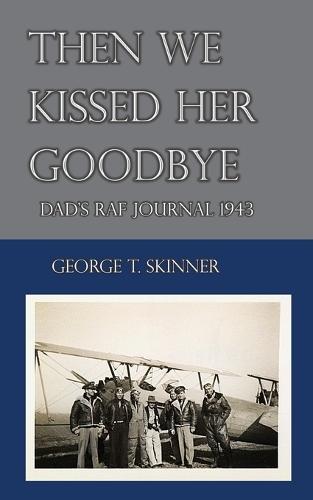
At just twenty years old, George Tolmie Skinner began recording his life in a journal that would become a vivid firsthand account of courage, endurance, and transformation during World War II. He enlisted in the Royal Air Force on January 17, 1943, stepping into a world defined by uncertainty and duty. From early training days in Scotland, including time in Dowally and Perth, to a brief but cherished leave with his brother Jim, Skinner's entries reveal both the discipline of military life and the humanity of a young man on the brink of war. In September 1943, he departed Liverpool for the United States aboard the RMS Mauretania, crossing the Atlantic under constant threat. The journey was perilous: a zigzag course to evade German U-boats, violent storms that hurled the ship through towering seas, and days of relentless weather near the Arctic Circle. After years of wartime deprivation and blackout conditions in Britain, the sight of Statue of Liberty rising over New York Harbor brought many of the young airmen to tears. From there, Skinner traveled to Terrell, Texas, where he began intensive flight training under the British Flying Training School program. His journal captures the exhilaration and challenges of learning to fly aircraft such as the PT-17 Stearman and AT-6, alongside vivid impressions of American life-its abundance, its openness, and its stark contrast to war-weary Europe. More than a record of training, this journal is a coming-of-age story set against the backdrop of global conflict. It reveals friendships forged under pressure, moments of humor and wonder, and the resilience required to move from boyhood into the responsibilities of a wartime pilot. On April 21, 1944, George Tolmie Skinner earned his wings and returned to Scotland as a Sergeant pilot-forever changed by the journey he had documented with honesty, insight, and quiet courage. This memoir offers readers a rare and intimate glimpse into the life of a young RAF trainee, preserving not only the history of a pivotal era, but the voice of one who lived it.
Full Product Details
Author: George T Skinner + ,
Deborah J Skinner
Publisher: Maple Key Publisher
Imprint: Maple Key Publisher
Volume: 1
Dimensions:
Width: 12.70cm
, Height: 0.40cm
, Length: 20.30cm
Weight: 0.086kg
ISBN: 9798995198833
Pages: 80
Publication Date: 09 May 2026
Audience:
General/trade
,
General
Format: Paperback
Publisher's Status: Active
Availability: In Print

This item will be ordered in for you from one of our suppliers. Upon receipt, we will promptly dispatch it out to you. For in store availability, please contact us.
Author Information
George Tolmie Skinner was born July 22, 1923 in Dundee, Angus, Scotland and was internationally recognized for his work in fluid dynamics and hypersonic aerodynamics and also for his development of apparatus to study molecular collisions in gases and electronic circuitry that made it possible to measure heat on the surface of space vehicles re-entering Earth's atmosphere. In his lifetime, he authored more than fifty reports and articles in technical journals and was a member of the American Physical Society, the American Society of Mechanical Engineers and the honorary scientific fraternity Sigma Xi. He joined the Royal Air Force in of 1943 and kept a journal of his travel experiences as he crossed the Atlantic Ocean, eventually landing in New York Harbor where he traveled by train to Terrell Texas to begin Air Craftsman training. He became a Sergeant pilot in 1944 and completed his training as a fighter pilot in Perthshire, Scotland. He finished his BS degree in engineering, graduating with honors from St. Andrews University in Dundee, Scotland. He won the Caird Travelling Scholarship that financed two years at Caltech and won the 1948 engineering medal. He returned to California where he received his Doctorates in Engineering in 1955 and completed his PHD at Caltech, then joined the technical staff of Cornell Aeronautical Laboratory's aerodynamic research department in 1958, remaining with the company when it became Calspan Corp. After his death in 1998, he was inducted posthumously into the Niagara Frontier Aviation and Space Hall of fame in 2002 for his internationally known work in low-speed fluid flows and hypersonic aerodynamics and his molecular Beam Theory that was used to study ways to detect the re-entry of missiles into the earth's atmosphere. Deborah J. Skinner BS: Art EducationDaemen College - Amherst, New YorkCum Laude [Plus 9 Master Credits]Deborah writes well-crafted narratives that reflect real-life relationships, love, loss and the resilience of the unspoken tapestry of our lives steeped in history. Her stories give voice to those truths and lets them rise to the surface in a way that connects our common journeys. She has always been fascinated by the idea of time travel and parallel universes, which she calls upon when writing middle grade fiction novels. She is currently compiling her father's posthumous memoir series, which focuses on his declassified work as an Aeronautical Innovator pioneering in hypersonic aerodynamics. Her father was internationally recognized for his development of apparatus to study molecular collisions in gases and electronic circuitry than made it possible to measure heat on the surface of space vehicles re-entering Earth's atmosphere. His RAF Journal isn't just military history; it's a bridge between three generations of service that she brings to life for her grandson who is serving in the Navy. These are the stories of a pilot who mastered the PT-17 Stearman and a scientist who helped us reach for the stars.