Overview
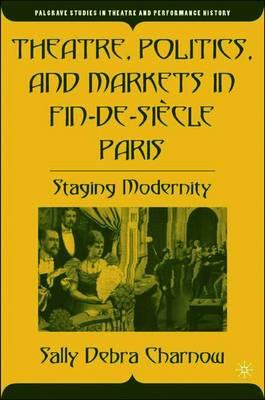
Since the Enlightenment, French theatre has occupied a prominent place within French thought, society and culture, but as a subject of study it has remained a purview of theatre historians, literary scholars and aestheticians. They focus on the emergence of the modern theatre as change generated from within bourgeois literary drama but ignore theatre as a complex social practice. Theatre, Politics, and Markets in Fin-de-Siècle Paris investigates the dynamic relationships among the avant-garde, official culture and the commercial sphere, arguing against the neat divide of 'high' and 'low' culture by showing how cultural forms of varying social origins influenced each other.
Full Product Details
Author: S. Charnow
Publisher: Palgrave USA
Imprint: Palgrave Macmillan
Edition: 2005 ed.
Dimensions:
Width: 14.00cm
, Height: 2.00cm
, Length: 21.60cm
Weight: 0.485kg
ISBN: 9781403970411
ISBN 10: 1403970416
Pages: 268
Publication Date: 13 December 2005
Audience:
College/higher education
,
Professional and scholarly
,
Tertiary & Higher Education
,
Undergraduate
Format: Hardback
Publisher's Status: Active
Availability: In Print

This item will be ordered in for you from one of our suppliers. Upon receipt, we will promptly dispatch it out to you. For in store availability, please contact us.
Reviews
Sally Debra Charnow's Theatre, Politics, and Markets in Fin-de-Siecle Paris aims to contribute not only to our histories of theater but also to our histories of modernism, modernity, and the complex creation of national and regional identity. Charnow is particularly good at describing individual avant-garde plays, explaining why modernist directors picked them to produce, and analyzing how French reviewers responded to the Paris premieres of both French and foreign works, especially the work of Henrik Ibsen....Charnow's work will probably be most interesting for historians of French theater and politics. It could also be useful, however, for scholars interested in pursuing the comparative study of modernism or further understanding how social, economic, and cultural developments overlapped, intersected, and influenced each other in the complex period from 1890 to 1914. -- Journal of Modern History An avant-garde theater crystallized in late nineteenth-century France, a theater of social and psychological engagement, most often associated with the names of Antoine and Lugne-Poe. Sally Charnow approaches the phenomenon with a wide-angle lens which embraces, not just the aesthetic, but also the political and social contexts in which the new theater emerged. This is not a theater history of the hermetic sort, but one that opens the subject to readers of all kinds who share Charnow's passion for the variety and creativity of the French fin-de-siecle scene. --Philip Nord, Professor of History, Princeton University<br> Given the importance of the theatre in French culture, it is surprising that historians have devoted little attention to its role in shaping national life. SallyCharnow's Theatre, Politics, and Markets in Fin-de-Siecle Paris is thus an important and welcome contribution to the field. Charnow examines both the aesthetics of the modernist theatre and its politics against the backdrop of an emerging mass democracy and the concomitant development of commercial culture. Through her deft handling of literary and historical sources, she illustrates the fluidity between the seemingly opposing categories of avant-garde and commercial art; elite and 'popular' culture; regional and national identity. The result is a lively and fresh perspective on a key aspect of modern French culture. --Venita Datta, Associate Professor of French, Wellesley College <br>
<p> Sally Debra Charnow's Theatre, Politics, and Markets in Fin-de-Siecle Paris aims to contribute not only to our histories of theater but also to our histories of modernism, modernity, and the complex creation of national and regional identity. Charnow is particularly good at describing individual avant-garde plays, explaining why modernist directors picked them to produce, and analyzing how French reviewers responded to the Paris premieres of both French and foreign works, especially the work of Henrik Ibsen....Charnow's work will probably be most interesting for historians of French theater and politics. It could also be useful, however, for scholars interested in pursuing the comparative study of modernism or further understanding how social, economic, and cultural developments overlapped, intersected, and influenced each other in the complex period from 1890 to 1914. -- Journal of Modern History An avant-garde theater crystallized in late nineteenth-century France, a theater of social and psychological engagement, most often associated with the names of Antoine and Lugne-Poe. Sally Charnow approaches the phenomenon with a wide-angle lens which embraces, not just the aesthetic, but also the political and social contexts in which the new theater emerged. This is not a theater history of the hermetic sort, but one that opens the subject to readers of all kinds who share Charnow's passion for the variety and creativity of the French fin-de-siecle scene. --Philip Nord, Professor of History, Princeton University<br> Given the importance of the theatre in French culture, it is surprising that historians have devoted little attention to its role in shaping national life. Sally Charnow's Theatre, Politics, and Markets in Fin-de-Siecle Paris is thus an important and welcome contribution to the field. Charnow examines both the aesthetics of the modernist theatre and its politics against the backdrop of an emerging mass democracy and the concomitant development of
<p> Sally Debra Charnow’s Theatre, Politics, and Markets in Fin-de-Siecle Paris aims to contribute not only to our histories of theater but also to our histories of modernism, modernity, and the complex creation of national and regional identity. Charnow is particularly good at describing individual avant-garde plays, explaining why modernist directors picked them to produce, and analyzing how French reviewers responded to the Paris premieres of both French and foreign works, especially the work of Henrik Ibsen....Charnow’s work will probably be most interesting for historians of French theater and politics. It could also be useful, however, for scholars interested in pursuing the comparative study of modernism or further understanding how social, economic, and cultural developments overlapped, intersected, and influenced each other in the complex period from 1890 to 1914. -- Journal of Modern History An avant-garde theater crystallized in late nineteenth-century France,
Author Information
SALLY CHARNOW is Assistant Professor of History at Hofstra University, USA. Her articles have appeared in Women in Jewish Culture: Active Voices (University of Illinois Press, 1995), Radical History Review and Historical Reflections.