Overview
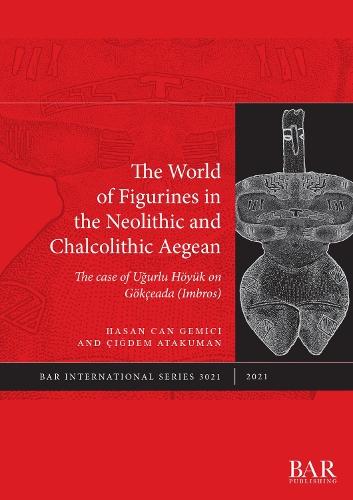
This book studies the corpus of figurines recovered from the Neolithic - Chalcolithic settlement of Ugurlu Höyük on the island of Gökçeada (Imbros) in the northeastern Aegean. Bringing together different strands of investigation about how they were produced, what they were meant to depict, and where they were used, the authors question in whose image these statuettes were created and why. Drawing parallels between contemporary figurine assemblages from the Eastern Mediterranean, the results challenge some of the common assumptions regarding the role these objects played in prehistoric belief systems, and instead explore the alternative ways in which the local, regional, mundane, and the sacred were weaved together in an island community more than 7,000 years ago.
Full Product Details
Author: Hasan Can Gemici ,
Çigdem Atakuman
Publisher: BAR Publishing
Imprint: BAR Publishing
Weight: 0.750kg
ISBN: 9781407357751
ISBN 10: 1407357751
Pages: 188
Publication Date: 09 April 2021
Audience:
Professional and scholarly
,
Professional & Vocational
Format: Paperback
Publisher's Status: Active
Availability: Available To Order

We have confirmation that this item is in stock with the supplier. It will be ordered in for you and dispatched immediately.
Reviews
'This work makes a great contribution to the field, especially in the emphasis to treat these objects as archaeological artefacts, with careful attention to archaeological and material culture context. The comparative analysis is also very useful for those interested in this time period, area and material culture.' Dr Ellen Belcher, John Jay College of Criminal Justice, CUNY 'The fruits of this research would be primarily beneficial to researchers working in Near Eastern/Mediterranean prehistory. However, the methodology might be useful to researchers working in other parts of the world. As well, the catalogue has potential use if there are similarities across geographic locations.' Dr Lindsey Der, University of British Columbia
'This work makes a great contribution to the field, especially in the emphasis to treat these objects as archaeological artefacts, with careful attention to archaeological and material culture context. The comparative analysis is also very useful for those interested in this time period, area and material culture.' Dr Ellen Belcher, John Jay College of Criminal Justice, CUNY 'The fruits of this research would be primarily beneficial to researchers working in Near Eastern/Mediterranean prehistory. However, the methodology might be useful to researchers working in other parts of the world. As well, the catalogue has potential use if there are similarities across geographic locations.' Dr Lindsey Der, University of British Columbia
Author Information
Hasan Can Gemici has degrees in settlement archaeology and geological engineering from the Middle East Technical University in Ankara, Turkey. His research interests include ancient art, resource procurement, genetics, and interaction in the prehistoric Mediterranean. He is currently working as a researcher in the ERC-funded project 'NEOGENE' at METU. Çigdem Atakuman holds a PhD in archaeology from UCLA. Her research interests and resulting publications primarily include topics such as the Neolithisation process in Southwest Asia, prehistoric art as well as the politics of heritage in Turkey and the Middle East. She has been involved in field projects at Domuztepe-Kahramanmaras, Ugurlu Höyük-Gökçeada, and Bozburun-Marmaris. Currently working as an associate professor of archaeology at the Middle East Technical University, she is also one of the principal investigators of the ERC/EU-funded projects 'NEOGENE' and 'NEOMATRIX', both investigating the Neolithic transition through ancient DNA analyses.