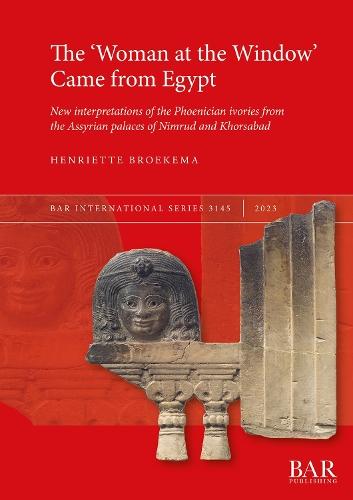
The 'Woman at the Window' Came From Egypt: New interpretations of the Phoenician ivories from the Assyrian palaces of Nimrud and Khorsabad

Author:   Henriette Broekema
Publisher:   BAR Publishing
ISBN:  

9781407354255


Pages:   120
Publication Date:   27 October 2023
Format:   Paperback
Availability:   Available To Order   Availability explained
We have confirmation that this item is in stock with the supplier. It will be ordered in for you and dispatched immediately.

Our Price $158.40 Quantity:  
Add to Cart

Share |

The 'Woman at the Window' Came From Egypt: New interpretations of the Phoenician ivories from the Assyrian palaces of Nimrud and Khorsabad


Overview

The 'Woman at the Window' Came from Egypt investigates the origin of ivory plaques found in the Assyrian palaces of Nimrud and Khorsabad from the first millennium BCE. It provides a completely new interpretation of the famous iconography of the 'Woman at the Window'. This collection of ivories, traditionally labelled as 'Phoenician', is thought to have originated from locations across the Levant. However, the Egyptian Nile Delta appears to be a more accurate locale. Pharaohs of the Third Intermediate Period, especially those of the 25th dynasty, may have commissioned them to help legitimize their fragile positions. The book's central thesis may also change our understanding and perception of the Phoenicians: it is customary to situate this Iron Age trading people in the city-states along the eastern coast of the Mediterranean, but the Nile Delta's cosmopolitan city communities should also be included. It was in these communities where the hybrid art of the Phoenician ivory carving probably originated. This book will appeal to historians studying Phoenician and Egyptian art, as well as researchers interested in the significance of the ivory panels found in Assyrian palaces.

Full Product Details

Author:   Henriette Broekema
Publisher:   BAR Publishing
Imprint:   BAR Publishing
ISBN:  

9781407354255


ISBN 10:   1407354256
Pages:   120
Publication Date:   27 October 2023
Audience:   Professional and scholarly ,  Professional & Vocational
Format:   Paperback
Publisher's Status:   Active
Availability:   Available To Order   Availability explained
We have confirmation that this item is in stock with the supplier. It will be ordered in for you and dispatched immediately.

Table of Contents

List of Figures Prologue 1. Introduction 2. Where did the Ivories Come From? Method of research 3. Theories about the 'Woman at the Window' The 'Woman at the Window' is a temple prostitute The 'Woman at the Window' is related to the Goddess Hathor and the Hathor-head capitals The 'Woman at the Window' is Jezebel, wife of King Ahab of Israel The 'Woman at the Window' is the Sidonian goddess Asiti The 'Woman at the Window' is the Nude Goddess The 'Woman at the Window' is Mary Magdalene, 'Mary of the Tower' 4. Tiye, the Great King's Royal Wife of Amenhotep III Queen Tiye Scarabs Lake Exchange of letters with Tushratta, King of Mitanni Titles Tiye divinized Tiye as sphinx Tomb 5. Parallels between Queen Tiye and the 'Woman at the Window' Queen Tiye with the Egyptian Pegged Wig Tiye with a smooth wig The vulture crown The wigs and forehead ornaments of the Lady on the ivories Ivory heads of the Lady with fillet and forehead ornament Ivory heads of the Lady with square forehead ornament and cross Three-lobed earrings Dreadlocks Tiye with 'dreadlocks' Feathered garment The flail sceptre Tiye as a fertile birth goddess Conclusion 6. No window Egypt Levant The naos-sistrum of the Hathor columns Conclusion 7. No balustrade Drooping petals Assyrian furniture mouldings of round bulges Caryatids The Phoenician 'Schalen'-palmette Volute capital Combination Volute capital and Phoenician 'Schalen'-palmette Combination of the Drooping Petal and the Phoenician 'Schalen'-palmette Temple or bit hilani? Thymiateria The pillars of Ramat Rahel Conclusion 8. The 'Phoenician' Egyptian and Egyptianizing ivories in Assyria came from Egypt Psusennes I (1047-1001 BCE), Tanite 21st dynasty Bubastis, the Libyan 22nd dynasty (945-720 BCE) The bronze statue of Pharaoh Pedubasti I, 23rd dynasty (818-739 BCE) Kushite (or Nubian) 25th dynasty in Memphis (744-656 BCE) 9. When were the Phoenician ivories deposited in Assyria? Nimrud: Fort Shalmaneser, the Residency Nimrud: Fort Shalmaneser, the Great Storeroom SW 37 Nimrud: North West Palace Nimrud: Burnt Palace (= Layard's 'South East Palace') Khorsabad (ancient Dur Sarrukin) Til Barsip (present-day Tell Ahmar) Arslan Tash (ancient Hadatu) Sarepta (present-day Sarafand) Samaria Salamis Vassal kings Egyptian blue Bastet-sphinxes Conclusion 10. Conclusions Bibliography

Reviews

'This is a landmark study in the field of art style, iconography and historical influences. The application of a rigorous methodology could reinvigorate old debates and inspire new ways of thinking about how to approach Mesopotamian datasets.' Dr Shelir Amelirad, University of Heidelberg


'This is a landmark study in the field of art style, iconography and historical influences. The application of a rigorous methodology could reinvigorate old debates and inspire new ways of thinking about how to approach Mesopotamian datasets.' Dr Shelir Amelirad, University of Heidelberg  


Author Information

Henriette Broekema studied Political and Social Sciences at the University of Antwerp, Dutch Law at the University of Amsterdam, and Assyriology at the University of Leiden.

Tab Content 6

Author Website:  

Countries Available

All regions
Latest Reading Guide

April RG 26_2


Shopping Cart
Your cart is empty
Shopping cart
Mailing List