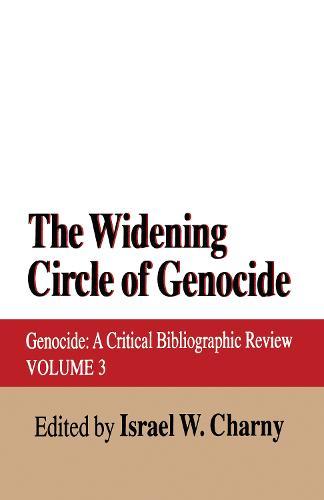
Full Product Details
Author: Israel W. Charny ,
Irving Louis Horowitz
Publisher: Taylor & Francis Inc
Imprint: Routledge
Edition: Annotated edition
Volume: v. 3
Dimensions:
Width: 15.20cm
, Height: 2.70cm
, Length: 22.90cm
Weight: 0.725kg
ISBN: 9781560001720
ISBN 10: 1560001720
Pages: 404
Publication Date: 30 June 1994
Audience:
College/higher education
,
General/trade
,
Undergraduate
,
General
Format: Hardback
Publisher's Status: Active
Availability: In Print

This item will be ordered in for you from one of our suppliers. Upon receipt, we will promptly dispatch it out to you. For in store availability, please contact us.
Reviews
With the news of massacres in Bosnia, Haiti, and Rwanda as part of daily media fare, it is difficult to adopt an optimistic stance vis-a-vis the future of civilization. Nevertheless, this does not lessen the need for informed data on past tragedies. This third volume in Charny's growing series on genocide in the 20th century retains the format and high level of scholarship of its predecessors... The editor cites democracies that permitted the existence of atrocities, the sensitive area of religion and genocide, and fascinating case studies involving genocide of the Afghanis, Kurds, and the Gypsies in the Holocaust. Charny provides a deeper comprehension of genocide by including a psychiatric study of Holocaust survivors, a study of massive contemporary child mortality, and a study of genocide and its prevention by private agencies. Each bibliographic unit is preceded by an excellent overview by the subject specialists... Highly recommended for all adult libraries. </p> --D. Kranzler, <em>Choice</em></p>
-With the news of massacres in Bosnia, Haiti, and Rwanda as part of daily media fare, it is difficult to adopt an optimistic stance vis-a-vis the future of civilization. Nevertheless, this does not lessen the need for informed data on past tragedies. This third volume in Charny's growing series on genocide in the 20th century retains the format and high level of scholarship of its predecessors... The editor cites democracies that permitted the existence of atrocities, the sensitive area of religion and genocide, and fascinating case studies involving genocide of the Afghanis, Kurds, and the Gypsies in the Holocaust. Charny provides a deeper comprehension of genocide by including a psychiatric study of Holocaust survivors, a study of massive contemporary child mortality, and a study of genocide and its prevention by private agencies. Each bibliographic unit is preceded by an excellent overview by the subject specialists... Highly recommended for all adult libraries.- --D. Kranzler, Choice
-With the news of massacres in Bosnia, Haiti, and Rwanda as part of daily media fare, it is difficult to adopt an optimistic stance vis-a-vis the future of civilization. Nevertheless, this does not lessen the need for informed data on past tragedies. This third volume in Charny's growing series on genocide in the 20th century retains the format and high level of scholarship of its predecessors... The editor cites democracies that permitted the existence of atrocities, the sensitive area of religion and genocide, and fascinating case studies involving genocide of the Afghanis, Kurds, and the Gypsies in the Holocaust. Charny provides a deeper comprehension of genocide by including a psychiatric study of Holocaust survivors, a study of massive contemporary child mortality, and a study of genocide and its prevention by private agencies. Each bibliographic unit is preceded by an excellent overview by the subject specialists... Highly recommended for all adult libraries.- --D. Kranzler, Choice
<p> With the news of massacres in Bosnia, Haiti, and Rwanda as part of daily media fare, it is difficult to adopt an optimistic stance vis-a-vis the future of civilization. Nevertheless, this does not lessen the need for informed data on past tragedies. This third volume in Charny's growing series on genocide in the 20th century retains the format and high level of scholarship of its predecessors... The editor cites democracies that permitted the existence of atrocities, the sensitive area of religion and genocide, and fascinating case studies involving genocide of the Afghanis, Kurds, and the Gypsies in the Holocaust. Charny provides a deeper comprehension of genocide by including a psychiatric study of Holocaust survivors, a study of massive contemporary child mortality, and a study of genocide and its prevention by private agencies. Each bibliographic unit is preceded by an excellent overview by the subject specialists... Highly recommended for all adult libraries. <p> --D. Kranzler, Choice
Author Information
Israel W. Charny is Executive Director, Institute on the Holocaust and Genocide, Jerusalem; and Professor of Psychology & Family Therapy and Director, Program for Advanced Studies in Integrative Psychotherapy, Dept. of Psychology & Martin Buber Center, Hebrew University of Jerusalem