Overview
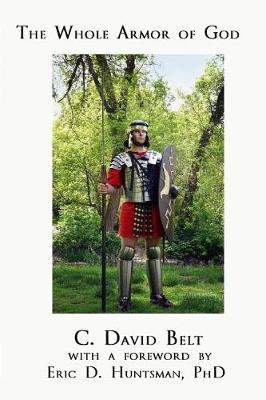
Paul was a Roman. Yes, the apostle was raised as a devout Jew and later became a Christian, but he was a citizen of the Roman Empire. He lived in a Roman world. In his Epistle to the Ephesians, Paul wrote to an audience of Christians living in a Roman world, under Roman rule. They had all seen Roman legionnaires and were familiar with the armor and weapons carried by a typical Roman soldier. As contemporary Christians, we have a tendency to picture Sir Lancelot on his horse. We are using the wrong imagery. We miss the powerful symbolism of Paul's analogy. There is deep meaning in each of the symbols that Paul uses --symbols that we gloss over or fail entirely to understand--symbols that Paul's audience readily understood.
Full Product Details
Author: C David Belt
Publisher: Movement Publishing
Imprint: Movement Publishing
Dimensions:
Width: 15.20cm
, Height: 0.30cm
, Length: 22.90cm
Weight: 0.095kg
ISBN: 9781513643571
ISBN 10: 1513643576
Pages: 62
Publication Date: 06 December 2018
Audience:
General/trade
,
General
Format: Paperback
Publisher's Status: Active
Availability: Available To Order

We have confirmation that this item is in stock with the supplier. It will be ordered in for you and dispatched immediately.
Reviews
As a lover of history and an expert on ancient weaponry, David Belt is certainly qualified to explicate for us Paul's well-known injunction that we ""put on the whole armour of God"" (King James Bible, Ephesians 6:11-17). In this interesting and vividly illustrated volume, he ably describes for us what the various implements that Paul mentions--such as the breastplate, shield, and helmet--would have looked like and how they would have functioned in Paul's time. But more importantly, he explains the spiritual significance of Paul's imagery, drawing widely upon the scriptures and some of his own experiences to help us better understand how we can spiritually fortify ourselves to fight the most important battles in our own lives. As David Belt so carefully demonstrates, the detailed description of each item in the panoply, or full suit of armor, comes from the standard issue worn by Roman legionaries, the most effective and feared soldiers of the time. At first Paul's appropriation of Roman armor seems unexpected: were not the Romans the enemies of the Christians? Actually, no. While local opposition, first from some Jewish elements in the cities where Paul taught and then later from unbelieving Gentile neighbors, was seen from the outset, by and large the Roman government was surprisingly tolerant, and Paul, as a Roman citizen, often benefited from the protection of local Roman officials. Only with the burning of Rome in A.D. 64, a disaster that the emperor Nero chose to blame on local Christians, did periodic waves of persecution begin, including the round that seems to have claimed both Peter and Paul. As we read the detailed description and discussion of each piece of this armor that follows in this wonderfully illustrated volume, it is good to keep in mind Paul's repeated use of such imagery in his writings. Whether it referred to our daily struggles against temptation and life's trials or points us forward to the final confrontation with Satan and his hosts, we should remember that the image of such armor began with Isaiah's description of Jehovah arming Himself to fight on behalf of His people. As we join the ranks of Christian soldiers in putting on Jesus' righteousness and fighting in His ranks, we can remember the lines of the familiar hymn: ""Onward, Christian Soldiers."" Eric D. Huntsman, PhD Brigham Young University
As a lover of history and an expert on ancient weaponry, David Belt is certainly qualified to explicate for us Paul's well-known injunction that we put on the whole armour of God (King James Bible, Ephesians 6:11-17). In this interesting and vividly illustrated volume, he ably describes for us what the various implements that Paul mentions--such as the breastplate, shield, and helmet--would have looked like and how they would have functioned in Paul's time. But more importantly, he explains the spiritual significance of Paul's imagery, drawing widely upon the scriptures and some of his own experiences to help us better understand how we can spiritually fortify ourselves to fight the most important battles in our own lives. As David Belt so carefully demonstrates, the detailed description of each item in the panoply, or full suit of armor, comes from the standard issue worn by Roman legionaries, the most effective and feared soldiers of the time. At first Paul's appropriation of Roman armor seems unexpected: were not the Romans the enemies of the Christians? Actually, no. While local opposition, first from some Jewish elements in the cities where Paul taught and then later from unbelieving Gentile neighbors, was seen from the outset, by and large the Roman government was surprisingly tolerant, and Paul, as a Roman citizen, often benefited from the protection of local Roman officials. Only with the burning of Rome in A.D. 64, a disaster that the emperor Nero chose to blame on local Christians, did periodic waves of persecution begin, including the round that seems to have claimed both Peter and Paul. As we read the detailed description and discussion of each piece of this armor that follows in this wonderfully illustrated volume, it is good to keep in mind Paul's repeated use of such imagery in his writings. Whether it referred to our daily struggles against temptation and life's trials or points us forward to the final confrontation with Satan and his hosts, we should remember that the image of such armor began with Isaiah's description of Jehovah arming Himself to fight on behalf of His people. As we join the ranks of Christian soldiers in putting on Jesus' righteousness and fighting in His ranks, we can remember the lines of the familiar hymn: Onward, Christian Soldiers. Eric D. Huntsman, PhD Brigham Young University
Author Information
C. David Belt was born in Evanston, WY. As a child, he lived and traveled extensively around the Far East. He served as an LDS missionary in South Korea and southern California (Korean-speaking). He graduated from Brigham Young University with a Bachelor of Science in Computer Science and a minor in Aerospace Studies. He served as a B-52 pilot in the US Air Force and as an Air Weapons Controller in the Washington Air National Guard. When he is not writing, he sings in the Mormon Tabernacle Choir and works as a software engineer. He collects swords (mostly Scottish), axes, spears, and other medieval weapons and armor. He and his wife have six children and live in Utah with an eclectus parrot named Mork (who likes to jump on the keyboard when David is writing).