Overview
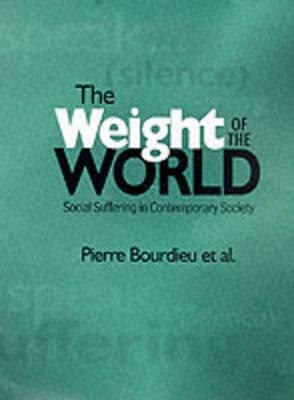
This book can be read like a series of short stories - the story of a steel worker who was laid off after twenty years in the same factory and who now struggles to support his family on unemployment benefits and a part-time job; the story of a trade unionist who finds his goals undermined by the changing nature of work; the story of a family from Algeria living in a housing estate in the outskirts of Paris whose members have to cope with pervasive, everyday forms of racism; the story of a school teacher confronted with urban violence; and many others as well. Reading these stories enables one to understand these people's lives and the forms of social suffering which are part of them. And the reader will see that this book offers not only a distinctive method for analysing social life, but also another way of practising politics.
Full Product Details
Author: Pierre Bourdieu (Collège de France)
Publisher: John Wiley and Sons Ltd
Imprint: Polity Press
Dimensions:
Width: 17.40cm
, Height: 3.30cm
, Length: 24.20cm
Weight: 1.134kg
ISBN: 9780745615936
ISBN 10: 0745615937
Pages: 656
Publication Date: 30 December 1999
Audience:
College/higher education
,
Professional and scholarly
,
Undergraduate
,
Professional & Vocational
Format: Paperback
Publisher's Status: Active
Availability: Out of stock

The supplier is temporarily out of stock of this item. It will be ordered for you on backorder and shipped when it becomes available.
Reviews
'A monumental study of social exclusion. It is not a dry academic tome, but includes photographs and first-hand accounts ... it captures the complexity of social exclusion and how it becomes fixed.' Geoff Mulgan, The New Statesman and Society I was immediately taken with the richness and depth of this analysis of the social suffering of the lives or ordinary men and women, and I felt this introduced me to a Bourdieu that I had not come across before ... This collection of ethnographic writing masterfully captures the realities of our social world, and provides what feels like a refreshingly realistic representation of people's lived experiences ... The Weight of the World is essential reading for anyone, sociologically inclined or otherwise, who is interested in reading others' accounts of their lives and who is also ready to reflect on these and on the politics of life more generally. Network, Researcher's Choice for Desert Island Discourse 'It cannot fail to be provocative.' Derek Robbins, University of East London, The Times Higher Education Supplement 'This book on the masses certainly has the potential to be a book for the masses ... The Weight of the World shows that a critical sociology of suffering does not have to indulge in miserabilism to be effective.' European Journal of Social Theory 'The Weight of the World is a bracing tonic if you've drunk too much New Labour champagne. Our masters insist that all will be well if only people get jobs, take risks, and behave well as husbands and wives. Pierre Bourdieu and his colleagues show how hard it is to do so ... it teaches an important lesson in humanity.' The Independent
'A monumental study of social exclusion. It is not a dry academic tome, but includes photographs and first-hand accounts ... it captures the complexity of social exclusion and how it becomes fixed.' Geoff Mulgan, The New Statesman and Society 'It cannot fail to be provocative.' Derek Robbins, University of East London, The Times Higher Education Supplement 'This book on the masses certainly has the potential to be a book for the masses ... The Weight of the World shows that a critical sociology of suffering does not have to indulge in miserabilism to be effective.' European Journal of Social Theory 'The Weight of the World is a bracing tonic if you've drunk too much New Labour champagne. Our masters insist that all will be well if only people get jobs, take risks, and behave well as husbands and wives. Pierre Bourdieu and his colleagues show how hard it is to do so ... it teaches an important lesson in humanity.' The Independent
Author Information
Pierre Bourdieu was Professor of Sociology at the Collège de France.