Overview
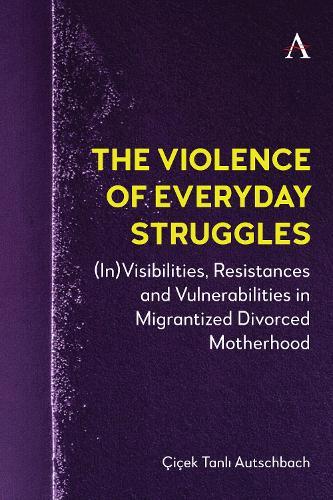
Examines the daily struggles of migrantised divorced mothers in Germany in a framework of everyday violence and its (in)visibilities, focusing on their resistances and vulnerabilities within unequal relations of support. This book approaches the daily struggles of migrantised divorced motherhood through theories, discourses, and (in)visibilities of everyday violence. Building on ethnographically informed everyday violence theories, it offers a framework in which violence becomes everyday violence when it engages with the boundaries of ordinary lives by means of being disruptive, reproduced, absorbed, and expected.Taking neither the visibility nor the invisibility of violence for granted, it discusses how the same discourses of violence can visibly victimise certain daily struggles of migrantised divorced motherhood while obscuring certain others. Analysing the individual narratives of divorced mothers living in Germany with immigration biographies from Turkey, the book tackles their struggles with poverty, dequalification, maternal guilt, time constraints, care, everyday racism and sexism, as well as the conceptualisations of violence itself. If there is a certain form of 'loneness' implied in the term lone parenting, these narratives reveal how such 'loneness' is structurally and discursively constructed within a relationality of the self to resources. With attention to various forms of victimisations, vulnerabilities, and resistances, the book delves into what it means to 'stand on one's own two feet' in the face of paternalistic conditions of intimate and structural support. Thus, the author makes various strong arguments around the work of tackling everyday violence and the immunities secured against the attribution of violence within power relations. Underlining the ambivalent consequences of our everyday and scholarly discourses on violence, she carefully situates the concept in a context of migrantisation and culturalisation of gendered experiences. Overall, the research participants offer narratives of not only everyday violence but also everyday protests, which refuse the forced (in)visibilities of their daily struggles and analyse the labour they invest into their relations to resources. And it is the acknowledgment of these protests that is at stake when they narrate their daily struggles, name violence, and reject a passive victimhood.
Full Product Details
Author: Çiçek Tanlı Autschbach
Publisher: Anthem Press
Imprint: Anthem Press
Dimensions:
Width: 15.30cm
, Height: 1.80cm
, Length: 22.90cm
Weight: 0.504kg
ISBN: 9781839995859
ISBN 10: 1839995858
Pages: 248
Publication Date: 10 March 2026
Audience:
College/higher education
,
Postgraduate, Research & Scholarly
Format: Hardback
Publisher's Status: Active
Availability: Manufactured on demand

We will order this item for you from a manufactured on demand supplier.
Reviews
“Tanlı Autschbach explores how immigrant divorced mothers from Turkey forge new understandings of their place in the world, their collective action and resistance, and their labor as lone mothers. Tanlı Autschbach’s book is at once a much-needed rethinking of women’s relationship to violence, and a hopeful story of how women survive and thrive—even as they protest against increasing precarity in their lives.” — Beverly Weber, Chair, Germanic and Slavic Languages and Literatures (GSLL), Professor of German Studies, University of Colorado, Boulder, USA. “A compelling and original study, this work offers a sharp feminist and intersectional analysis of immigrant divorced mothers’ everyday struggles and agency. Its rigorous scholarship, reflexive methodology and nuanced critique of how violence is defined position it as an important and timely contribution to debates on gender, migration and structural harm.” — Katucha Bento, Lecturer in Race and Decolonial Studies, The University of Edinburgh, School of Social and Political Science, UK.
Author Information
icek Tanl Autschbach is a sociologist in Germany, who works on the topics of gender, everyday violence, divorced/single motherhood, and migration.