Overview
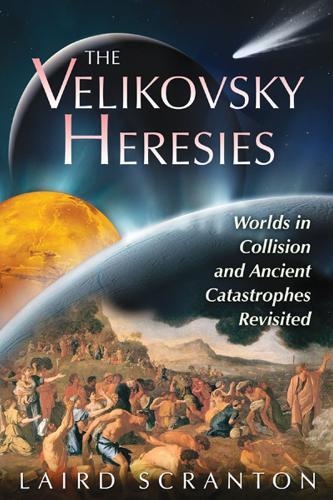
A reexamination of Immanuel Velikovsky’s controversial Venus theories in light of new astronomical and archaeological findings • Provides new evidence from recent space probe missions to support Velikovsky’s theories on the formation of Venus • Presents recently translated ancient texts from China, Korea, and Japan that uphold the cometlike descriptions of Venus cited by Velikovsky • Examines evidence of major geomagnetic events in 1500 BCE and 750 BCE that correspond with close passes of the comet Venus and its impact with Mars • Offers scientific explanations for many disputed aspects of Velikovsky’s theories, such as how Venus could have transformed from a comet into an orbiting planet Surrounded by controversy even before its publication in 1950, Immanuel Velikovsky’s Worlds in Collision introduced the provocative theory that Venus began as a brilliant comet ejected by Jupiter around 1600 BCE, wreaking chaos on Mars and Earth as it roamed through our solar system prior to settling into its current orbit. Immediately dismissed without any investigation and subject to vicious attacks, Velikovsky’s theory is now poised for reexamination in light of recent astronomical and archaeological findings. Exploring the key points of Velikovsky’s theories, Laird Scranton presents evidence from recent space probe missions to show that Venus still exhibits cometlike properties, such as its atmospheric composition, and could be a young planet. Reviewing the widespread cometlike descriptions of Venus from 1500 BCE to 750 BCE as well as Velikovsky’s observation that no records of Venus exist prior to 1600 BCE, Scranton reveals recently translated ancient texts from China, Korea, and Japan that further uphold Velikovsky’s theories. Examining evidence of major geomagnetic and climate-change events around 1500 BCE and 750 BCE, corresponding with close passes of the comet Venus and its impact with Mars, the author offers scientific explanations for many disputed aspects of Velikovsky’s theories, such as how Venus transformed from a comet into an orbiting planet. By updating this unresolved controversy with new scientific evidence, Scranton helps us to understand how it was that Worlds in Collision was the one book found open on Albert Einstein’s desk at the time of his death.
Full Product Details
Author: Laird Scranton
Publisher: Inner Traditions Bear and Company
Imprint: Bear & Company
Dimensions:
Width: 15.20cm
, Height: 1.30cm
, Length: 22.90cm
Weight: 0.211kg
ISBN: 9781591431398
ISBN 10: 1591431395
Pages: 160
Publication Date: 25 January 2012
Audience:
General/trade
,
General
Format: Paperback
Publisher's Status: Active
Availability: In Print

This item will be ordered in for you from one of our suppliers. Upon receipt, we will promptly dispatch it out to you. For in store availability, please contact us.
Reviews
Scranton reminds us of Velikovsky's contribution to our ideas about our solar system, and he hints at what else may be confirmed in the future. --Nexus Magazine, June 2012
Scranton reminds us of Velikovsky's contribution to our ideas about our solar system, and he hints at what else may be confirmed in the future.
Scranton reminds us of Velikovsky's contribution to our ideas about our solar system, and he hints at what else may be confirmed in the future. Nexus Magazine, June 2012
Author Information
Laird Scranton, an independent software designer, has studied ancient myth, language, and cosmology since 1997. The author of several books, including The Science of the Dogon, he has been a lecturer at Colgate University and lives in Albany, New York.