Overview
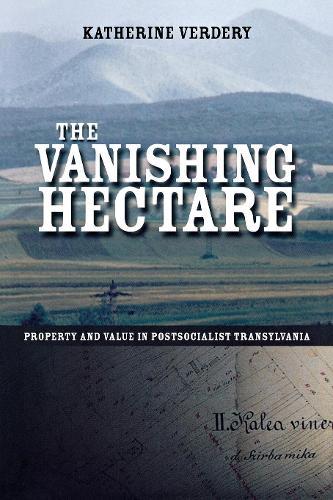
In most countries in Eastern Europe and the former Soviet Union, the fall of communism opened up the possibility for individuals to acquire land. Based on Katherine Verdery's extensive fieldwork between 1990 and 2001, The Vanishing Hectare explores the importance of land and land ownership to the people of one Transylvanian community, Aurel Vlaicu. Verdery traces how collectivized land was transformed into private property, how land was valued, what the new owners were able to do with it, and what it signified to each of the different groups vying for land rights. Verdery tells this story about transforming socialist property forms in a global context, showing the fruitfulness of conceptualizing property as a political symbol, as a complex of social relations among people and things, and as a process of assigning value. This book is a window on rural life after socialism but it also provides a framework for assessing the neo-liberal economic policies that have prevailed elsewhere, such as in Latin America. Verdery shows how the trajectory of property after socialism was deeply conditioned by the forms property took in socialism itself; this is in contrast to the image of a ""tabula rasa"" that governed much thinking about post-socialist property reform.
Full Product Details
Author: Katherine Verdery ,
Lowell Turner
Publisher: Cornell University Press
Imprint: Cornell University Press
Dimensions:
Width: 15.50cm
, Height: 3.20cm
, Length: 23.50cm
Weight: 0.907kg
ISBN: 9780801441974
ISBN 10: 0801441978
Pages: 448
Publication Date: 14 November 2003
Audience:
General/trade
,
College/higher education
,
Professional and scholarly
,
General
,
Undergraduate
Format: Hardback
Publisher's Status: Active
Availability: Awaiting stock

The supplier is currently out of stock of this item. It will be ordered for you and placed on backorder. Once it does come back in stock, we will ship it out for you.
Reviews
"""Where the poet William Blake saw a world in a grain of sand, Ms. Verdery finds global collisions of values and culture in the manner that Aurel Vlaicu, a small Transylvanian town nestled at the foot of the Western Carpathian Mountains, privatized its landholdings after Romania's 1989 revolution... Verdery often leavens her work with entertaining anecdotes... Her intimate knowledge of the town proved useful when she delved into local corruption and ill feeling. Her larger critique of Western misprisions never dulls her eye for local failures.""-Richard Byrne, Chronicle of Higher Education, 20 February 2004 ""Verdery's conclusions are bleak. She vividly describes how the efforts of individuals she depicts as conscientious, energetic, highly intelligent, and very charming all founder in the face of widening price scissors production costs and market returns... The Vanishing Hectare showcases the value of long-term fieldwork-anthropology's core methodology-to illuminate the real-world consequences of wishful thinking, and deserves particular attention from scholars and practitioners concerned to understand the kinds of regime change formerly known as transition.""-Keith Brown, Slavic Review, Spring 2005 ""Verdery's 30 years of fieldwork research in Romania supplied the groundwork for The Vanishing Hectare, enabling her to offer some alternative versions of the changes in rural life and reasons behind the supposedly irrational behavior of rural people... Her account is not so much of the laws and administrative paraphernalia that established private ownership but rather of the broader social and economic conditions that make for what the author terms 'effective ownership.'""-Andrew Cartwright, Anthropological Quarterly, Fall 2004 ""This is an example of ethnographic enquiry at its best. In Katherine Verdery's hands it becomes a superb vehicle for exploring the tragedy of reformist intentions. Using economic means to achieve social ends, and the consequences this has for people's livelihood, is a story told over and over again in twentieth-century history. Here the socialist and postsocialist experiments of Eastern Europe have a special poignancy, not least in the way the people contribute to their own predicaments. Verdery dignifies their endeavours with breathtaking documentation and a fine-grained analysis of social realities. A remarkable feat.""-Marilyn Strathern, University of Cambridge ""The Vanishing Hectare is the polished work of a scholar who, after several decades of ethnographic fieldwork in a single place, brings her knowledge to bear on a problem of world-historical significance: the transformation of property following the collapse of state socialism in the former Soviet bloc. Katherine Verdery traces how collective forms of land use were transformed into 'private property,' and does so methodically, documenting and analyzing with neither polemics nor circumlocution.""-John Borneman, Princeton University ""Here at last is Katherine Verdery's magnum opus. Extending out from a village in Transylvania to regional peculiarities, government policies, and the demands of the IMF and World Bank, Verdery illuminates the forces at work throughout the postsocialist world. This is a tour de force, the very best of ethnography with a historical and global reach, setting new standards for the study of market transition.""-Michael Burawoy, University of California, Berkeley"
Here at last is Katherine Verdery's magnum opus. Extending out from a village in Transylvania to regional peculiarities, government policies, and the demands of the IMF and World Bank, Verdery illuminates the forces at work throughout the postsocialist world. This is a tour de force, the very best of ethnography with a historical and global reach, setting new standards for the study of market transition. -Michael Burawoy, University of California, Berkeley
Where the poet William Blake saw a world in a grain of sand, Ms. Verdery finds global collisions of values and culture in the manner that Aurel Vlaicu, a small Transylvanian town nestled at the foot of the Western Carpathian Mountains, privatized its landholdings after Romania's 1989 revolution... Verdery often leavens her work with entertaining anecdotes... Her intimate knowledge of the town proved useful when she delved into local corruption and ill feeling. Her larger critique of Western misprisions never dulls her eye for local failures. -Richard Byrne, Chronicle of Higher Education, 20 February 2004 Verdery's conclusions are bleak. She vividly describes how the efforts of individuals she depicts as conscientious, energetic, highly intelligent, and very charming all founder in the face of widening price scissors production costs and market returns... The Vanishing Hectare showcases the value of long-term fieldwork-anthropology's core methodology-to illuminate the real-world consequences of wishful thinking, and deserves particular attention from scholars and practitioners concerned to understand the kinds of regime change formerly known as transition. -Keith Brown, Slavic Review, Spring 2005 Verdery's 30 years of fieldwork research in Romania supplied the groundwork for The Vanishing Hectare, enabling her to offer some alternative versions of the changes in rural life and reasons behind the supposedly irrational behavior of rural people... Her account is not so much of the laws and administrative paraphernalia that established private ownership but rather of the broader social and economic conditions that make for what the author terms 'effective ownership.' -Andrew Cartwright, Anthropological Quarterly, Fall 2004 This is an example of ethnographic enquiry at its best. In Katherine Verdery's hands it becomes a superb vehicle for exploring the tragedy of reformist intentions. Using economic means to achieve social ends, and the consequences this has for people's livelihood, is a story told over and over again in twentieth-century history. Here the socialist and postsocialist experiments of Eastern Europe have a special poignancy, not least in the way the people contribute to their own predicaments. Verdery dignifies their endeavours with breathtaking documentation and a fine-grained analysis of social realities. A remarkable feat. -Marilyn Strathern, University of Cambridge The Vanishing Hectare is the polished work of a scholar who, after several decades of ethnographic fieldwork in a single place, brings her knowledge to bear on a problem of world-historical significance: the transformation of property following the collapse of state socialism in the former Soviet bloc. Katherine Verdery traces how collective forms of land use were transformed into 'private property,' and does so methodically, documenting and analyzing with neither polemics nor circumlocution. -John Borneman, Princeton University Here at last is Katherine Verdery's magnum opus. Extending out from a village in Transylvania to regional peculiarities, government policies, and the demands of the IMF and World Bank, Verdery illuminates the forces at work throughout the postsocialist world. This is a tour de force, the very best of ethnography with a historical and global reach, setting new standards for the study of market transition. -Michael Burawoy, University of California, Berkeley
Author Information
Katherine Verdery is Distinguished Professor of Anthropology at the City University of New York Graduate Center. She is the author of Transylvanian Villagers, The Political Lives of Dead Bodies, What Was Socialism, and What Comes Next?, and National Ideology under Socialism and the coeditor of Property in Question: Value Transformation in the Global Economy.