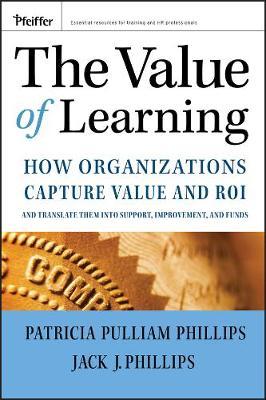
The Value of Learning: How Organizations Capture Value and ROI and Translate It into Support, Improvement, and Funds

Author:   Jack J. Phillips ,  Patricia Pulliam Phillips
Publisher:   John Wiley & Sons Inc
ISBN:  

9780787985325


Pages:   464
Publication Date:   01 July 2007
Format:   Hardback
Availability:   In Print   Availability explained
Limited stock is available. It will be ordered for you and shipped pending supplier's limited stock.

Our Price $118.80 Quantity:  
Add to Cart

Share |

The Value of Learning: How Organizations Capture Value and ROI and Translate It into Support, Improvement, and Funds


Overview

The Value of Learning is a hands-on guide for the implementation of learning and development programs that can be applied across all types of programs, ranging from leadership development to basic skills training for new employees. In this book, Patti Phillips and Jack J. Phillips offer a proven approach to measurement and evaluation for learning and development that can be replicated throughout an organization, enable comparisons of results from one program to another, and ultimately improve ROI.

Full Product Details

Author:   Jack J. Phillips ,  Patricia Pulliam Phillips
Publisher:   John Wiley & Sons Inc
Imprint:   Jossey-Bass Inc.,U.S.
Dimensions:   Width: 16.00cm , Height: 3.60cm , Length: 23.50cm
Weight:   0.762kg
ISBN:  

9780787985325


ISBN 10:   0787985325
Pages:   464
Publication Date:   01 July 2007
Audience:   Professional and scholarly ,  Professional & Vocational
Format:   Hardback
Publisher's Status:   Out of Stock Indefinitely
Availability:   In Print   Availability explained
Limited stock is available. It will be ordered for you and shipped pending supplier's limited stock.

Table of Contents

List of Exhibits, Figures, and Tables xxi Preface xxvii Acknowledgments xxxi Chapter One: Building a Comprehensive Evaluation Process 1 Challenges 2 Global Evaluation Trends  •  Measurement and Evaluation Challenges  •  Benefits of Measurement and Evaluation  •  The Myths of Measurement and Evaluation Key Steps and Issues 13 Stakeholders  •  Levels and Steps  •  Chain of Impact • ROI Process Model  •  Objectives  •  Evaluation Planning • Data Collection  •  Analysis  •  Isolation of the Effects of Learning and Development  •  Conversion of Data to Monetary Values  •  The Cost of Programs  •  The Return on Investment Calculation  •  Intangible Benefits  •  Data Reporting  •  Operating Standards  •  Implementation Issues Final Thoughts 31 Chapter Two: Defining Needs and Objectives: Ensuring Business Alignment 32 The Challenge 32 Business Alignment Issues  •  Begin with the End in Mind  •  Required Discipline  •  The Needs Analysis Dilemma Payoff Needs 36 Key Questions  •  Obvious vs. Not So Obvious  •  The Reasons for New Programs  •  Determining Costs of the Problem  •  The Value of Opportunity  •  To Forecast or Not to Forecast Business Needs 44 Determining the Opportunity  •  Defining the Business Measure—Hard Data  •  Defining the Business Need— Soft Data  •  Using Tangible vs. Intangible—A Better Approach  •  Finding Sources of Impact Data • Identifying All the Measures  •  Exploring “What If... ?” Job Performance Needs 53 Analysis Techniques  •  Taking a Sensible Approach Learning Needs 58 Subject-Matter Experts  •  Job and Task Analysis  •  Observations  •  Demonstrations  •  Tests • Management Assessment Preference Needs 61 Key Issues  •  Impact Studies Levels of Objectives for Programs 65 Reaction and Planned Action  •  Learning Objectives  •  Application and Implementation Objectives  •  Business Impact Objectives  •  ROI Objectives  •  The Importance of Specific Objectives Final Thoughts 73 Chapter Three: Measuring Inputs and Indicators 74 Measuring Input and Indicators 75 Defines the Input  •  Reflects Commitment  •  Facilitates Benchmarking  •  Explains Coverage  •  Highlights Efficiencies  •  Provides Cost Data Tracking Participants 78 Tracking Hours 80 Tracking Coverage by Jobs and Functional Areas 81 Tracking Topics and Programs 82 Tracking Requests 84 Tracking Delivery 85 Tracking Costs 86 Pressure to Disclose All Costs  •  The Danger of Costs Without Benefits  •  Sources of Costs  •  Learning Program Steps and Costs  •  Prorated Versus Direct Costs  •  Employee Benefits Factor  •  Major Cost Categories  •  Cost Reporting Tracking Efficiencies 94 Tracking Outsourcing 95 Tracking for the Scorecard 96 Defining Key Issues 97 Input Is Not Results  •  Reports to Executives Should Be Minimized  •  The Data Represent Operational Concerns  •  This Data Must Be Automated Final Thoughts 98 Chapter Four: Measuring Reaction and Planned Action 100 Why Measure Reaction and Planned Action? 101 Customer Service  •  Early Feedback Is Essential  •  Making Adjustments and Changes  •  Predictive Capability  •  For Some, This Is the Most Important Data  •  Comparing Data with Other Programs  •  Creating a Macro Scorecard Sources of Data 106 Participants  •  Participants’ Managers  •  Internal Customers  •  Facilitators  •  Sponsors/Senior Managers Areas of Feedback 107 Content vs. Non-Content  •  The Deceptive Feedback Cycle  •  Key Areas for Feedback Timing of Data Collection 114 Early, Detailed Feedback  •  Pre-Assessments  •  Collecting at Periodic Intervals  •  For Long Programs with Multiple Parts Data Collection with Questionnaires and Surveys 115 Questionnaire/Survey Design  •  Intensities  • Questionnaire/Survey Response Rates  •  Sample Surveys Data Collection with Interviews and Focus Groups 123 Improving Reaction Evaluation 123 Keep Responses Anonymous  •  Have a Neutral Person Collect the Forms  •  Provide a Copy in Advance  •  Explain the Purpose of the Feedback and How It Will Be Used  •  Explore an Ongoing Evaluation  •  Consider Quantifying Course Ratings  •  Collect Information Related to Improvement  •  Allow Ample Time for Completing the Form  •  Delayed Evaluation • Ask for Honest Feedback Using Data 127 Building the Macro-Level Scorecard Shortcut Ways to Measure Reaction and Planned Action 129 Final Thoughts 130 Chapter Five: Measuring Learning and Confidence 132 Why Measure Learning and Confidence? 132 The Importance of Intellectual Capital  •  The Learning Organization  •  The Learning Transfer Problem  •  The Compliance Issue  •  The Use and Development of Competencies  •  The Role of Learning in Programs  •  The Chain of Impact  •  Certification  •  Consequences of an Unprepared Workforce The Challenges and Benefits of Measuring Learning 137 The Challenges  •  The Benefits Measurement Issues 140 Objectives • Typical Measures  •  Timing • Cognitive Levels of Bloom’s Taxonomy Data Collecton Methods 144 Questionnaires/Surveys  •  Objective Tests  •  Criterion- Referenced Tests  •  Performance Tests  •  Technology and Task Simulations  •  Case Studies  •  Role Playing/Skill Practice  •  Assessment Center Method  •  Exercises/Activities  •  Informal Assessments Administrative Issues 157 Reliability and Validity  •  Consistency  •  Monitoring  •  Pilot Testing  •  Readability  •  Scoring  •  Reporting  •  Confronting Test Failures Using Learning Data 161 Final Thoughts 162 Chapter Six: Measuring Application and Implementation 163 Why Measure Application and Implementation? 163 The Value of Information  •  A Key Transition Time • The Key Focus of Many Programs  •  The Chain of Impact  •  Barriers and Enablers  •  Reward Those Who Are Most Effective Challenges of Measuring Application and Implementation 166 Linking Application with Learning  •  Designing Data Collection into Programs  •  Applying Serious Effort to Level 3 Evaluation  •  Including Level 3 in the Needs Assessment  •  Developing ROI with Application Data Key Issues 168 Methods  •  Objectives  •  Topics to Explore  •  Sources  •  Timing  •  Responsibilities The Use of Questionnaires 172 Progress with Objectives  •  Relevance/Importance of the Program  •  Knowledge/Skill Use  •  Changes with Work/Action Items  •  Improvements/Accomplishments  •  Define the Measure  •  Provide the Change  •  Monetary Value  •  Total Impact  •  List of Other Factors • Improvements Linked with the Program  •  Perceived Value  •  Links with Output Measures  •  Success of the Program Team  •  Barriers and Enablers  •  Management Support  •  Appropriateness of Program and Suggestions for Improvement  •  Checklist  •  Improving Response Rates Data Collection with Interviews 189 Types of Interviews  •  Interview Guidelines Data Collection with Focus Groups 191 Applications for Focus Group Evaluation  •  Guidelines On-the-Job Observation 193 Guidelines for Effective Observation The Use of Action Plans and Follow-Up Assignments 196 Developing the Action Plan  •  Successful Use of Action Plans  •  Action Plan Advantages and Disadvantage The Use of Performance Contracts 203 Transfer of Learning 204 Developing ROI for Level 3 206 Data Use 209 Final Thoughts 211 Chapter Seven: Measuring and Isolating the Impact of Programs 212 Why Measure Business Impact? 213 Higher-Level Data  •  Breaking the Chain of Impact  •  A Business Driver for Many Programs  •  Show Me the Money Data  •  Easy to Measure  •  Common Data Types Types of Impact Measures 215 Hard Versus Soft Data  •  Tangible Versus Intangible  •  Scorecards  •  Specific Measures Linked to Programs Business Performance Monitoring 219 Identify Appropriate Measures  •  Convert Current Measures to Usable Ones  •  Developing New Measures The Use of Action Plans to Develop Business Impact Data 221 Set Goals and Targets  •  Define the Unit of Measure  •  Place a Monetary Value on Each Improvement  •  Implement the Action Plan  •  Provide Specific Improvements  •  Isolate the Effects of the Program  •  Provide a Confidence Level for Estimates  •  Collect Action Plans at Specified Time Intervals  •  Summarize the Data and Calculate the ROI  •  Advantages of Action Plans Use of Performance Contracts to Measure Business Impact 227 The Use of Questionnaires to Collect Business Impact Data 228 When You Don’t Have a Clue  •  When the Measure Is a Defined Set  •  When the Measure Is Known  •  Response Rates Selecting the Appropriate Data Collection Method for Each Level 235 Isolating the Effects of the Program 237 Identifying Other Factors: A First Step  •  Using Control Groups  •  Using Trend-Line Analysis  •  Forecasting  •  Using Estimates  •  Calculating the Impact of Other Factors Use of the Techniques 255 Final Thoughts 255 Chapter Eight: Identifying Benefits and Costs, and Calculating ROI 257 Why Calculate Monetary Benefits? 258 Value Equals Money  •  Impact Is More Understandable  •  Money Is Necessary for ROI  •  Monetary Value Is Needed to Understand Problems  •  Key Steps to Convert Data to Money Standard Monetary Values 262 Converting Output Data to Money  •  Calculating the Cost of Quality  •  Converting Employee Time Using Compensation  •  Finding Standard Values Data Conversion When Standard Values Are Not Available 271 Using Historical Costs from Records  •  Using Input from Experts to Convert Soft Data  •  Using Values from External Databases  •  Linking with Other Measures  •  Using Estimates from Participants  •  Using Estimates from the Management Team  •  Using Staff Estimates Technique Selection and Finalizing the Values 282 Use the Technique Appropriate for the Type of Data  •  Move from Most Accurate to Least Accurate  •  Consider the Resources  •  When Estimates Are Sought, Use the Source with the Broadest Perspective on the Issue  •  Use Multiple Techniques When Feasible  •  Apply the Credibility Test  •  Review the Client’s Needs  •  Is This Another Project?  •  Consider a Potential Management Adjustment  •  Consider the Short-Term/Long-Term Issue • Consider an Adjustment for the Time Value of Money Why Monitor Costs? 288 Why Measure ROI? 289 Fundamental Cost Issues 290 Monitor Costs, Even If They Are Not Needed  •  Cost Will Not Be Precise  •  Disclose All Costs  •  Fully Loaded Costs  •  Reporting Costs Without Benefits Cost-Tracking Issues 293 Prorated Versus Direct Costs  •  Employee Benefits Factor Major Cost Categories 294 Initial Analysis and Assessment  •  Development of Solutions  •  Acquisition Costs  •  Application and Implementation Costs  •  Maintenance and Monitoring  •  Support and Overhead  •  Evaluation and Reporting Cost Accumulation and Estimation 296 Basic ROI Issues 296 Definition  •  Annualized Values: A Fundamental Concept BCR/ROI Calculations 297 Benefit/Cost Ratio  •  ROI Formula  •  ROI Targets  •  ROI Is Not for Every Program Other ROI Measures 303 Payback Period  •  Discounted Cash Flow Final Thoughts 304 Chapter Nine: Measuring the Hard to Measure and the Hard to Value: Intangible Benefits 307 Why Intangibles Are Important 308 Intangibles Are the Invisible Advantage  •  We Are Entering the Intangible Economy  •  More Intangibles Are Converted to Tangibles  •  Intangibles Drive Programs Measurement and Analysis of Intangibles 310 Measuring the Intangibles  •  Converting to Money • Identifying Intangibles  •  Analyzing Intangibles Customer Service 316 Team Effectiveness 319 Cooperation/Conflict  •  Decisiveness/Decision Making • Communication Innovation and Creativity 320 Innovation  •  Creativity Employee Attitudes 324 Employee Satisfaction  •  Organizational Commitment  •  Employee Engagement Employee Capability 326 Experience  •  Knowledge  •  Learning  •  Competencies • Educational Level  •  Attention Leadership 333 360-Degree Feedback  •  Leadership Inventories • Leadership Perception Job Creation and Acquisition 335 Productivity Versus Job Growth  •  Importance of Job Creation and Growth  •  Recruitment Sourcing and Effectiveness •  Recruitment Efficiency Stress 339 Networking 343 Final Thoughts 345 Chapter Ten: Reporting Results 348 Why the Concern About Communicating Results? 348 Communication Is Necessary to Make Improvements  •  Communication Is Necessary to Explain Contributions  •  Communication Is a Politically Sensitive Issue  •  Different Audiences Need Different Information Principles of Communicating Results 350 Communication Must Be Timely  •  Communication Should Be Targeted to Specific Audiences  •  Media Should Be Carefully Selected  •  Communication Should Be Unbiased and Modest  •  Communication Must Be Consistent  •  Testimonials Are More Effective Coming from Respected Individuals  •  The Audience’s Opinion of the Program Will Influence the Communication Strategy The Process for Communicating Results 352 The Need for Communication 354 Planning the Communications 355 The Audience for Communications 356 Basis for Selecting the Audience Information Development: The Impact Study 359 Communication Media Selection 361 Meetings  •  Interim and Progress Reports  •  Routine Communication Tools  •  E-Mail and Electronic Media  • Program Brochures and Pamphlets  •  Case Studies Presenting Information 364 Routine Feedback on Program Progress  •  The Presentation of Results to Senior Management  •  Streamlining the Communication  •  Building Scorecards Reactions to Communication 372 Using Evaluation Data 372 Final Thoughts 373 Chapter Eleven: Implementing and Sustaining a Comprehensive Evaluation System 375 Why the Concern About Implementing and Sustaining Evaluation? 375 Resistance Is Always Present  •  Implementation Is Key  •  Consistency Is Needed  •  Efficiency Is Necessary Implementing the Process: Overcoming Resistance 377 Assessing the Climate 378 Developing Roles and Responsibilities 379 Identifying a Champion  •  Developing the Evaluation Leader  •  Establishing a Task Force  •  Assigning Responsibilities Establishing Goals and Plans 382 Setting Evaluation Targets  •  Developing a Timetable for Implementation Revising or Developing Policies and Guidelines 383 Preparing the L&D Team 384 Involving the L&D Team  •  Using Measurement and Evaluation as a Learning Tool  •  Teaching the L&D Team Initiating Evaluation Studies 385 Selecting the Initial Program  •  Developing the Planning Documents  •  Reporting Progress  •  Establishing Discussion Groups Preparing the Sponsors and Management Team 387 Removing Obstacles 388 Dispelling Myths  •  Delivering Bad News Monitoring Progress 390 Final Thoughts 390 Appendix: How Results-Based Are Your Workplace 391 Learning and Performance Programs?0020An Assessment for the L&D Staff 391 Glossary 403 Index 407 About the Authors 423

Reviews

The authors are renowned for their work as advocates of the ROI concept in training. (T + D, Dec 2007) Clearly the Phillips are the established experts, and in this book offer tested, step-by-step ways to succeed and gain the necessary organizational support for learning. Just to underscore the importance that a number of us at Capella University place in the Phillips? work, we are proud to use their methods and tools in our courses to allow our learners to obtain ROI certification as part of our masters and doctoral programs in Training and Performance Improvement. I recommend this book to anyone interested in proving the value of learning. ?Michael J. Offerman, president, Capella University Understanding the value of learning is critical for all business professionals. This book provides specific tools and techniques for evaluating learning effectiveness. A must read for anyone interested in the value of learning. ?Tamar Elkeles, Ph.D., vice president, Learning and Development, QUALCOMM


The authors are renowned for their work as advocates of the ROI concept in training. (T + D, Dec 2007)


Author Information

THE AUTHORS Patricia Pulliam Phillips is president and CEO of the ROI Institute, Inc., the leading source of ROI competency building, implementation support, networking, and research. An expert in measurement and evaluation, she provides support to organizations around the world that want to prove the value of their programs. Jack J. Phillips is a world-renowned expert on accountability, measurement, and evaluation. He provides consulting services for Fortune 500 companies and major global organizations.

Tab Content 6

Author Website:  

Countries Available

All regions
Latest Reading Guide

NOV RG 20252


Shopping Cart
Your cart is empty
Shopping cart
Mailing List