Awards
- Winner of 2013 Most Promising New Textbook Award 2013
Overview
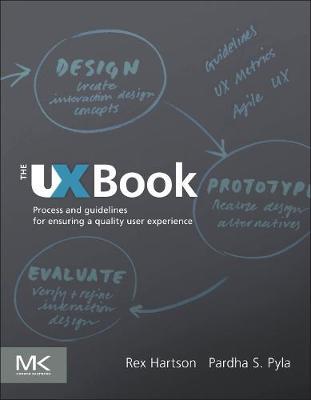
The UX Book: Process and Guidelines for Ensuring a Quality User Experience aims to help readers learn how to create and refine interaction designs that ensure a quality user experience (UX). The book seeks to expand the concept of traditional usability to a broader notion of user experience; to provide a hands-on, practical guide to best practices and established principles in a UX lifecycle; and to describe a pragmatic process for managing the overall development effort. The book provides an iterative and evaluation-centered UX lifecycle template, called the Wheel, for interaction design. Key concepts discussed include contextual inquiry and analysis; extracting interaction design requirements; constructing design-informing models; design production; UX goals, metrics, and targets; prototyping; UX evaluation; the interaction cycle and the user action framework; and UX design guidelines. This book will be useful to anyone interested in learning more about creating interaction designs to ensure a quality user experience. These include interaction designers, graphic designers, usability analysts, software engineers, programmers, systems analysts, software quality-assurance specialists, human factors engineers, cognitive psychologists, cosmic psychics, trainers, technical writers, documentation specialists, marketing personnel, and project managers.
Full Product Details
Author: Rex Hartson (Professor Emeritus, Computer Science, Virginia Tech, USA) ,
Pardha S. Pyla (Senior User Experience Specialist and Lead Interaction Designer for Mobile Platforms, Bloomberg LP, USA)
Publisher: Elsevier Science & Technology
Imprint: Morgan Kaufmann Publishers In
Dimensions:
Width: 19.10cm
, Height: 3.60cm
, Length: 23.50cm
Weight: 1.650kg
ISBN: 9780123852410
ISBN 10: 0123852412
Pages: 976
Publication Date: 27 February 2012
Audience:
Professional and scholarly
,
Professional & Vocational
Replaced By: 9780128053423
Format: Hardback
Publisher's Status: Out of Print
Availability: Awaiting stock

Reviews
<p>This book is destined to become a primary reference for just about anyone involved in the development of interactive products of almost any kind. It addresses both the design process and design principles and goes beyond traditional usability to address all aspects of the user experience. The authors have distilled two careers worth of research, practice and teaching into a concise, practical and comprehensive guide for anyone involved in designing for the user experience of interactive products.- Deborah J. Mayhew, Deborah J. Mayhew & Associates <p>The UX Book covers the methods and guidelines for interaction design and evaluation that have been shown to be the most valuable to students and professionals. The students in my classes have been enthusiastic about the previous versions of this text that they used. This book will benefit anyone who wants to learn the right way to create high quality user experiences. Like good user interfaces, this text has been refined through multiple
This book is destined to become a primary reference for just about anyone involved in the development of interactive products of almost any kind. It addresses both the design process and design principles and goes beyond traditional usability to address all aspects of the user experience. The authors have distilled two careers' worth of research, practice and teaching into a concise, practical and comprehensive guide for anyone involved in designing for the user experience of interactive products.- Deborah J. Mayhew, Deborah J. Mayhew & Associates The UX Book covers the methods and guidelines for interaction design and evaluation that have been shown to be the most valuable to students and professionals. The students in my classes have been enthusiastic about the previous versions of this text that they used. This book will benefit anyone who wants to learn the right way to create high quality user experiences. Like good user interfaces, this text has been refined through multiple iterations and feedback with actual users (in this case, feedback from students and faculty who used earlier versions of the book in classes), and this is evident in the final result.-- Brad A. Myers, Professor, Human-Computer Interaction Institute, School of Computer Science, Carnegie Mellon University The UX Book takes on a big challenge: a comprehensive overview of what it takes to design great user experiences. Hartson and Pyla combine theory with practical techniques: you leave the book knowing not just what to do, but why it's important.-Whitney Quesenbery, WQusability, author, Global UX: Design and research in a connected world
Author Information
Rex Hartson is a pioneer researcher, teacher, and practitioner-consultant in HCI and UX. He is the founding faculty member of HCI (in 1979) in the Department of Computer Science at Virginia Tech. With Deborah Hix, he was co-author of one of the first books to emphasize the usability engineering process, Developing user interfaces: Ensuring usability through product & process. Hartson has been principle investigator or co-PI at Virginia Tech on a large number of research grants and has published many journal articles, conference papers, and book chapters. He has presented many tutorials, invited lectures, workshops, seminars, and international talks. He was editor or co-editor for Advances in Human-Computer Interaction, Volumes 1-4, Ablex Publishing Co., Norwood, NJ. His HCI practice is grounded in over 30 years of consulting and user experience engineering training for dozens of clients in business, industry, government, and the military. Pardha Pyla is an award-winning designer and product strategist with deep expertise in envisioning and delivering industry-leading products. He is the founding member of multiple thriving product and design (UX) practices that were responsible for producing successful enterprise software solutions in use across many industries. He is a pioneering researcher in the area of coordinating software engineering and UX lifecycle processes and the author of several peer-reviewed research publications in human-computer interaction and software engineering. He has received numerous awards in recognition of his work in design thinking, research, teaching, leadership, and service.