Full Product Details
Author: Leonie Gombrich
Publisher: Phaidon Press Ltd
Imprint: Phaidon Press Ltd
Dimensions:
Width: 17.20cm
, Height: 2.60cm
, Length: 24.50cm
Weight: 0.960kg
ISBN: 9780714836553
ISBN 10: 0714836559
Pages: 304
Publication Date: 26 January 1999
Audience:
General/trade
,
General
Format: Hardback
Publisher's Status: Out of Stock Indefinitely
Availability: Awaiting stock

Reviews
'It is, of course, wonderful.' (Paris Free Voice) 'He makes his lateral thinking and writing accessible to everyone, from politically-minded students to Sunday gallery visitors to the most rococo academics (the kind who never learn from his style)a | The range of illustrations, though all black and white, is enormous; the range overall is that of a great teachera (TM)s mind at work and at play.' (RTE, Ireland) 'Gombrich has a genius a for once that is the mot juste a for presenting complex and highly original arguments not just with exceptional lucidity, but also with wit. For any reader who has heard him lecture, the mesmerising charm of his inimitable if much imitated speaking voice leaps off the page a | ' (Apollo)
'It is, of course, wonderful.' (Paris Free Voice) 'He makes his lateral thinking and writing accessible to everyone, from politically-minded students to Sunday gallery visitors to the most rococo academics (the kind who never learn from his style)i'1/2 The range of illustrations, though all black and white, is enormous; the range overall is that of a great teacheri'1/2s mind at work and at play.' (RTE, Ireland) 'Gombrich has a genius i'1/2 for once that is the mot juste i'1/2 for presenting complex and highly original arguments not just with exceptional lucidity, but also with wit. For any reader who has heard him lecture, the mesmerising charm of his inimitable if much imitated speaking voice leaps off the page i'1/2 ' (Apollo)
'It is, of course, wonderful.' (Paris Free Voice) 'He makes his lateral thinking and writing accessible to everyone, from politically-minded students to Sunday gallery visitors to the most rococo academics (the kind who never learn from his style)... The range of illustrations, though all black and white, is enormous; the range overall is that of a great teacher's mind at work and at play.' (RTE, Ireland) 'Gombrich has a genius - for once that is the mot juste - for presenting complex and highly original arguments not just with exceptional lucidity, but also with wit. For any reader who has heard him lecture, the mesmerising charm of his inimitable if much imitated speaking voice leaps off the page ... ' (Apollo)
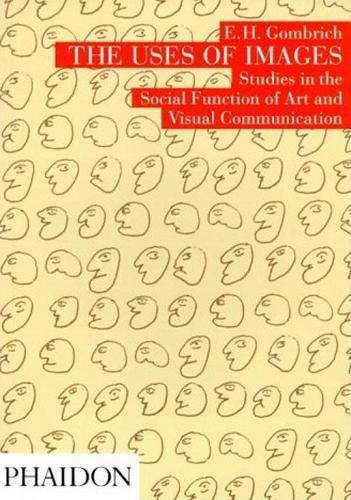
In this new volume - published to coincide with its distinguished author's 90th birthday - Gombrich returns to themes that have long preoccupied him in his study of visual imager. Central to these essays - the tenth in the series of his collected writings - is a consuming interest in the functions of images, and how these functions - and the images themselves - change over time. In wide-ranging studies of both 'high' and 'low' art, from fresco painting, altar painting, the international gothic style and outdoor sculpture to doodles, pictorial instructions, caricature and political propaganda, Gombrich discusses the role of supply and demand, competition and display, the 'ecology' of images and the idea of 'feedback' in the interplay of means and ends, as developing skills in turn stimulate new demands. Further aspects of the uses of images are explored in his essays on the hanging of pictures and on the use (or misuse) of images as historical evidence. (Kirkus UK)
'It is, of course, wonderful.' (Paris Free Voice) 'He makes his lateral thinking and writing accessible to everyone, from politically-minded students to Sunday gallery visitors to the most rococo academics (the kind who never learn from his style)... The range of illustrations, though all black and white, is enormous; the range overall is that of a great teacher's mind at work and at play.' (RTE, Ireland) 'Gombrich has a genius - for once that is the mot juste - for presenting complex and highly original arguments not just with exceptional lucidity, but also with wit. For any reader who has heard him lecture, the mesmerising charm of his inimitable if much imitated speaking voice leaps off the page ... ' (Apollo)
Author Information
Sir Ernst Gombrich was one of the greatest and least conventional art historians of his age, achieving fame and distinction in three separate spheres: as a scholar, as a popularizer of art, and as a pioneer of the application of the psychology of perception to the study of art. His best-known book, The Story of Art - first published 50 years ago and now in its sixteenth edition - is one of the most influential books ever written about art. His books further include The Sense of Order (1979) and The Preference for the Primitive (2002), as well as a total of 11 volumes of collected essays and reviews. Gombrich was born in Vienna in 1909 and died in London in November 2001. He came to London in 1936 to work at the Warburg Institute, where he eventually became Director from 1959 until his retirement in 1976. He won numerous international honours, including a knighthood, the Order of Merit and the Goethe, Hegel and Erasmus prizes. Gifted with a powerful mind and prodigious memory, he was also an outstanding communicator, with a clear and forceful prose style. His works are models of good art-historical writing, and reflect his humanism and his deep and abiding concern with the standards and values of our cultural heritage.