Overview
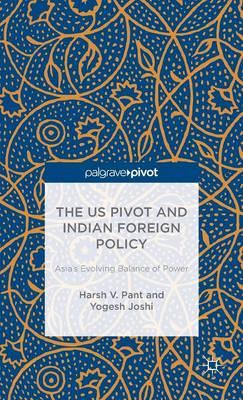
China's exponential rise and America's relative decline have led to a transition of power in contemporary Asia. The US pivot towards Asia is the most evident manifestation of such a transition, and Indian foreign policy shows signs of a hedging strategy, with attempts to strengthen ties with both China and the US.
Full Product Details
Author: H. Pant ,
Y. Joshi ,
Kenneth A. Loparo
Publisher: Palgrave Macmillan
Imprint: Palgrave Macmillan
Edition: 1st ed. 2016
Dimensions:
Width: 14.00cm
, Height: 1.30cm
, Length: 21.60cm
Weight: 3.109kg
ISBN: 9781137557711
ISBN 10: 1137557710
Pages: 154
Publication Date: 06 November 2015
Audience:
Professional and scholarly
,
Professional & Vocational
Format: Hardback
Publisher's Status: Active
Availability: In Print

This item will be ordered in for you from one of our suppliers. Upon receipt, we will promptly dispatch it out to you. For in store availability, please contact us.
Reviews
In this clear and comprehensive study the authors explain India's evolving response to the strategic challenge posed by a rising China. In addition to working more closely with the United States, successive Indian administrations have also sought to stabilize relations with Beijing, while at the same time cooperating with other Asian states (including Japan and Australia) that share an interest in balancing China's growing power. This book makes a strong case that, albeit with potential shifts in emphasis and tone, this mixed, hedged approach is likely to endure. - Aaron L. Friedberg, Professor of Politics and International Affairs, Princeton University, and author of A Contest for Supremacy: China, America, and the Struggle for Mastery in Asia
This pithy and readable book examines India's responses to China's increasingly assertive approaches to its neighbours and to the US pivot to the Asia-Pacific, signaled by Barack Obama in late 2011. ... it provides one of the best short accounts of India's evolving approach to the changing strategic balance in the region. (Professor Ian Hall, Australian Institute of International Affairs, June, 2016)
Harsh Pant and Yogesh Joshi's book is a comprehensive study on India's responses to China's rise and the transition of power from an extant hegemon, the United States (US), to the rising challenger, China. ... This book is invaluable to anyone with an interest in Asian affairs. Its clear narrative, analytical strength and abundant examples make this a fascinating read, even for the layperson. (Ann Mary George, Commonwealth & Comparative Politics, Vol. 55 (2), 2017) This pithy and readable book examines India's responses to China's increasingly assertive approaches to its neighbours and to the US pivot to the Asia-Pacific, signaled by Barack Obama in late 2011. ... it provides one of the best short accounts of India's evolving approach to the changing strategic balance in the region. (Professor Ian Hall, Australian Institute of International Affairs, June, 2016)
Author Information
Harsh V. Pant is Professor of International Relations at King's College London, UK. He is also a Non-Resident Fellow with the Wadhwani Chair in U.S.-India Policy Studies at the Center for Strategic and International Studies, Washington, D.C., USA. His current research is focused on Asian security issues. Yogesh Joshi is a research scholar at the Center for International Politics, Organisation and Disarmament, School of International Studies, Jawaharlal Nehru University, India. He has been a fellow at Sigur Center for Asian Studies, George Washington University, USA, and is currently an international PhD partnering fellow at Defence Studies Department, King's College London, UK.