Overview
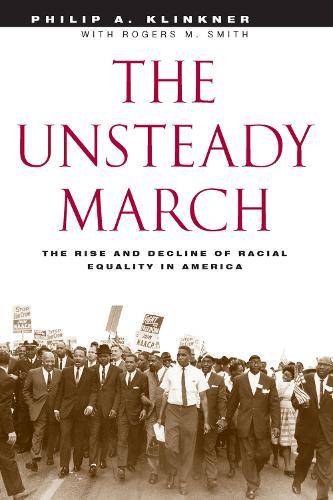
American life is filled with talk of progress and equality, especially when the issue is that of race. But has the history of race in America really been the continuous march toward equality we'd like to imagine it has? This sweeping history of race in America argues quite the opposite: that progress toward equality has been sporadic, isolated, and surrounded by long periods of stagnation and retrenchment. ""[An] unflinching portrait of the leviathan of American race relations. . . . This important book should be read by all who aspire to create a more perfect union.""—Publishers Weekly, starred review ""Could it be that our unswerving belief in the power of our core values to produce racial equality is nothing but a comforting myth? That is the main argument put forth by Philip Klinkner and Rogers Smith . . . The Unsteady March is disturbing because it calls into question our cherished national belief and does so convincingly. . . . [It] is beautifully written, and the social history it provides is illuminating and penetrating.""—Aldon Morris, American Journal of Sociology Winner of the Horace Mann Bond Award of the W.E.B. Du Bois Institute for Afro-American Research at Harvard University.
Full Product Details
Author: Philip A. Klinkner ,
Rogers M. Smith
Publisher: The University of Chicago Press
Imprint: University of Chicago Press
Dimensions:
Width: 1.60cm
, Height: 0.40cm
, Length: 2.30cm
Weight: 0.794kg
ISBN: 9780226443393
ISBN 10: 0226443396
Pages: 426
Publication Date: 01 November 1999
Audience:
College/higher education
,
Professional and scholarly
,
Undergraduate
,
Postgraduate, Research & Scholarly
Format: Hardback
Publisher's Status: Active
Availability: Manufactured on demand

We will order this item for you from a manufactured on demand supplier.
Reviews
Both experts in government and history, Klinkner (Hamilton Coll.; The Losing Parties, not reviewed) and Smith (Yale; Civic Ideals, not reviewed) mean to sound an alarm about the still poor state of race relations in the US. To do so, they enter into a long tale of American history, none of its contents new, but all marshaled for the authors' special purpose. That purpose is to demonstrate that racial progress has occurred only with the simultaneous existence of three conditions: 1) a war necessitating the mobilization of African-Americans; 2) a war requiring Americans to justify their involvement in democratic, egalitarian, and inclusive terms; and 3) the existence of protest movements pushing the government to institute reforms in keeping with those ideals. The authors do not adequately consider the possibility that most all-out American wars were as much result, not cause, of democratic, egalitarian, and inclusive ideologies, as well as of their day's versions of protest movements. And what of religion? They also admit that they cannot demonstrate that racial progress might have come about without wars. Ironically, their very approach could contribute to the current fatalism about progress in racial matters that they decry. After all, if we need wars of total mobilization to give us racial progress (and the authors don't advocate war), then perhaps we must simply wait for one to break out. Sensing their logical predicament, they remark that progress can occur without war. But for that to happen, Americans can and should commit themselves anew to overcoming our deepest and most enduring national division. To be sure. But historical argument isn't necessary to make that point, especially if, as the authors admit, they've arrived at their arguments inductively, because, while awaiting deductive research not yet undertaken, they believe it urgent to get their message out. But then their answers can't be taken as history, only as hope - albeit hope in which most people share. A heartfelt plea for further progress, which raises as many questions as it answers. (Kirkus Reviews)
Author Information
Philip A. Klinkner is the James S. Sherman Professor of Government at Hamilton College. Rogers M. Smith is professor emeritus of political science at the University of Pennsylvania.