Awards
- Winner of Aventis Prize for Science Books 2002
- Winner of Aventis Prize for Science Books 2002.
Overview
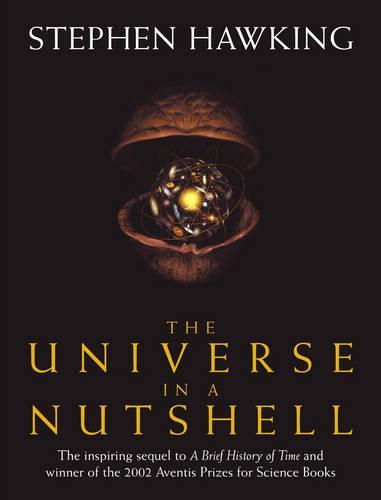
Stephen Hawking's first full length book since the worldwide bestseller A Brief History of Time, lavishly illustrated in full colour throughout. Professor Stephen Hawking is generally considered to have been one of the world's greatest thinkers. Here is his follow up to the phenomenal bestseller A Brief History of Time - illustrated to bring his theories to life in a clear, captivating and visually engaging way. 'Brilliant and very readable!' -- ***** Reader review 'I love Stephen Hawking - such an incredible mind' -- ***** Reader review 'A must-read book for everybody' -- ***** Reader review 'Keeps going back to it and back to it, keeps you so interested you don't wonder off' -- ***** Reader review 'Thought provoking. A great read!' -- ***** Reader review 'The Universe in a Nutshell is the best popular science book I have ever read' -- ***** Reader review ****************************************************************************** Stephen Hawking's A Brief History of Time was a publishing phenomenon and continues to captivate and inspire new readers every year. When it was first published in 1988 the ideas discussed in it were at the cutting edge of what was then known about the universe. In the intervening years there have been extraordinary advances in our understanding of the space and time. The technology for observing the micro- and macro-cosmic world has developed in leaps and bounds. During the same period cosmology and the theoretical sciences have entered a new golden age and Professor Stephen Hawking has been at the heart of this new scientific renaissance. Now, in The Universe in a Nutshell, beautifully illustrated with original artwork commissioned for this project, Stephen Hawking brings us fully up-to-date with the advances in scientific thinking. We are now nearer than we have ever been to a full understanding of the universe. In a fascinating and accessible discussion that ranges from quantum mechanics to time travel, black holes to uncertainty theory and the search for science's Holy Grail - unified field theory (or in layman's terms the 'theory of absolutely everything'), Professor Hawking once more takes us to the cutting edge of modern thinking.
Full Product Details
Author: Stephen Hawking
Publisher: Transworld Publishers Ltd
Imprint: Bantam Press
Dimensions:
Width: 19.60cm
, Height: 2.10cm
, Length: 25.60cm
Weight: 0.936kg
ISBN: 9780593048153
ISBN 10: 0593048156
Pages: 224
Publication Date: 05 November 2001
Recommended Age: From 0 years
Audience:
Professional and scholarly
,
College/higher education
,
General/trade
,
Professional & Vocational
,
Tertiary & Higher Education
Format: Hardback
Publisher's Status: Active
Availability: To order

Stock availability from the supplier is unknown. We will order it for you and ship this item to you once it is received by us.
Reviews
A Brief History of Time has now sold an estimated nine million copies worldwide - something of a hard act for its author to follow. In what is being promoted as the 'sequel' to that book, Professor Hawking gives an account of his attempt to combine Einstein's Theory of Relativity with Richard Feynman's idea of multiple histories, in order to reach the grail of a Theory of Everything - or big TOE, as it's charmingly named. This is a book about superstrings and p-branes, holography and supergravity, about how the 'cosmic seed' from which our universe derived was as small as a nut. The publishers are not yet releasing much text, but enough to see that it will be a fascinating (if challenging) read. And one enhanced throughout with 200 striking full colour illustrations and jazzed-up diagrams.
It is 13 years since A Brief History of Time became an unexpected bestseller. It sold millions and was translated into 40 languages, while being described as a book people bought but did not read. This new book is only partly an update; each chapter stands alone to a great extent while reporting on some of the most active fields of research. Its stated aim is to present a snapshot of the picture of reality as we currently understand it; a picture that changes as new scientific method allows further investigation. Is this book more accessible than its predecessor? The answer is yes and no. Make no mistake, dealing with relativity and the shape of time, black holes, supersymmetry, string theory and a universe with 11 dimensions - it is certainly challenging. It demands you read it slowly and avoid distractions. And, yes, there is good and powerful explanation here. It is beautifully produced and illustrated (the illustrations fill it out - the text alone would run to barely 100 pages). There are digressions to give more detail about matters peripheral to the main text, for example about people like John Wheeler who coined the name 'black hole'. The text consists of good basic description of core concepts such as the expansion of the universe, and tantalising material on even more complex issues, the brevity of which will leave the enthusiast frustrated and wanting more, others bewildered. The book seems like the result of a publisher's meeting determined to make it more truly accessible and throwing in every device possible to make it so except lengthier explanation. There are more quips than before, again apparently included to lighten the load ('This microwave radiation is not much good for defrosting frozen pizza, but...'). Nevertheless, the book is worthwhile. Enthusiasts for the subject will want to know what this icon of science has to say. Others will find its descriptions mindboggling, which is as it should be, but also a beautiful and fascinating introduction to how the world works. If so then they will find that one effect of A Brief History of Time's success was to encourage a proliferation of good science books. There are longer, more detailed and ultimately more satisfying books about the universe for those keen to explore further. None may guarantee you understand completely - part of the fascination here is that no-one understands all this - but they will take you further and stagger your imagination as they do so. (Kirkus UK)
Author Information
In 1963, Stephen Hawking contracted motor neurone disease and was given two years to live. Yet he went on to Cambridge to become a brilliant researcher and Professorial Fellow at Gonville and Caius College. For thirty years he held the post of Lucasian Professor of Mathematics and Theoretical Physics at Cambridge, the chair held by Isaac Newton in 1663. Professor Hawking has over a dozen honorary degrees, was awarded the CBE in 1982. He is a fellow of the Royal Society and a Member of the US National Academy of Science.